
Backgammon scoring and the doubling cube
Score singles, gammons and backgammons correctly, then use the cube in a match without mixing in money-play rules.
On this page
In a match, you play a series of games to an agreed target such as 5 or 7 points. A game begins worth one point. Its final value depends on the way it ends and the doubling cube. The first player to reach the target wins the match; you do not need to land on the target exactly.
Single, gammon and backgammon
Start with the result before applying the cube.
| Result | Condition when the winner bears off the last checker | Base value |
|---|---|---|
| Single | The loser has borne off at least one checker | 1 point |
| Gammon | The loser has borne off no checkers | 2 points |
| Backgammon | The loser has borne off no checkers and still has a checker on the bar or in the winner’s home board | 3 points |
Then multiply that base value by the cube’s current value. A gammon with the cube on 2 is worth 4 points; a backgammon with the cube on 4 is worth 12.
Only the final position matters. A player who bore off one checker earlier cannot later lose a gammon, even if that checker was removed while the rest remain far behind.
Set the cube correctly
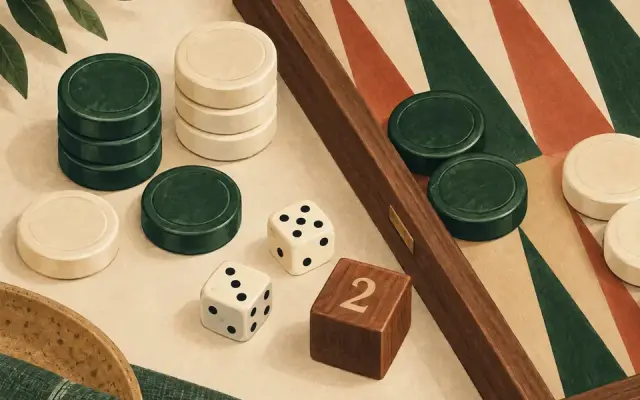
Place the cube between the players with 64 face up. Because most cubes have no 1, centered 64 represents a game currently worth one point. Either player may offer the first double.
A double is offered at the beginning of your turn before rolling. The opponent chooses:
- Take: continue at twice the previous value. The taker places the cube on their side and owns it.
- Pass: end the game immediately. The doubler wins the cube’s value before the offered double.
After a take, only the cube owner may offer the next double. A redouble again happens before that player rolls. If accepted, ownership crosses to the other player.
Example: the cube is on 2 and belongs to Maya. She offers 4. If Lee passes, Maya scores 2. If Lee takes, the game continues at 4 and Lee owns the cube.
Score a completed game
Use this order:
- Decide whether the result is a single, gammon or backgammon.
- Read the cube’s current value; centered means 1.
- Multiply the base value by the cube.
- Add the points to the winner’s match score.
- Stop the match immediately if the target has been reached or passed.
Example: in a 7-point match the score is 2–1. The cube reaches 2. The leader wins a gammon, worth 2 × 2 = 4 points. The score becomes 6–1, so the match continues.
Understand Crawford
The Crawford rule applies when a player first reaches exactly one point short of the match target. The next game is the Crawford game, and the cube is removed for that game only.
In a 5-point match, reaching 4–1 triggers Crawford. The game at 4–1 is played without doubling. Gammons and backgammons still count as two and three points. If the trailing player wins and the match continues, the following game is post-Crawford and the cube returns.
Crawford happens once per match. It is not repeated every time the score remains one-away.
Notice a dead cube
A cube is dead for a player who would win the match at its current value. Offering a larger value cannot improve that player’s match result. Tournament rules treat cube action with a dead cube as void.
For beginners, the practical question is simple: before reaching for the cube, compare its current value with the points each player still needs.
Keep money-play conventions separate
Automatic doubles, beavers and the Jacoby rule are money-play conventions and are not used in standard match play. Agreeing to one of them changes cube procedure or gammon value. Do not quietly import those rules into a points match.
If you are learning, first practise scoring matches with ordinary doubles, ownership and Crawford. Cube strategy—whether a position is strong enough to double or good enough to take—is a separate judgement from cube procedure.
Continue learning
Beginner strategy
 Beginner strategyMake safer choices in BackgammonBefore you move in Backgammon: use the whole roll, weigh points, hits and escapes, and count the risk of leaving a checker exposed.Beginner strategyBackgammon opening movesThe fifteen backgammon opening rolls with standard moves and one-line reasons — plus doubles replies and how to handle the back pair.
Similar games
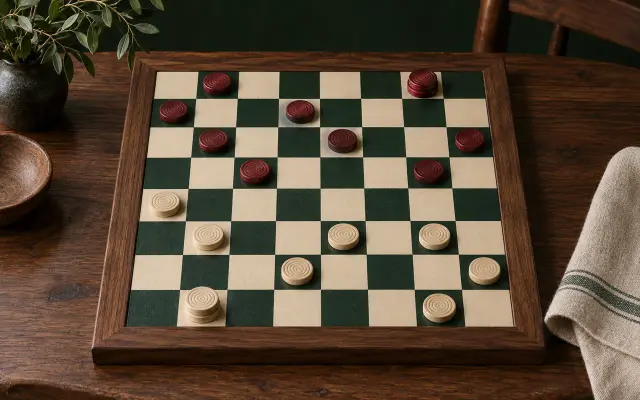
Checkers
American Checkers rules on an 8×8 board: setup, forward moves, compulsory captures, multiple jumps, crowning, when pieces can move backward and how to win.
Also known as English draughts, Draughts
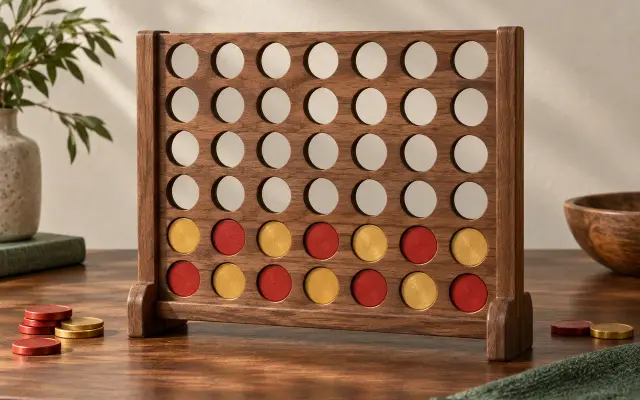
Connect 4
Classic Connect 4 rules: assemble and orient the vertical grid, take turns dropping discs, and make four horizontally, vertically or diagonally.
Also known as Connect Four, Four in a Row, Four-in-a-row
Mancala (Kalah)
Mancala rules for Kalah with four stones per pit: board setup, counterclockwise sowing, extra turns, opposite-pit captures, the end sweep and winning.
Also known as Kalah