
Single games by default; doubling cube and match play explained
How to play Backgammon
Backgammon rules for beginners: board setup, dice moves, hitting and the bar, bearing off to win — with the 15 opening moves and key terms.
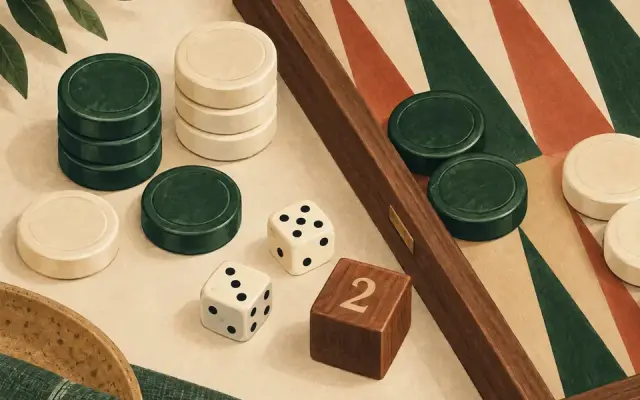
On this page
Quick reference
At the table
Ruleset: Single games by default; doubling cube and match play explained
- Goal
- Bear off all 15 checkers first.
- Setup
- Place 2 checkers on your 24-point, 5 on your 13-point, 3 on your 8-point and 5 on your 6-point.
- Turn
- Roll two dice and play each number separately toward your home board. Use both numbers when legally possible.
- Scoring
- A single game is worth 1 point, a gammon 2 and a backgammon 3, multiplied by the doubling cube when used.
- End of game
- After every checker reaches your home board, bear them off. The first player to remove all 15 wins.
Objective
Bear off all 15 checkers before your opponent. The three ways a game ends are worth knowing up front, because they decide how much a game is worth: a single game scores 1 point, a gammon (the loser has borne off none) scores 2, and a backgammon (the loser has borne off none and still has a checker on the bar or in the winner’s home board) scores 3. In a plain single game the points matter only if you double or play matches — see the doubling cube and match play sections below.
Setup
The board has 24 narrow triangles called points, split into four quadrants of six. The ridge down the middle is the bar. Your home board is the six points you bear off from; the far quadrant is your starting side.
Number the points from your own perspective, 1 to 24: points 1–6 are your home board, 7–12 your outer board, and 24 is the point deep in the opponent’s home board. Place two checkers on your 24-point, five on your 13-point, three on your 8-point, and five on your 6-point. Your opponent mirrors this exactly — the two 24-points are the same triangles, counted from the other side. Checkers move toward lower numbers, so the two players move in opposite directions around the board.
Roll one die each; reroll ties. Higher roller starts using both numbers just rolled — so the first roll is never doubles.
Turns
Roll two dice. Each number is a separate move toward point 1. Doubles give four moves. You may move two checkers separately or one checker the combined total, using the numbers in either order — the landing point and any intermediate point must be open.
A point is open when it holds no checkers, your checkers, or exactly one opposing checker. Land on a lone opposing checker and it is hit: it goes on the bar. Never land where two or more opponents sit.
Use both numbers if possible. If only one can be played, play it; if either can be played but not both, you must play the higher. If neither can be played, the turn is lost.
A hit checker waits on the bar. A player with checkers on the bar must re-enter them before moving others, using dice to enter the opponent’s home board: a 1 enters your point 24, a 6 enters point 19. Blocked entries are unavailable. If neither die permits entry, lose the turn.
Winning
Once all your checkers are home, bear off using matching numbers. A roll matching a point removes a checker from that point. You normally bear off from the point matching your roll. If the rolled point is empty but you still have checkers on higher points, you must move a checker from a higher point down; checkers never move backwards. Only when no checkers remain on higher points may an oversized roll remove a checker from the highest occupied point. You may also split a roll — use one die to move within the home board and the other to bear off.
First to remove all 15 wins. If the loser has borne off no checkers, the win is a gammon; if they also have a checker on the bar or in your home board, it is a backgammon.
Opening moves
The winner of the opening roll plays both numbers, so there are 15 possible first rolls. These are the standard first moves from computer rollouts; a close alternative is listed where one exists. Notation is start/finish, so 13/11 moves a checker from the 13-point to the 11-point.
| Roll | Standard play | Close alternative |
|---|---|---|
| 2-1 | 13/11 6/5 | 24/23 13/11 |
| 3-1 | 8/5 6/5 | — |
| 4-1 | 24/23 13/9 | 13/9 6/5 |
| 5-1 | 24/23 13/8 | 13/8 6/5 |
| 6-1 | 13/7 8/7 | — |
| 3-2 | 24/21 13/11 | 13/11 13/10 |
| 4-2 | 8/4 6/4 | — |
| 5-2 | 24/22 13/8 | 13/11 13/8 |
| 6-2 | 24/18 13/11 | — |
| 4-3 | 13/10 13/9 | 24/21 13/9 |
| 5-3 | 8/3 6/3 | — |
| 6-3 | 24/18 13/10 | 24/15 |
| 5-4 | 24/20 13/8 | 13/9 13/8 |
| 6-4 | 24/18 13/9 | 8/2 6/2 |
| 6-5 | 24/13 | — |
3-1, making your five-point, is the best opener; 6-5, running a back checker all the way to the 13-point, is the simplest. Making your five-point or four-point (3-1, 4-2) beats making the bar-point (6-1) because home-board points also make it hard for a hit opponent to re-enter. If you want to vary, the alternatives in the table are close — no first move here is a mistake.
Doubling cube
The doubling cube is a die marked 2, 4, 8, 16, 32, 64 that tracks the game’s value. Each game starts worth 1 point. Before rolling, at the start of your turn, you may double that value. Your opponent either refuses, which ends the game and scores you the current value, or accepts and plays on for twice that. Accepting hands over the cube: only the owner may offer the next double. The game value can keep doubling; the final cube value multiplies the winner’s points. Gammons score twice the cube, backgammons three times.
In friendly single games the cube is optional — leave it off the board entirely if you prefer, and just play for one point per game.
Match play
In match play two players race to a target score — first to 5 points is a common club length. Wins score 1, 2 or 3 points (single, gammon, backgammon), multiplied by the final cube value. One standard rule: when a player is one point from winning, the next game is the Crawford game and doubling is not allowed for either player; doubling returns after it. Winning by more than the target scores no bonus — the match ends the moment the target is reached.
Variants
This introduction uses single games at 1 point each; the doubling cube and match play above are the standard extensions, and house rules such as automatic doubles or beavers are variants you can add by agreement. Acey-deucey and Nackgammon are separate games with their own rules.
Beginner tips
Protect exposed checkers by making points. Reconsider risky hits when already ahead. A short glossary to read the table and the rest of this page:
- Blot — a checker alone on a point; it can be hit.
- Prime — consecutive made points, up to all six, that wall the opponent in.
- Anchor — two or more of your checkers held on a point in the opponent’s home board.
- Gammon — a win worth 2: the loser has borne off no checkers.
- Backgammon — a win worth 3: the loser has borne off none and still has a checker on the bar or in your home board.
Learn the standard opening moves from the table above, then start every game the same way: split or build, cover your blots, and keep your back checkers moving.
See the backgammon beginner strategy guide for what to do after the opening.
Common questions
Can you hit from the bar?
Yes, an entering checker can hit a single opposing checker on its entry point. No other checker may move until every checker on the bar has re-entered; after the last one enters, any remaining die value is played normally.
Can you hit and move with the same roll?
Yes. The hit and the further move use the two dice separately: hit with one number, then move the same or another checker with the other. If you roll a double you can hit and keep moving.
Do you need the exact number to bear off?
Not always. You normally bear off from the point matching your roll. With no checkers left on higher points, an oversized roll removes the highest checker instead. If the matching point is empty but higher points are still occupied, you must move within the home board — checkers never move backwards.
What is the difference between gammon and backgammon?
A gammon scores 2: the loser has borne off no checkers. A backgammon scores 3: the loser has borne off none and still has a checker on the bar or in the winner’s home board.
Learn this game
Beginner strategy
 Beginner strategyMake safer choices in BackgammonBefore you move in Backgammon: use the whole roll, weigh points, hits and escapes, and count the risk of leaving a checker exposed.Beginner strategyBackgammon opening movesThe fifteen backgammon opening rolls with standard moves and one-line reasons — plus doubles replies and how to handle the back pair.
Similar games
Checkers
American Checkers rules on an 8×8 board: setup, forward moves, compulsory captures, multiple jumps, crowning, when pieces can move backward and how to win.
Also known as English draughts, Draughts
Connect 4
Classic Connect 4 rules: assemble and orient the vertical grid, take turns dropping discs, and make four horizontally, vertically or diagonally.
Also known as Connect Four, Four in a Row, Four-in-a-row
Mancala (Kalah)
Kalah Mancala rules with four stones per pit: board setup, counterclockwise sowing, extra turns, opposite-pit captures, the end sweep and winning.
Also known as Kalah