
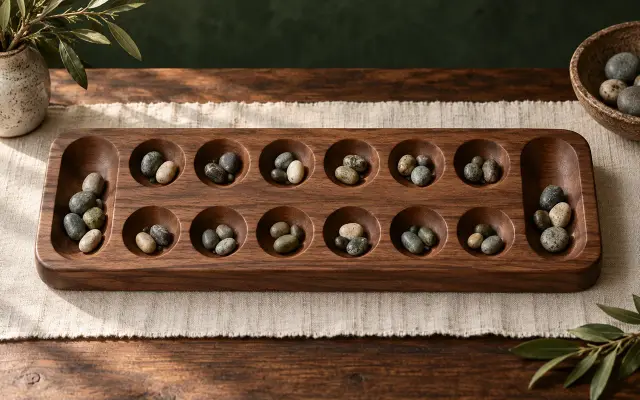
Kalah with six pits per player and four stones per pit
How to play Mancala (Kalah)
Kalah Mancala rules with four stones per pit: board setup, counterclockwise sowing, extra turns, opposite-pit captures, the end sweep and winning.
Also known as Kalah
On this page
Quick reference
At the table
Ruleset: Kalah with six pits per player and four stones per pit
- Goal
- Collect more stones in your store than your opponent does.
- Setup
- Put four stones in each of the six small pits per player and leave both stores empty (Kalah).
- Turn
- Pick up one of your pits and sow counter-clockwise, skipping the opponent’s store. Ending in your store earns another turn.
- Scoring
- Ending in an empty pit on your side captures the stones opposite plus your final stone, but only if that opposite pit has stones. Stones in stores are your score.
- End of game
- When one side is empty, the other player sweeps their remaining stones into their store. More than 24 stones wins; 24–24 is a draw.
Objective
Collect more stones in your store than your opponent collects in theirs.
Mancala is a family of games, not one universal ruleset. This page teaches Kalah, the familiar form with two rows of six small pits and a large store at each end. Oware and other mancala games use different sowing, capture and ending rules.
Setup
Place the board lengthwise between two players. Each player controls the six small pits nearest them and the large store to their right. Their opponent’s store is at the other end.
Put four stones in each small pit, for 48 stones total. Leave both stores empty. Choose a starting player by agreement; alternate the starter in a series of games.
It helps to trace the sowing path before the first turn. From one of your pits, the path moves counterclockwise through the remaining pits on your side, into your store, across the opponent’s six pits, then back to your side. It always skips the opponent’s store.
Turns
Choose one non-empty pit on your own side. Pick up every stone from it and move counterclockwise, placing one stone in each following pit. Include your own store when you reach it, but skip the opponent’s store. Never choose a pit from the opponent’s side.
The location of the final stone controls what happens next:
- Own store: take another turn immediately. Extra turns can chain if the next move also ends in your store.
- Empty pit on your side: if the directly opposite opponent pit contains stones, move your final stone and all stones from that opposite pit into your store. This is a capture.
- Any other pit: the turn ends with no special action.
Under this ruleset, landing opposite an empty pit does not capture anything; the final stone remains in your previously empty pit. The capture requires at least one stone in the opposite pit.
Worked example
You choose a pit containing four stones. You sow one stone into each following space, and the fourth lands in your own store. You take another turn.
Later, your final stone lands in an empty pit on your side. The pit directly opposite holds three stones. Move those three stones and your landing stone into your store: the capture adds four stones to your score.
Winning
The game ends as soon as either player’s six small pits are all empty. The player who still has stones in their six pits moves every one of those remaining stones into their own store. This is the end sweep; no further turns or captures are played.
Count the stones in both stores. The player with more stones wins. Because there are 48 stones, 25 guarantees a win. A 24–24 result is a draw.
For a match, alternate the starting player and count game wins. Do not carry store stones from one game into the next unless you have agreed on a separate match-scoring system.
Common mistakes
- Calling every pit yours. You may start a turn only from one of the six small pits nearest you.
- Dropping a stone into the opponent’s store. Always skip it.
- Stopping after an own-store landing. That final stone earns an immediate extra turn.
- Capturing from the opponent’s side. Your last stone must land in an empty pit on your own side.
- Capturing opposite an empty pit. This ruleset requires stones in the opposite pit.
- Continuing after one side empties. End the game immediately and sweep the other side.
- Assuming another mancala game’s rules apply. Kalah has its own capture and store system.
Variants
Kalah boards may start with three, five or six stones in every small pit. The turn rules stay recognizable, but the opening and game length change. Some versions allow a capture when the opposite pit is empty, moving only the landing stone to the store; that is not the capture convention used here.
The pie rule lets the second player swap sides after the first move to reduce first-player advantage. Other house rules change when the game ends or who receives the remaining stones, so state them before setup.
Oware and related mancala games are separate games. They often have no end stores, sow from different positions and capture from the opponent’s row under specific counts. Use their own rules rather than treating them as small Kalah variations.
Common questions
Do you put stones in your opponent’s store in Mancala?
No. In Kalah, sow counterclockwise through the small pits and your own store, always skipping your opponent’s store.
When do you capture stones in Mancala?
In this Kalah ruleset, your last stone must land in an empty pit on your side, and the opposite pit must contain stones. Move that landing stone and all the opposite stones into your store.
Who gets the remaining stones when Mancala ends?
When one side’s six small pits are empty, the other player sweeps the stones remaining on their own side into their own store. Compare the store totals; with this 48-stone setup, 24–24 is a draw.
Learn this game

Similar games
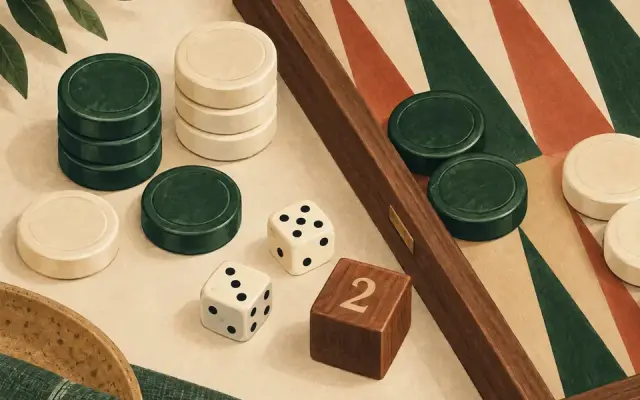
Backgammon
Backgammon rules for beginners: board setup, dice moves, hitting and the bar, bearing off to win — with the 15 opening moves and key terms.
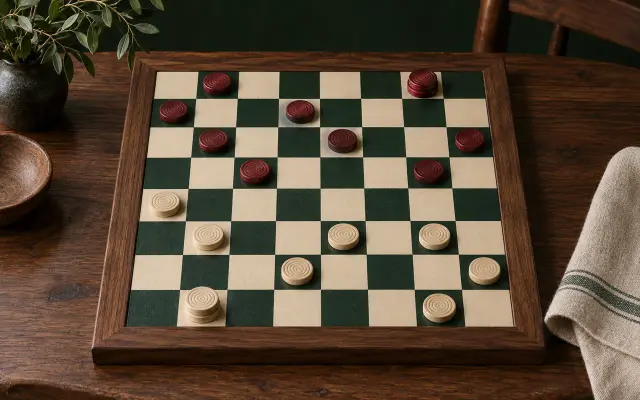
Checkers
American Checkers rules on an 8×8 board: setup, forward moves, compulsory captures, multiple jumps, crowning, when pieces can move backward and how to win.
Also known as English draughts, Draughts
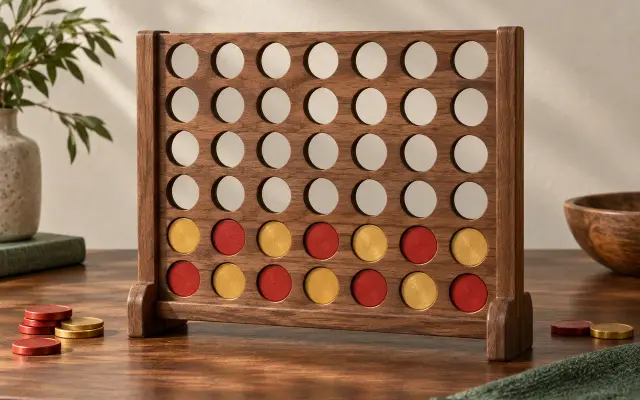
Connect 4
Classic Connect 4 rules: assemble and orient the vertical grid, take turns dropping discs, and make four horizontally, vertically or diagonally.
Also known as Connect Four, Four in a Row, Four-in-a-row