
Mancala scoring: Kalah captures and the end sweep
Count captures, remaining stones and the final store totals in four-stone Kalah, with 48-stone checks and worked end-sweep examples.
On this page
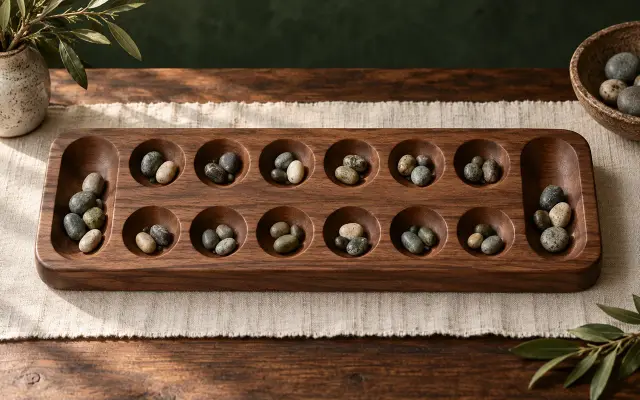
This guide uses Kalah with four stones in each of twelve pits: 48 stones total, with stores empty at setup. Other mancala games and other starting quantities need different totals.
Stores hold the score
Each stone in your store counts as one. Stones in small pits remain in play until sowed into a store, captured or collected in the final sweep. Do not add them to your current store score during a normal turn.
Sowing includes your own store and skips your opponent’s. A final stone in your store gives an extra turn, but no separate point bonus. You gained the stone deposited there; the extra turn is a new opportunity to play.
A capture includes the landing stone
A capture requires your final stone to land in a pit that was empty on your side, opposite an opponent’s pit that contains stones. Move the landing stone and all opposite stones to your store.
If the opposite pit contains five, the capture transfers 5 + 1 = 6 stones. It does not award five points and leave the landing stone behind. If the opposite pit is empty, this ruleset makes no capture; the landing stone stays in its pit.
The capture also does not automatically give an extra turn. That extra-turn rule applies to a final stone in your store, not to a capture’s later transfer into it.
Stop as soon as one side is empty
When either row of six small pits becomes empty, end the game. The player whose row still contains stones collects their own remaining stones into their store. No further moves are played to try to capture that remainder.
Emptying your row does not itself win. It ends play and triggers the count. The other player may receive a large sweep that changes who has the higher store total.
Worked example: winning through the sweep
At the ending, North’s row is empty and North has 22 in their store. South has 18 in their store and eight stones across their six pits.
| Player | Store before sweep | Own pits collected | Final score |
|---|---|---|---|
| North | 22 | 0 | 22 |
| South | 18 | 8 | 26 |
South wins 26–22, despite being the player with stones left in the small pits. The totals reconcile: 22 + 18 + 8 = 48 before the sweep, and 22 + 26 = 48 afterwards.
Worked example: a draw
One row empties with its owner on 24. The other player has 19 in their store and five still in their pits. The sweep produces 19 + 5 = 24, so the result is 24–24.
A store total of 25 guarantees more than half of the original 48. The physical game still reaches its normal ending and sweep; do not invent a new early-ending procedure.
Use the total to catch mistakes
After the sweep, both stores must sum to 48. A total of 47 suggests a missing stone or an overlooked pit. A total above 48 suggests an extra stone or a double count. Check the equipment and transfers instead of awarding a result from inconsistent totals.
Reset each pit to four for another game; do not carry captured stones into the next setup. You may agree to track game wins across a series and alternate the starting player. That record is separate from the store scores of one game.
See Kalah common mistakes for capture conditions and beginner strategy for using extra turns.
Continue learning

Similar games
Backgammon
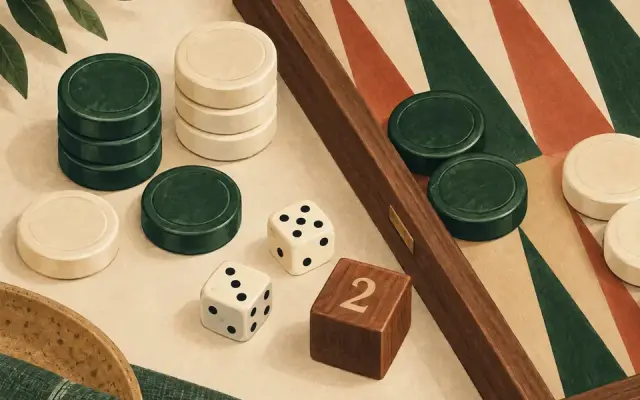
Backgammon rules for beginners: board setup, dice moves, hitting and the bar, bearing off to win — with the 15 opening moves and key terms.
Checkers
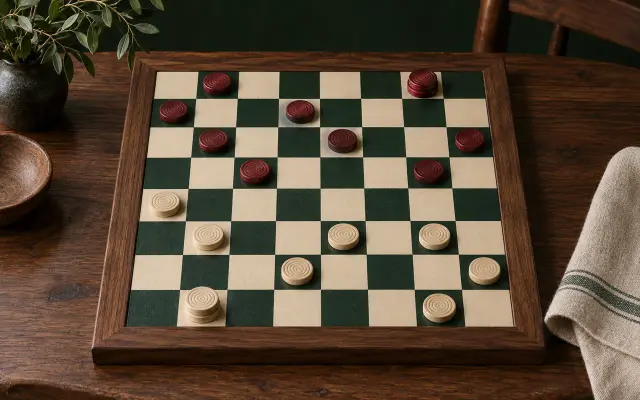
American Checkers rules on an 8×8 board: setup, forward moves, compulsory captures, multiple jumps, crowning, when pieces can move backward and how to win.
Also known as English draughts, Draughts
Connect 4
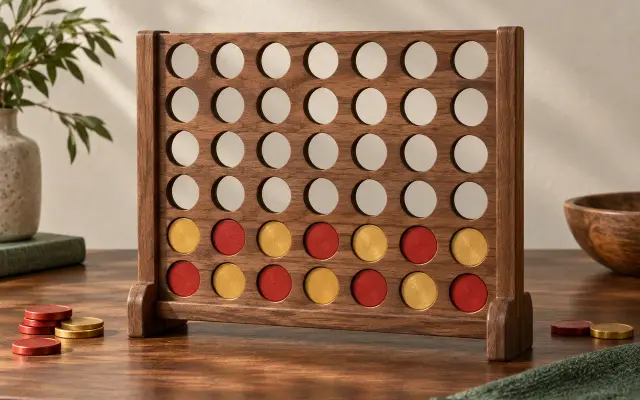
Classic Connect 4 rules: assemble and orient the vertical grid, take turns dropping discs, and make four horizontally, vertically or diagonally.
Also known as Connect Four, Four in a Row, Four-in-a-row