
American checkers (English draughts) on an 8×8 board
How to play Checkers
American Checkers rules on an 8×8 board: setup, forward moves, compulsory captures, multiple jumps, crowning, when pieces can move backward and how to win.
Also known as English draughts, Draughts
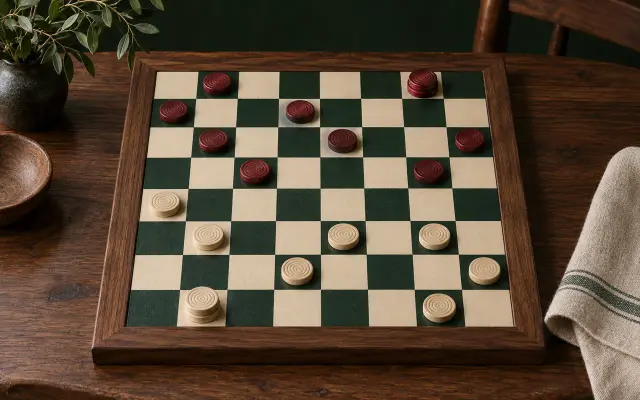
On this page
Quick reference
At the table
Ruleset: American checkers (English draughts) on an 8×8 board
- Goal
- Leave your opponent with no legal move by capturing or blocking every piece.
- Setup
- Put 12 pieces each on the dark squares of the three nearest rows. Dark moves first.
- Turn
- Move a man one diagonal step forward. If any capture exists you must jump, and keep jumping with the same piece.
- Scoring
- There are no points. Captured pieces are removed from the board.
- End of game
- You win when your opponent cannot move at the start of their turn. A man reaching the far row becomes a king and its turn ends.
Objective
Win by leaving your opponent with no legal move. That happens when you capture all opposing pieces or block every piece that remains.
This page teaches American checkers, the same 8×8 game governed internationally as English draughts. Its men capture forward only, its kings move one square at a time, and captures are compulsory. International draughts on a 10×10 board is a different ruleset.
Setup
Place the board between the two players with a dark playing square at each player’s near left. Use only the 32 dark squares.
Each player takes 12 pieces of one colour. Put them on the dark squares of the three rows nearest that player, four pieces per row. The two middle rows begin empty. The player with the darker pieces—traditionally red or black—moves first, then turns alternate.
All pieces start as men. They move toward the opponent’s side of the board. Keep spare pieces nearby for marking kings by stacking one piece on another.
Turns
On your turn, first check whether any of your pieces can capture. A capture is compulsory. You may make a simple move only when none of your pieces has a legal capture.
Simple moves
A man moves one square diagonally forward into an empty dark square. It cannot move sideways, straight ahead or backward.
A king moves one square diagonally forward or backward into an empty dark square. Kings in this ruleset do not fly across several empty squares.
Captures and multiple jumps
A man captures by jumping diagonally forward over one adjacent opposing piece into the empty square immediately beyond it. The jumped piece is captured. A king captures the same way forward or backward.
If the capturing piece can jump again from its landing square, it must continue in the same turn. Remove all jumped pieces when the whole sequence is finished; a jumped piece stays on the board until then and cannot be jumped twice.
When more than one piece can begin a capture, choose any capturing piece. When a piece has more than one legal continuation, choose either route. American checkers does not require the route that takes the most pieces—but after choosing the route, continue with that same piece for as long as another capture is available.
Crowning
When a man reaches the farthest row, its turn ends and it becomes a king. Stack a second piece of the same colour on it to mark the promotion.
American crowning timing matters during a jump: if a man lands on the king row, stop the move there even if a newly crowned king would appear to have a backward capture. It can move or capture as a king on its next turn.
Worked example
A red man jumps diagonally forward over a white piece into an empty square. From that landing square it has another forward capture, so the same red man must jump again.
The second landing square is on the far king row. Remove both captured white pieces, crown the red man and end the turn. Do not turn around for a backward king jump during the same move.
Winning
You win immediately when your opponent has no legal move at the start of their turn. Capturing the last opposing piece is therefore a win, and so is trapping all remaining opposing pieces behind occupied squares or board edges.
A player may resign when the position is clearly lost. For casual games, players may agree to a draw when neither can force progress. Formal competition rules also define draw claims, such as WCDF’s third repetition of a position or 40 moves each without a man advancing or a capture; use the event rules when a clock, notation or adjudicator is involved.
Common mistakes
- Making a quiet move when a jump exists. A capture anywhere on your side is mandatory.
- Stopping a multiple jump early. The same piece must keep capturing while a legal continuation exists.
- Demanding the longest capture. In American checkers you choose among legal routes; maximum capture belongs to other draughts rulesets.
- Capturing backward with a man. Men move and jump forward only here.
- Letting a new king continue its jump. Reaching the king row ends that turn.
- Moving a king several squares. Kings move one diagonal square or jump one adjacent opponent at a time.
- Using the light squares. Every move stays on the 32 dark squares.
Variants
International draughts uses a 10×10 board and 20 pieces each. Men can capture backward, kings fly over distance, and a player must choose a maximum capture. Those rules cannot be mixed into an American checkers game without changing legal moves.
Other national draughts games use 8×8 boards but differ on backward captures, flying kings, board orientation or capture priorities. Some informal American games let a man continue jumping as a king immediately after promotion; the WCDF rule used here ends the move on the king row.
Casual draw rules such as “a fixed number of king moves without a capture” vary widely. Agree on one before play, or use the formal rules of the competition or platform.
Common questions
Do you have to jump in Checkers?
Yes. In English draughts, a legal capture is compulsory. If several capture routes are available, choose one; you do not have to choose the route taking the most pieces.
Can you move or jump backwards in Checkers?
Not with an ordinary piece. A man moves and captures only diagonally forward until it reaches the far row and is crowned. From its next turn, the king may move and jump backward as well. Some other draughts variants let men capture backward.
Can you keep jumping after becoming a king?
No. Reaching the far row crowns the piece and ends its turn, even if the new king could make another capture.
Learn this game
Similar games
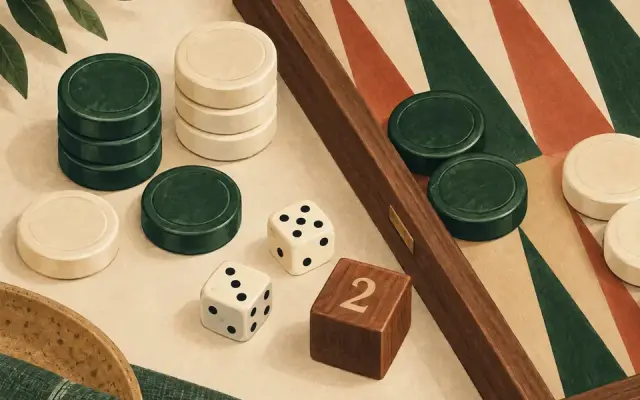
Backgammon
Backgammon rules for beginners: board setup, dice moves, hitting and the bar, bearing off to win — with the 15 opening moves and key terms.
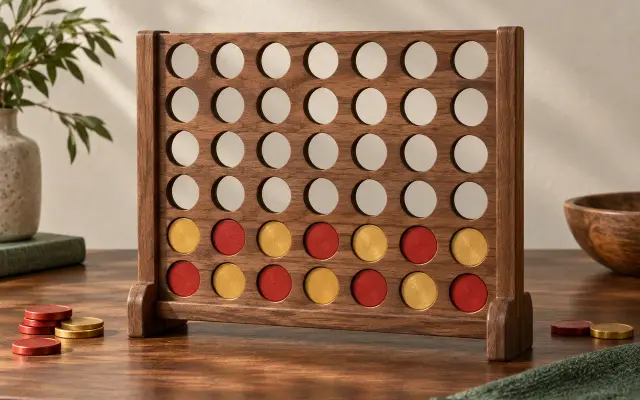
Connect 4
Classic Connect 4 rules: assemble and orient the vertical grid, take turns dropping discs, and make four horizontally, vertically or diagonally.
Also known as Connect Four, Four in a Row, Four-in-a-row
Mancala (Kalah)
Kalah Mancala rules with four stones per pit: board setup, counterclockwise sowing, extra turns, opposite-pit captures, the end sweep and winning.
Also known as Kalah