
Checkers beginner strategy: control, trades and kings
Practical American checkers strategy: centre control, back row, forced captures, trading and endgame kings.
On this page
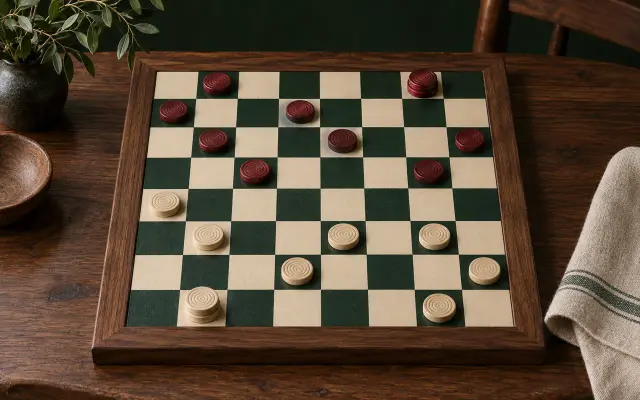
This guide is for American checkers as taught on our Checkers rules page: forced captures, men that move and jump forward only, and kings that move one square at a time.
Use the forced capture
Captures are compulsory, so you can steer your opponent. Offering one piece to make them jump can pull a piece out of position and open a multiple jump for you. Before every move, ask what your opponent must do afterwards, not only what they might like to do.
Control the centre
Pieces in the middle of the board have more moves and can support each other. Pieces on the edge have fewer options and can be trapped. Do not rush a lone piece up the side.
Keep your pieces together
A piece with a friend diagonally behind it cannot easily be jumped, because the landing square is occupied. Advance in small groups. A piece that leaves the group alone is easy to attack.
Guard your back row
Your back row stops enemy men from crowning. Keep some back-row pieces at home in the opening and middle game, and move them only when you have a reason. Once most of the pieces are gone, the back row matters less.
Trade when you are ahead
If you have more pieces, swapping one for one leaves you with a bigger advantage. If you are behind, avoid trades and look for tactics instead.
Get the first king
A king moves in both directions and is far more flexible than a man. But rushing a man forward alone can lose it. Crown when the path is safe, and remember the move ends as soon as you land on the king row.
Endgame
Kings move one square at a time here, so a lone king can be hard to trap and hard to catch. Bring your kings together and use the board edge to limit the enemy’s moves. If you cannot force progress, agree a draw with your opponent.
Continue learning
Similar games
Backgammon
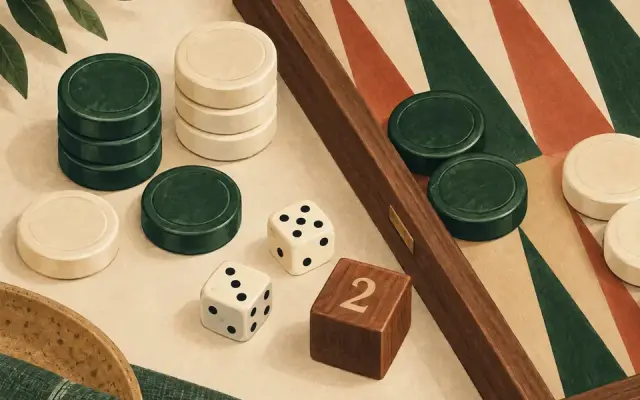
Backgammon rules for beginners: board setup, dice moves, hitting and the bar, bearing off to win — with the 15 opening moves and key terms.
Connect 4
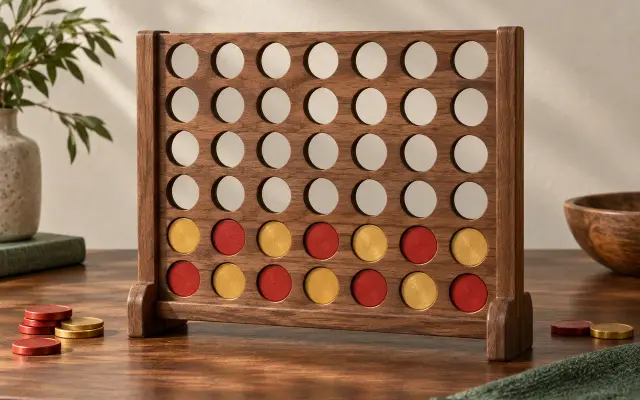
Classic Connect 4 rules: assemble and orient the vertical grid, take turns dropping discs, and make four horizontally, vertically or diagonally.
Also known as Connect Four, Four in a Row, Four-in-a-row

Mancala (Kalah)
Mancala rules for Kalah with four stones per pit: board setup, counterclockwise sowing, extra turns, opposite-pit captures, the end sweep and winning.
Also known as Kalah