
Make safer choices in Backgammon
Before you move in Backgammon: use the whole roll, weigh points, hits and escapes, and count the risk of leaving a checker exposed.
On this page
Read the whole roll
Before moving, consider both dice together. A tempting first move can make the second awkward. Remember that the rules require you to play both numbers when possible.
List the legal ways to use the larger die first and the smaller die first. When only one number can be played, the rules may require the larger number. Trying both orders also reveals plays that are easy to miss when you treat the roll as one combined jump.
Scan three jobs
For each legal play, ask whether it can make a useful point, hit an opposing blot, or help a back checker escape. These are prompts, not a fixed priority order. A strong home-board point can be worth more than a loose hit; escaping may matter more when the race is already favourable.
Notice exposed checkers
A single checker on a point can be hit. Two establish a point your opponent cannot land on. Count which rolls could hit you before deciding whether the progress is worth the exposure.
Think about the next turn
A move can gain distance while leaving fewer useful options later. Look for a balance between progress and checkers that can support one another. A hit is useful only in the context of the whole position.
Checkers stacked six deep on one point have little flexibility. Builders spread within useful range can combine to make points next turn. Avoid burying checkers on the one- and two-points early unless the position gives a concrete reason.
Notice what kind of game you have
If the checkers no longer touch, you are racing: pip count and smooth bearing-in matter most. If both sides still have anchors and contact, hits and blocks remain possible. A prime tries to trap checkers behind consecutive made points. A back game is a recovery plan for a position that has already fallen far behind, not a plan to choose from the opening.
Separate advice from rules
These are beginner prompts, not a move-selection formula. The dice, board position, and match conditions all matter. Start with casual single games before adding the doubling cube.
Continue learning
Similar games
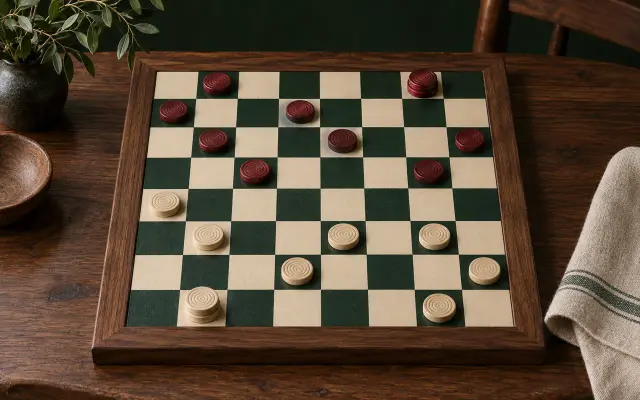
Checkers
American Checkers rules on an 8×8 board: setup, forward moves, compulsory captures, multiple jumps, crowning, when pieces can move backward and how to win.
Also known as English draughts, Draughts
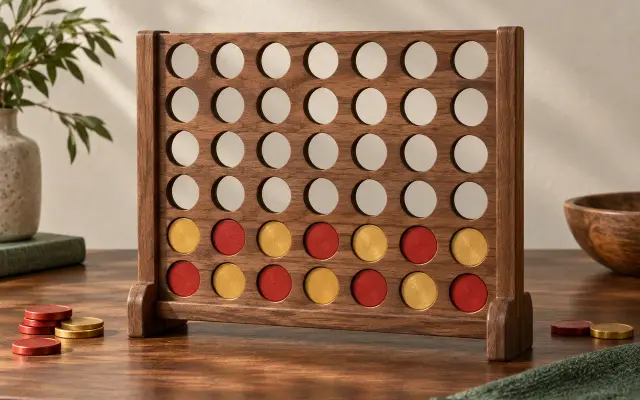
Connect 4
Classic Connect 4 rules: assemble and orient the vertical grid, take turns dropping discs, and make four horizontally, vertically or diagonally.
Also known as Connect Four, Four in a Row, Four-in-a-row
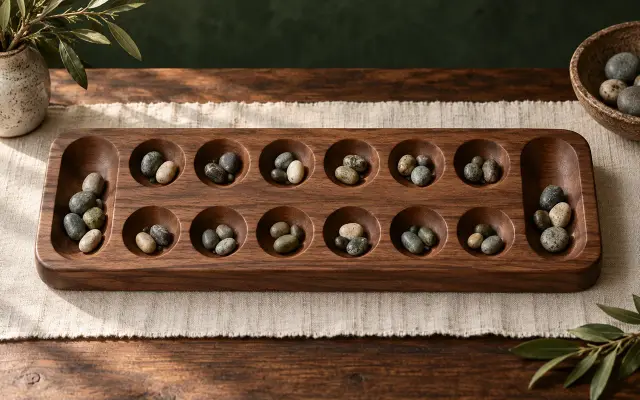
Mancala (Kalah)
Kalah Mancala rules with four stones per pit: board setup, counterclockwise sowing, extra turns, opposite-pit captures, the end sweep and winning.
Also known as Kalah