
Common Backgammon mistakes and how to check them
Avoid illegal dice use, stranded checkers, broken primes and cube errors with a short turn-by-turn routine.
On this page
Backgammon mistakes come in two forms: illegal plays and legal plays that solve the wrong problem. Check legality first, then compare the position each candidate move leaves behind.
Treat the dice as separate moves
A 6-3 is not one nine-space jump. It is a six and a three, with a legal landing point after each number. One checker may use both numbers only when the intermediate point is open.
Try both orders. A move blocked when played 6 then 3 may be legal as 3 then 6. You must use both dice when possible. If only one number can be played, use the larger number when it is legally available. Doubles are four separate moves.
Enter from the bar before doing anything else
When you have a checker on the bar, every available move must be used to enter it before another checker can move. With two checkers on the bar, you may need both dice to enter them. If no entry is open, the turn ends.
A common accidental illegal move is improving the home board while forgetting the checker waiting on the bar.
Stop counting only distance
Moving the farthest total number of pips is not automatically best. In contact positions, compare:
- which blots become exposed;
- which points you make or break;
- whether a back checker can be trapped;
- how many useful rolls the position creates next turn; and
- whether the opponent gains a direct shot.
Once all opposing checkers have passed one another, the game becomes a race and pip count matters much more.
Do not hit automatically
Hitting sends a checker to the bar and can gain time, but it can also leave the hitting checker exposed or abandon a stronger point. Ask what happens if the opponent enters and hits back. A hit that traps the checker behind a prime or strengthens your home board is different from a hit that merely creates action.
Keep useful points connected
A prime works because consecutive made points block movement. Breaking the middle of a four- or five-point prime may release the checker you worked to trap. Before lifting two checkers from a made point, check whether another legal play preserves the blockade.
The opposite mistake is stacking too many checkers on one point. Extra checkers beyond the two needed to own a point should become builders when they can do so safely.
Do not bury checkers too early
Checkers placed deep on your one- and two-points are difficult to reuse. Early in the game they may contribute little to blocking or building. A deep move can still be correct to hit, cover a vital point, or use a forced number; the mistake is treating deep safety as free.
Change plans when contact ends
Do not keep building attacks after the last opposing checker has escaped. With no possible hits remaining, make the bear-in efficient: fill gaps, avoid awkward stacks, and reduce wasted rolls. Likewise, do not play a pure race while opposing checkers can still hit you.
Separate cube procedure from cube judgement
You may offer a double only before rolling at the start of your turn, and only the cube owner may redouble. A pass loses the current cube value, not the newly offered value. Match score and Crawford can restrict the cube even when the board position looks strong.
Learning when a position is a double takes practice. Learning who owns the cube and when it may be turned is a rules check you can get right every time.
Use a turn routine
Before picking up the dice:
- Confirm bar entry and forced-use requirements.
- List plays in both dice orders.
- Look for making a point, hitting, and escaping.
- Count the blots and broken points each play leaves.
- Identify whether the position is contact, race, prime, holding game, or a damaged back game.
Move checkers tentatively while comparing legal plays, restore the original position between candidates, and end the turn only when the final play is clear.
Continue learning
Beginner strategy
 Beginner strategyMake safer choices in BackgammonBefore you move in Backgammon: use the whole roll, weigh points, hits and escapes, and count the risk of leaving a checker exposed.Beginner strategyBackgammon opening movesThe fifteen backgammon opening rolls with standard moves and one-line reasons — plus doubles replies and how to handle the back pair.
Similar games
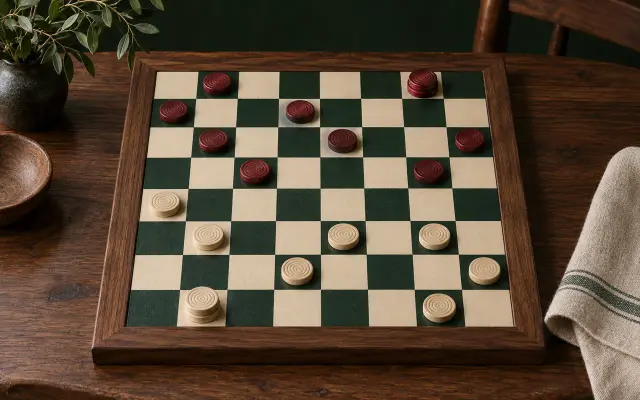
Checkers
American Checkers rules on an 8×8 board: setup, forward moves, compulsory captures, multiple jumps, crowning, when pieces can move backward and how to win.
Also known as English draughts, Draughts
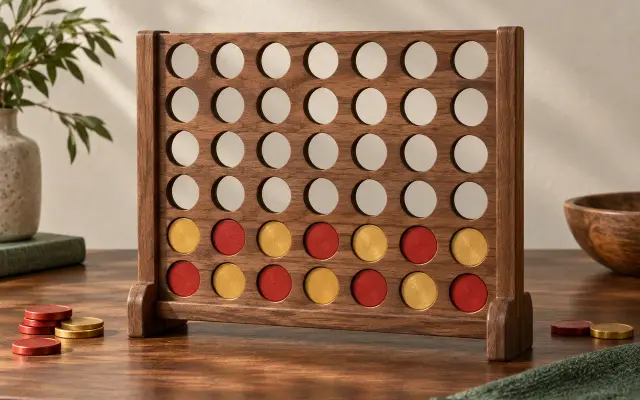
Connect 4
Classic Connect 4 rules: assemble and orient the vertical grid, take turns dropping discs, and make four horizontally, vertically or diagonally.
Also known as Connect Four, Four in a Row, Four-in-a-row

Mancala (Kalah)
Mancala rules for Kalah with four stones per pit: board setup, counterclockwise sowing, extra turns, opposite-pit captures, the end sweep and winning.
Also known as Kalah