
Backgammon opening moves
The fifteen backgammon opening rolls with standard moves and one-line reasons — plus doubles replies and how to handle the back pair.
On this page
The fifteen opening rolls
Backgammon starts with one die each. The higher number goes first and plays both numbers just rolled — ties reroll, so the first roll of a game is never doubles. That leaves fifteen possible openings, and every game begins with one of them. It is the only position in backgammon you are guaranteed to see, which is why these fifteen moves are worth learning rather than working out at the table.
If you are still learning the board itself, start with the backgammon rules, then come back.
Moves are written start/finish: 8/5 moves a checker from the 8-point to the 5-point. A (2) after a move means it happens twice — two checkers moved the same way. The table gives the standard play for each roll, chosen by computer rollouts, with the short reason.
| Roll | Standard play | Why |
|---|---|---|
| 2-1 | 13/11 6/5 | Slots the five-point; the split 24/23 13/11 is just as good |
| 3-1 | 8/5 6/5 | Makes the five-point — the best roll, played one way |
| 4-1 | 24/23 13/9 | Split plus a builder; slotting (13/9 6/5) is the gamble |
| 5-1 | 24/23 13/8 | Split plus a builder for the bar-point |
| 6-1 | 13/7 8/7 | Makes the bar-point — third-best roll, one obvious play |
| 3-2 | 24/21 13/11 | Split and build; the quiet build 13/11 13/10 is close |
| 4-2 | 8/4 6/4 | Makes the four-point — second-best roll |
| 5-2 | 24/22 13/8 | Split for an anchor, build for the bar-point |
| 6-2 | 24/18 13/11 | Runs a back checker and brings down a builder |
| 4-3 | 13/10 13/9 | Two builders; the split 24/21 13/9 is just as popular |
| 5-3 | 8/3 6/3 | Makes the three-point — third-best roll |
| 6-3 | 24/18 13/10 | Run plus builder, progress on both sides |
| 5-4 | 24/20 13/8 | Anchors on their five-point and builds |
| 6-4 | 24/18 13/9 | Run plus build; 24/14 and 8/2 6/2 are equally fine |
| 6-5 | 24/13 | The lover’s leap — one back checker runs all the way home |
Three rolls stand out: 3-1 first, then 4-2, then 6-1, in that order, by how much advantage the rollouts give up. Notice the pattern — making home-board points (3-1, 4-2, 5-3) beats making the bar-point (6-1) by a little. Home-board points also make it hard for a hit opponent to re-enter, and that extra value shows in the numbers.
Several rolls have a genuine choice, not a mistake: 2-1, 4-1, 5-1, 3-2, 5-2, 4-3, 5-4 and 6-4 all have a second play that rollout analysis puts within a whisker of the first. Pick one shape, play it consistently, and refine later.
The ideas behind the plays
- Make points. Own points in your home board, and make the five-point before any other. It blocks re-entries and starts a prime.
- Split the two back checkers to put one on an advanced point (24/23, 24/22, 24/21, 24/20). Early, the opponent cannot punish it; late, it gets risky.
- Slot a point by landing a lone checker on it (6/5), ready to cover next roll. The blot is the price; 2-1, 4-1 and 5-1 can all justify it.
- Run with a back checker (6-5, 6-4, 6-3, 6-2 all move one). The opener 6-5 is pure race.
- Build — bring checkers down from the 13-point where they can complete points over the next few rolls.
Doubles on your first roll
One more time, because it gets asked constantly: under the standard rules, doubles cannot be your first roll of the game. Each player rolls one die, ties reroll, and the winner plays both numbers. If your group lets the winner reroll both dice, or the previous game’s winner simply opens, doubles can appear — and here is what the software says to do with them.
| Roll | Standard play | What it does |
|---|---|---|
| 6-6 | 24/18(2) 13/7(2) | Makes both bar-points and advances both back checkers |
| 5-5 | 13/3(2) | Makes the three-point with four checkers |
| 4-4 | 24/20(2) 13/9(2) | Makes the five-point and the four-point in one roll |
| 3-3 | 8/5(2) 6/3(2) | Makes the five-point and the three-point |
| 2-2 | 13/11(2) 6/4(2) | Makes the eleven-point and the four-point |
| 1-1 | 8/7(2) 6/5(2) | Makes the bar-point and the five-point |
These plays come from Snowie rollout analysis, published by GammonVillage in 2000, and they are still the standard answers. Doubles are four moves, so they build two points at once — every one of these makes a point and does something else useful in the same turn.
The five-point
Most opening theory is a fight over one triangle. The five-point is the best point on the board: it blocks your opponent’s re-entry from the bar, starts the kind of prime that traps runners, and sits where your own checkers want to live. That is why 3-1 is the dream roll, why the 1-and-2 rolls are happy to slot it and risk a hit, and why 4-4, 3-3 and 1-1 all make it immediately. If you take one thing from this page: build your five-point, and stop your opponent building theirs.
The back pair
Your two deepest checkers — the pair on the 24-point — decide the character of your game. Splitting them means putting one on an advanced point while the other stays deep. It works best right at the start, before your opponent has points to hit with, and it buys you an anchor and a shorter run later. Rolls with a 1, 2 or 3 usually do the splitting; 5-4 anchors the checker straight onto their five-point.
Doubles 6-6 and 5-5 do the opposite: they move the whole pair. 6-6 plays 24/18(2), both back checkers jumping to the 18-point, and 5-5 would rather build the three-point than fuss with the runners. When a doubles roll gives you the choice, advancing both checkers together is the normal play — the pair escapes as a unit instead of stranding one deep checker behind a growing blockade.
Do not feel obliged to split late. Once your opponent has made home-board points, a lone split checker is a liability, not an investment; that is the time to keep the pair together and escape with a big roll.
After the first roll
The opening you just made shapes your opponent’s reply, and theirs shapes yours — bkgm counts 693 reasonable positions after two rolls, so nobody memorises all of them. The working priorities: hit a blot on the opponent’s side of the board when you can, knock their checkers off your five- and four-point, and otherwise make the points the table above aims at. If you would rather meet the first roll with a plan, start from the backgammon rules and play a few single games — the opening table is much easier to absorb while the board in front of you matches it.
Continue learning
Similar games
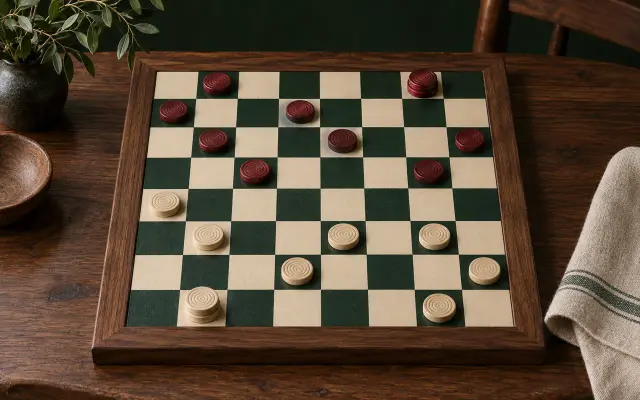
Checkers
American Checkers rules on an 8×8 board: setup, forward moves, compulsory captures, multiple jumps, crowning, when pieces can move backward and how to win.
Also known as English draughts, Draughts
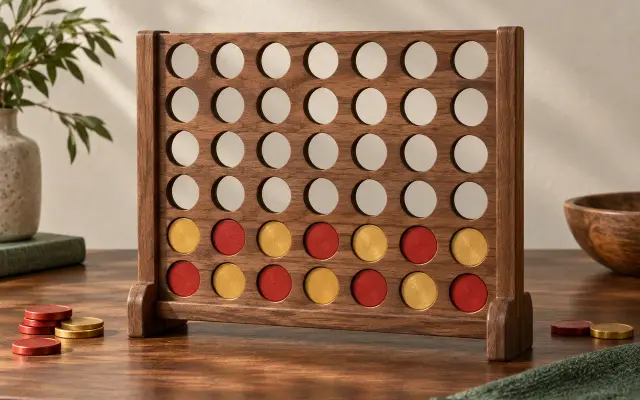
Connect 4
Classic Connect 4 rules: assemble and orient the vertical grid, take turns dropping discs, and make four horizontally, vertically or diagonally.
Also known as Connect Four, Four in a Row, Four-in-a-row
Mancala (Kalah)
Kalah Mancala rules with four stones per pit: board setup, counterclockwise sowing, extra turns, opposite-pit captures, the end sweep and winning.
Also known as Kalah