
Scrabble scoring, blanks and challenges: worked examples
Worked Scrabble US Classic examples for letter and word premiums, cross-words, blanks, bingo bonuses, challenges and final tile deductions.
On this page
These examples follow US Classic A8166 home play on our Scrabble rules page. Letter values are those of its US English set. Agree the dictionary before play; tournament challenge procedures are separate.
Score the opening
Place DOG with O on the centre star. D scores 2; O and G score 1 and 2. The centre doubles the word: (2 + 1 + 2) × 2 = 10.
If D is a blank declared as D, it contributes zero instead: (0 + 1 + 2) × 2 = 6. Its identity stays D after this turn.
Add letter premiums before word premiums
For a legal QUIZ placement with newly played Q on a double-letter square and no other active premiums:
| Letter | Contribution |
|---|---|
| Q on double letter | 10 × 2 = 20 |
| U | 1 |
| I | 1 |
| Z | 10 |
| Total | 32 |
For any placement covering a word premium as well, total the adjusted letters first, then apply the word multiplier. Two double-word squares in the same word multiply by four, not by three.
Score every word made
Suppose a new X on a double-letter square simultaneously completes AX across and EX down, using an existing A and E. With no other active premiums, AX scores 1 + (8 × 2) = 17, and EX scores another 17. The turn earns 34.
The same newly covered premium applies in both words. In contrast, an old covered premium supplies no multiplier when its tile is reused in a later word.
Add the seven-tile bonus last
If all seven newly placed rack tiles form READING, ordinary letter values total 9. On an opening placement through the centre, with no other premiums, score 9 × 2 + 50 = 68.
The 50 belongs to using seven rack tiles in one turn. Extending a six-letter board word with one tile does not earn it, even if the finished word has seven letters. A blank among the seven still counts as a played tile.
Resolve a challenge
Under A8166, challenge before the next player starts. If the play fails the agreed dictionary, take back its tiles and lose that turn. If it is valid, the challenger loses their next turn. Resolve disputed cross-words as well as the main word.
Use the dictionary for challenges, not to search for a move during your turn.
Apply the endgame adjustments
Suppose the bag is empty. You have 180 points and go out with a 7-point play; your opponent has 195 points and nine points of tiles left.
| Step | You | Opponent |
|---|---|---|
| Score the last play | 187 | 195 |
| Deduct remaining tiles | 187 | 186 |
| Add opponent’s leftovers to the player who went out | 196 | 186 |
You win 196–186. A blank has no leftover value. If everyone passes twice in turn instead, each player subtracts their own leftovers, with no going-out addition. A final-score tie uses the higher score before the adjustments in this edition.
Continue learning
Similar games
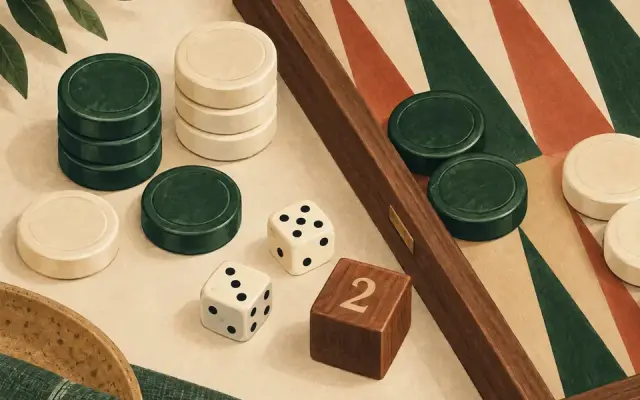
Backgammon
Backgammon rules for beginners: board setup, dice moves, hitting and the bar, bearing off to win — with the 15 opening moves and key terms.
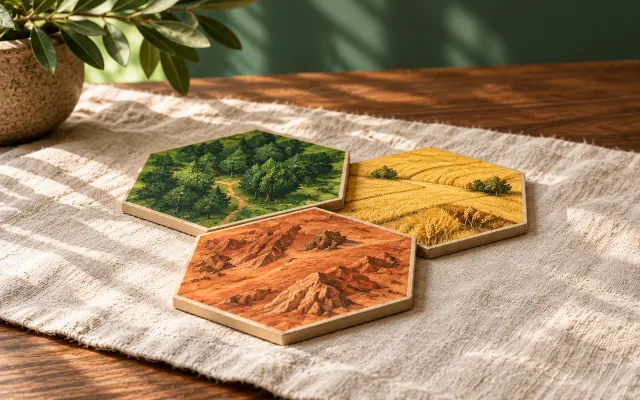
CATAN
Learn CATAN’s 2025 base-game rules for 3–4 players: setup, resource production, trading, building costs, the robber and how to reach 10 victory points.
Also known as Settlers of Catan
Checkers
American Checkers rules on an 8×8 board: setup, forward moves, compulsory captures, multiple jumps, crowning, when pieces can move backward and how to win.
Also known as English draughts, Draughts