
Scrabble beginner strategy: rack balance and board position
Beginner Scrabble strategy: compare scores and leftover letters, find hooks and short words, use premiums and plan around the final tile adjustments.
On this page
Use this guide with our Scrabble rules page, which teaches US Classic A8166 home play. The strategy sources include club advice from other regions; their word lists, timers and challenge penalties do not replace your agreed home rules.
Compare the letters you keep
A play changes both your score and your rack. Before choosing, arrange the letters you would retain. A few extra points now may leave repeated vowels or awkward consonants that are difficult to use next turn.
Suppose two legal placements score 18 and 22. The 18-point play leaves A–E–R–S; the 22-point play leaves I–I–U–V. The four-point difference is real, but so is the difference in useful combinations. Neither option is automatically best: check the board before deciding.
Look for places before long words
Start with available scoring squares and letters already on the board. Ask whether a short word can use a valuable tile on a letter premium or score across and down at once. Length by itself does not determine points.
Learn small words from the dictionary your group actually uses between games. A two-letter word learned from another region’s list may not be accepted by yours.
Find hooks
A hook adds a letter to an existing word to make another word. Turning CAT into CATS can also connect your new word through the S. Check the entire resulting placement; the main word’s validity does not settle the cross-words.
Give useful tiles a job
An S or blank can enable a strong connection or a seven-tile play. Compare that potential with the points available now. Saving either forever can cost turns, especially when the board becomes crowded.
Shuffle your rack to break a fixed reading pattern. Try separating possible beginnings and endings, then test the remaining letters between them. A plausible word still needs a legal place on the board.
Inspect the reply you allow
After imagining a move, look from your opponent’s side. Have you supplied an easy route to a triple-word square? A risky opening may be worthwhile for a strong score or when you need opportunities to catch up. When ahead, compare a quieter placement that keeps the lead harder to overturn.
Consider an exchange
If your legal plays score poorly and leave an equally awkward rack, compare exchanging with accepting another weak turn. An exchange gives up this turn’s points for uncertain replacement tiles; it is a tool, not a guarantee of improvement.
Count the endgame
When the bag is empty, count the value of your unplayed tiles and your possible route to an empty rack. Going out changes both players’ scores. The scoring walkthrough shows why the apparent leader can lose.
Continue learning
Similar games
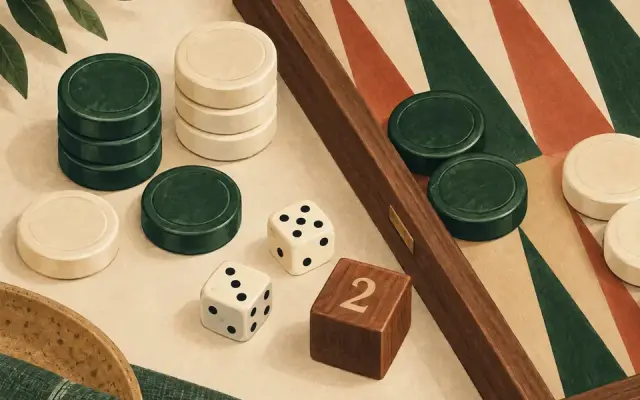
Backgammon
Backgammon rules for beginners: board setup, dice moves, hitting and the bar, bearing off to win — with the 15 opening moves and key terms.

CATAN
Learn CATAN’s 2025 base-game rules for 3–4 players: setup, resource production, trading, building costs, the robber and how to reach 10 victory points.
Also known as Settlers of Catan
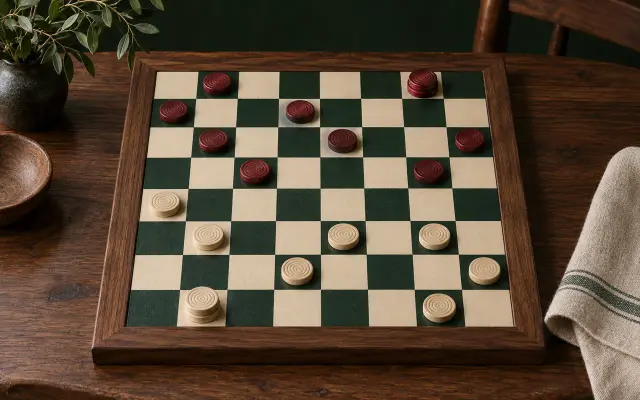
Checkers
American Checkers rules on an 8×8 board: setup, forward moves, compulsory captures, multiple jumps, crowning, when pieces can move backward and how to win.
Also known as English draughts, Draughts