
Hasbro Scrabble US Classic A8166; home-play challenge rules
How to play Scrabble
Independent rules summary
Scrabble US Classic rules: legal word placement, premium squares, blanks, exchanges, challenges, seven-tile bonuses and final scoring.
On this page
Quick reference
At the table
Ruleset: Hasbro Scrabble US Classic A8166; home-play challenge rules
- Goal
- Finish with the highest adjusted score.
- Setup
- Draw for first play, return those tiles, then each player draws seven.
- Turn
- Place tiles in one row or column, exchange tiles or pass. Refill after scoring a play.
- Scoring
- Add tile values, apply newly covered premiums and add 50 for playing all seven rack tiles.
- End of game
- End when the bag is empty and a player goes out, or everyone passes twice in succession.
Objective
Build words for points and finish with the highest score after remaining tiles are accounted for. This page uses Hasbro’s US Classic A8166 home rules, not tournament rules or Scrabble Together.
Setup
Agree a dictionary before playing; word lists differ by language and region. Put all 100 tiles in the bag. Each player draws one: the letter nearest A starts, with a blank ahead of A. Return those tiles and mix again. In playing order, take seven tiles each. Keep racks hidden and choose a scorekeeper. Turns proceed clockwise.
Turns
Choose to play tiles, exchange tiles or pass. When placing tiles, put them in a single horizontal or vertical line. Existing tiles may fill gaps in that line. Every new sequence of touching letters across and down must be a valid word.
The first word must contain at least two letters and cross the centre star. Later plays must connect to the existing layout. You may extend a word, cross it or play parallel to it if every resulting cross-word is valid. Diagonal words do not count. Tiles already played cannot be moved.
Announce the score for every word made or extended, add the total to your running score and draw back up to seven while tiles remain.
If you accidentally draw too many tiles and have more than seven, another player removes the excess at random without seeing the letters and returns them to the bag.
Legal words and challenges
Use the agreed dictionary to resolve disputes. Names requiring capitals, standalone prefixes or suffixes, and words requiring hyphens or apostrophes are excluded under these home rules. An expression’s appearance in everyday writing does not establish its eligibility; check the agreed word list.
A player may challenge before the next player starts. An invalid play is removed and the person who made it loses that turn. If the challenged play is valid, the challenger loses their next turn. Check every word formed by the play, including short cross-words.
Scoring and blanks
Add the values printed on the tiles for each word formed or extended. Existing letters count again when they belong to a newly scored word. Premiums apply only on the turn a tile first covers that square.
| Square or play | Effect |
|---|---|
| Double or triple letter | Multiply the newly placed tile’s value by two or three |
| Double or triple word | Multiply the whole word’s value after letter bonuses |
| Centre star | Double word on the opening play |
| Two word premiums in one word | Apply both multipliers: two doubles give four times the score |
| All seven rack tiles played | Add 50 after scoring the words |
If one new tile belongs to two words, count it and its applicable premium in each word. The seven-tile bonus is awarded once for the turn; playing a seven-letter word with fewer than seven new tiles does not qualify.
A blank may represent any letter. Announce its letter when playing it; that identity stays fixed. It always scores zero, including on letter premiums, but it still activates a newly covered word premium.
Exchanging or passing
To exchange, set aside the unwanted tiles face down, draw an equal number from the bag, then return the discarded tiles to the bag. This uses the turn and scores nothing. You need enough tiles in the bag to draw the replacements. You may also pass while keeping your rack, even when you could play.
Worked example
For an opening CAT, C is worth 3 and A and T are worth 1 each. With A covering the centre star, the score is (3 + 1 + 1) × 2 = 10.
If the C is a blank declared as C, the same placement scores (0 + 1 + 1) × 2 = 4. On a later turn, extending CAT to CATS scores the completed word, but the centre star no longer doubles it.
Winning
The game ends when the bag is empty and someone plays their last tile, or when every player passes twice in successive turns. Subtract each player’s remaining tile values from their score. If someone emptied their rack, also add all opponents’ remaining tile values to that player’s score.
For example, you go out on 210 points while the other players retain tiles worth 8 and 12. Your final score becomes 230; they subtract 8 and 12 from their own scores. A leftover blank deducts zero.
The highest final score wins. The current Hasbro guide gives no tie-break; older Hasbro rule sheets break a tie in favour of the higher score before the unused-tile adjustments.
Common mistakes
- Reusing a premium on later turns.
- Ignoring the short words created beside a parallel play.
- Giving a blank the value of its represented letter.
- Awarding 50 for a seven-letter word that used existing tiles.
- Checking a dictionary for possible moves instead of using it for challenges.
Variants
Tournament play can change dictionaries, challenge penalties, exchange requirements and the ending condition. Do not mix those rules into this edition. Returning a board blank to a rack is an optional variant in the A8166 guide, not part of the standard play described here.
Common questions
Can you use a double word square twice in Scrabble?
No. A premium applies only on the turn a tile first covers it. Existing letters count in a new word, but previously used premium squares do not apply again.
How many points is a blank worth in Scrabble?
Zero, whichever letter it represents. A letter premium cannot increase it, but a newly covered word premium still multiplies the whole word. The blank’s chosen letter stays fixed.
Do you get 50 points for any seven-letter word?
No. The bonus requires playing all seven tiles from your rack in one turn. A seven-letter word that uses letters already on the board does not qualify by length alone.
Learn this game
Similar games
Backgammon
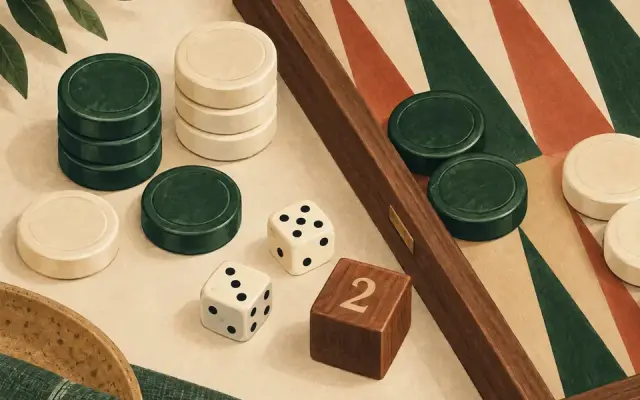
Backgammon rules for beginners: board setup, dice moves, hitting and the bar, bearing off to win — with the 15 opening moves and key terms.
CATAN
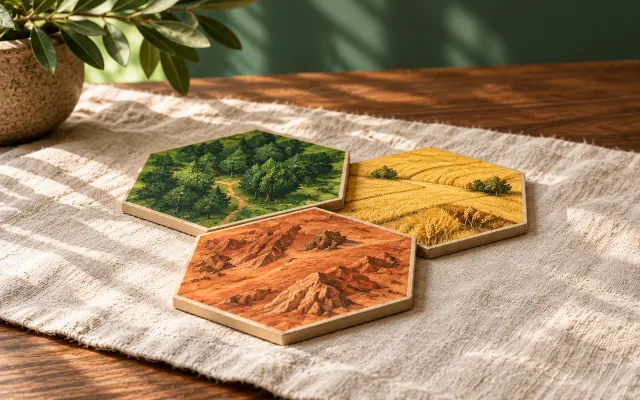
Learn CATAN’s 2025 base-game rules for 3–4 players: setup, resource production, trading, building costs, the robber and how to reach 10 victory points.
Also known as Settlers of Catan
Checkers
American Checkers rules on an 8×8 board: setup, forward moves, compulsory captures, multiple jumps, crowning, when pieces can move backward and how to win.
Also known as English draughts, Draughts