
Scrabble common mistakes: premiums, words and rack choices
Avoid Scrabble mistakes with reused premiums, cross-words, blank values, bingo bonuses, rack balance, challenges and endgame adjustments.
On this page
This checklist accompanies our Scrabble rules page. It uses US Classic A8166 home rules and your agreed dictionary. The advice about rack choices is a heuristic; the scoring and placement rules are requirements.
Counting a covered premium again
A premium works when first covered, not every time that tile contributes to a word. To check a score, mark the newly placed tiles mentally. Only their squares can supply fresh multipliers.
For example, extending an opening DOG to DOGS with an ordinary S scores 2 + 1 + 2 + 1 = 6. The centre does not double it again. Existing letters still contribute their normal values.
Checking only the longest word
A parallel placement can create several short cross-words. Read every new across and down sequence from end to end before finishing. One illegal cross-word makes the placement a problem even if the main word is familiar.
Similarly, tiles placed in the same turn belong in one row or column. You cannot add an unrelated second word elsewhere to use spare letters.
Giving a blank its letter’s points
A blank declared as Q is not worth ten. Keep its value at zero whenever it is counted, including in later extensions. A newly covered word premium can still multiply the word containing it; a letter premium cannot make the blank itself valuable.
The declared letter also stays fixed. Recovering a blank with a matching rack tile is an optional variant in this guide’s source, not the standard game described here.
Awarding a bonus for seven letters on the board
Count tiles played from the rack, not letters in the finished word. Six new tiles plus an old board letter do not qualify. Seven new tiles do, even when they use an existing letter to make an eight-letter word.
Choosing points without looking at the leftover rack
After imagining your move, arrange what remains. If a slightly better score keeps the same repeated vowels or troublesome consonants, compare another placement or an exchange. Also inspect the premium squares your move makes available to your opponent.
Bringing a different challenge penalty
Do not assume a casual challenge has a five-point penalty or no risk. Here, an unsuccessful challenger loses their next turn. Choose the dictionary and challenge rules before play, and use the dictionary to resolve a dispute rather than find your next word.
Forgetting the last adjustments
The announced score on the last turn may not be the final score. Deduct leftover tile values, then award the going-out player the opponents’ total when applicable. Use the scoring examples to check the order.
Continue learning
Similar games
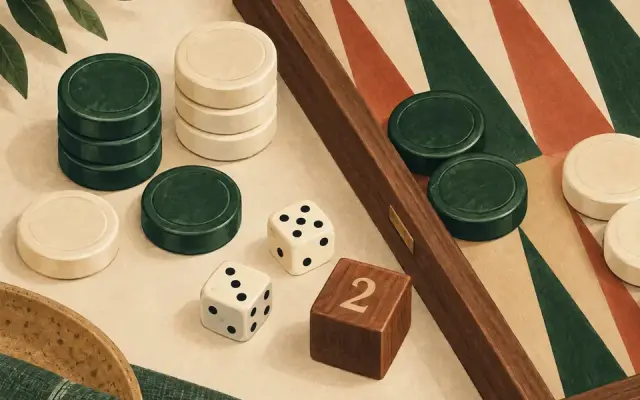
Backgammon
Backgammon rules for beginners: board setup, dice moves, hitting and the bar, bearing off to win — with the 15 opening moves and key terms.

CATAN
Learn CATAN’s 2025 base-game rules for 3–4 players: setup, resource production, trading, building costs, the robber and how to reach 10 victory points.
Also known as Settlers of Catan
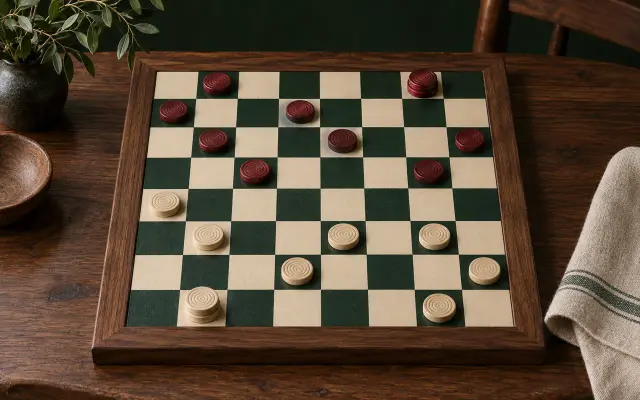
Checkers
American Checkers rules on an 8×8 board: setup, forward moves, compulsory captures, multiple jumps, crowning, when pieces can move backward and how to win.
Also known as English draughts, Draughts