
Rummikub initial meld, jokers and scoring: worked examples
Worked Rummikub Classic examples: opening for 30, splitting runs, retrieving and reusing jokers, leftover penalties and blocked-game scoring.
On this page
These examples follow the 2019 English 2600 Classic sheet linked on our Rummikub rules page. Earlier joker rules and Twist’s special jokers are separate rulesets.
Count an initial meld
| Tiles from your rack | Total | Opening result |
|---|---|---|
| Black 9–10–11 | 9 + 10 + 11 = 30 | Enough |
| Blue 6–7–8 | 6 + 7 + 8 = 21 | Not enough alone |
| Blue 6–7–8 plus three 3s in different colours | 21 + 9 = 30 | Enough |
| Red 10–joker–12, joker represents red 11 | 10 + 11 + 12 = 33 | Enough |
All these tiles must come from your rack, and each set must be complete. A joker’s opening value is the number it represents, not its leftover penalty. Access to the table begins on a later turn.
Split a run without stranding tiles
Suppose the table has black 3–4–5–6–7, and you hold another black 5. After opening previously, you may split it into 3–4–5 and 5–6–7, supplying your extra 5. Both runs contain three tiles.
Without that extra tile, separating 3–4–5 from 6–7 fails: the second piece has only two tiles. The important check is the finished table, not whether the first new run looks right.
Retrieve and replay a joker
You have already opened. The table contains red 6–joker–8; your rack has red 7, blue 11 and black 11.
Replace the joker with red 7, leaving red 6–7–8. Play the freed joker as orange 11 with your blue and black 11s. The new three-colour group is valid, the original run remains valid, and you have played rack tiles.
You cannot put the freed joker on your rack. Replacement tiles may also come from a legal table rearrangement. In a group containing blue 9, red 9 and a joker, either black 9 or orange 9 can replace it.
Score an ordinary finish
When someone empties their rack, opponents receive negative totals for their leftover tiles; the winner receives their combined penalties. A leftover joker contributes 30.
| Player | Rack remaining | Score |
|---|---|---|
| Winner | Empty | +52 |
| Player B | 4, 9 | −13 |
| Player C | 2, 7, joker | −39 |
Check: 52 − 13 − 39 = 0. Points are not awarded each time you lay a set.
Score a blocked finish
An empty pool alone does not end play. If nobody can play further, compare rack totals. With totals of 5, 12 and 19, the lowest rack wins. Differences from 5 are 7 and 14: scores are +21, −7 and −14.
The sheet does not specify a tiebreak for equal lowest racks in a blocked game. Agree that edge case before a match rather than borrowing a rule from another edition.
Record game wins as well as points. Across the agreed schedule, most game wins decides the overall winner; cumulative points break a tie in game wins.
Continue learning
Similar games
Backgammon
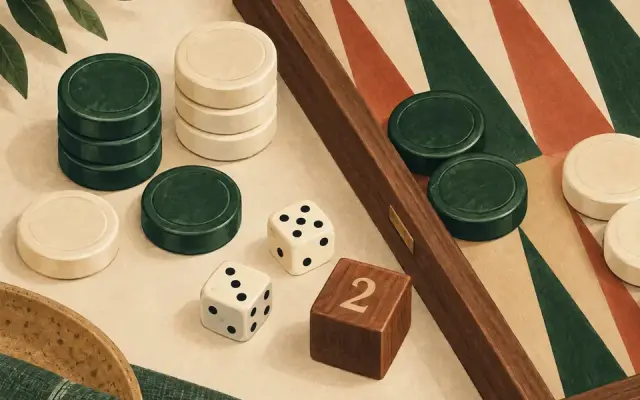
Backgammon rules for beginners: board setup, dice moves, hitting and the bar, bearing off to win — with the 15 opening moves and key terms.

CATAN
Learn CATAN’s 2025 base-game rules for 3–4 players: setup, resource production, trading, building costs, the robber and how to reach 10 victory points.
Also known as Settlers of Catan
Checkers
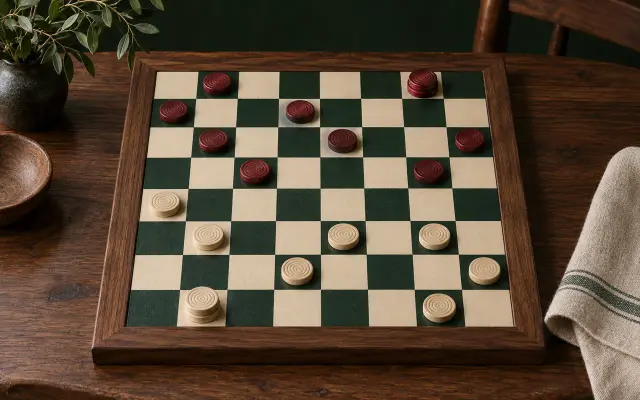
American Checkers rules on an 8×8 board: setup, forward moves, compulsory captures, multiple jumps, crowning, when pieces can move backward and how to win.
Also known as English draughts, Draughts