
Rummikub Classic, official English 2600 rules (2019)
How to play Rummikub
Independent rules summary
Rummikub Classic rules: groups, runs, the 30-point initial meld, rearranging tiles, retrieving jokers, turn limits and scoring, with examples.
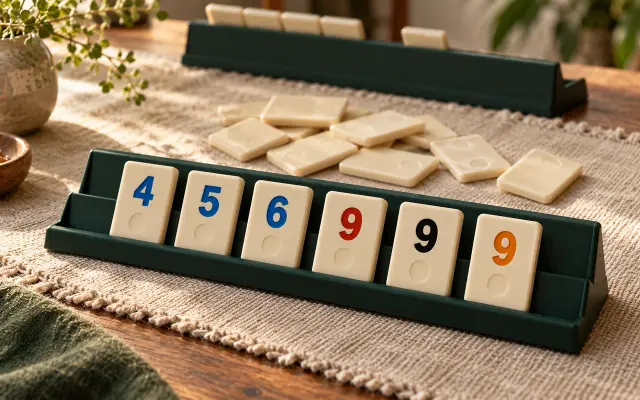
On this page
Quick reference
At the table
Ruleset: Rummikub Classic, official English 2600 rules (2019)
- Goal
- Play every tile from your rack before your opponents.
- Setup
- Use 106 tiles, including two jokers; draw 14 each and leave the rest as the pool.
- Turn
- Open for 30 points from your own tiles. On later turns add or rearrange; otherwise draw one and end.
- Scoring
- Leftover numbers count their face value; a leftover joker counts 30 penalty points.
- End of game
- Call Rummikub when your rack is empty. If the pool is empty, continue until no plays remain.
Objective
Empty your rack by playing numbered tiles in valid sets. This page follows the official English 2600 Classic rules linked by Rummikub, with two ordinary jokers. It does not use the extra jokers in Rummikub Twist or the larger XP set.
Setup
Use 106 tiles: two copies of 1–13 in each of four colours and two jokers. Mix them face down. Each player picks a tile to determine who starts; the highest number goes first. Return those tiles and mix again. Take 14 tiles each and keep them hidden on racks. The rest form the pool. Play proceeds clockwise.
Agree the number of games before starting. The official schedule uses as many games per round as there are players, but permits an agreed schedule.
Turns
A set must be one of these:
- Group: three or four tiles of the same number, all in different colours.
- Run: at least three consecutive numbers, all in one colour.
A 1 is low only. A run cannot wrap from 13 to 1. Two copies of the same colour and number cannot share a group.
The 30-point initial meld
Your first play must contain one or more complete sets totalling at least 30 points, entirely from your rack. Each numbered tile contributes its face value; a joker contributes the value it represents. You cannot borrow from or rearrange the table to reach 30.
Once you have opened, you may use the table on subsequent turns. If you cannot or choose not to play, draw one tile and end your turn. You cannot play the tile you just drew until your next turn.
Adding and rearranging
After your initial meld, you may lay new sets, extend existing ones, split runs or move tiles between sets. Every successful turn must play at least one tile from your rack. When you finish, every tile on the table must belong to a complete valid set. You cannot return table tiles to your rack or leave an isolated tile.
Plan the result before moving pieces. A run may be split only when both resulting runs contain at least three tiles. Taking the fourth tile from a group is legal if the remaining three still form a group and the removed tile joins another valid set.
Jokers
A joker represents whichever number and colour its set needs. You may use one in your initial meld. You cannot retrieve a table joker before you have opened.
On a subsequent turn, free a joker by replacing it or rearranging its set while leaving legal sets. Replacement tiles may come from your rack or the table. In a three-tile group, either missing colour can replace the joker.
Play the retrieved joker in a new set during the same turn, and play at least one tile from your rack that turn. Do not keep it for later. These rules permit rearranging joker-containing sets; older instruction sheets may be more restrictive.
Turn limit and incomplete moves
The official limit is one minute per turn. If time expires without a play, draw one and finish. If you have begun rearranging but cannot complete a valid layout in time, restore the original table, take back your own played tiles and draw three penalty tiles; your turn ends.
Worked examples
Opening: a red 8–9–10 run scores 27, so it does not open by itself. Three 2s in different colours add 6. Playing both sets from your rack gives 33 and opens legally.
Rearranging: the table has blue 4–5–6–7–8. You hold another blue 6. After opening on an earlier turn, you can make blue 4–5–6 and blue 6–7–8, using both copies of the 6. Both runs remain legal, and you have played one rack tile.
Winning
When your rack is empty, call “Rummikub” and end the game. Each opponent records the negative total of their remaining tiles, with a joker worth 30. You record the positive sum of their penalties.
For example, opponents retain tiles worth 9, 17 and 34. Their scores are −9, −17 and −34; the winner scores +60.
If the pool empties, continue while legal plays remain. If everyone is blocked, the lowest rack total wins that game. Subtract that lowest total from each opponent’s total: those differences are their penalties, and their sum is the winner’s positive score. For racks of 6, 10 and 15, the opponents receive −4 and −9, and the winner receives +13.
The linked sheet does not specify what happens when the lowest rack totals tie in a blocked game. Agree that edge case before starting.
Across the agreed schedule, the player with the most game wins wins overall. Break a tie using the higher cumulative score.
Common mistakes
- Treating 30 as a single-set requirement: several complete sets can add up to it.
- Using table tiles to make the initial 30.
- Playing a newly drawn tile immediately.
- Wrapping a run from 13 to 1 or repeating a colour in a group.
- Leaving a two-tile set after rearranging.
- Taking a joker into your rack instead of replaying it that turn.
Variants
Older Classic sheets differ on how a joker can be freed and reused. Check the sheet supplied with your set and agree which edition applies. Longer turns or removing the opening threshold are house rules. Twist and XP need their own instructions.
Common questions
Can you use a joker for the first 30 points in Rummikub?
Yes. In the 2600 Classic rules, a joker counts as the number it represents in your initial meld. All opening sets must come entirely from your rack and total at least 30.
Can you play the tile you just drew in Rummikub?
No. Drawing one tile ends your turn. Keep it on your rack until a later turn.
Can a Rummikub run go from 13 to 1?
No. A 1 is low only, so a run cannot wrap from 13 back to 1. Every run needs at least three consecutive numbers of the same colour.
Learn this game
Similar games
Backgammon
Backgammon rules for beginners: board setup, dice moves, hitting and the bar, bearing off to win — with the 15 opening moves and key terms.

CATAN
Learn CATAN’s 2025 base-game rules for 3–4 players: setup, resource production, trading, building costs, the robber and how to reach 10 victory points.
Also known as Settlers of Catan
Checkers
American Checkers rules on an 8×8 board: setup, forward moves, compulsory captures, multiple jumps, crowning, when pieces can move backward and how to win.
Also known as English draughts, Draughts