
Rummikub common mistakes: opening melds and jokers
Avoid Rummikub Classic mistakes with opening points, duplicate colours, table manipulation, joker reuse, drawn tiles and unfinished turns.
On this page
This checklist uses the 2019 English 2600 Classic rules on our Rummikub rules page. Check the instruction sheet before bringing a remembered joker restriction into this edition.
Counting points without checking sets
A collection of high tiles is not automatically an opening meld. Every tile must belong to a valid group or run. Lay out the complete sets on your rack first, then total their numbers.
For example, red 12, blue 12 and black 7 total 31 but form no set. Three 12s in different colours would work. Several separate complete sets may jointly reach the threshold.
Borrowing a table tile to open
Your first meld comes entirely from your rack. A table tile that completes your run is an option for later turns, not a shortcut into the game. Keep the opening play separate from subsequent table moves.
Treating repeated colours as a group
Two red 8s and a blue 8 do not form a group: the repeated colour is the problem. They may be useful in separate runs or separate groups. Similarly, red 12–13–1 is not a run, because numbers do not wrap around.
Solving one set while breaking another
Taking an attractive tile from the table can leave a two-tile fragment behind. Count the sets you leave, not just the one you make. Before touching tiles, describe the final destination of every tile you intend to move.
Treating a joker as a prize to keep
A retrieved joker is part of that turn’s plan. Identify its new set before freeing it, and ensure the turn uses a rack tile. The joker walkthrough shows a complete move instead of only the replacement step.
Do not give a joker an opening value of 30. That is its penalty if still on your rack at the finish, not the number it stands for in a set.
Drawing and then playing the new tile
Drawing ends the turn. Put the tile on your rack, inspect it privately and wait until your next turn to use it. A promising draw does not reopen the move you declined or could not make.
Starting a rearrangement without a recovery plan
The official turn limit is one minute. Running out of time during an incomplete manipulation requires restoring the table, reclaiming your played tiles and drawing three penalty tiles. Simply failing to play within the limit requires drawing one.
Remember the original layout before starting, and prefer a smaller move you can finish over a large move you cannot yet explain.
Ending as soon as the pool empties
An empty pool changes the available choices, but players may still have legal plays. Continue until someone goes out or nobody can play. Only the latter uses blocked-game scoring.
Continue learning
Similar games
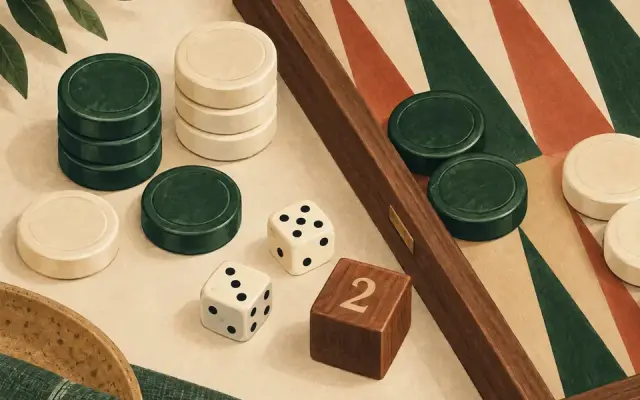
Backgammon
Backgammon rules for beginners: board setup, dice moves, hitting and the bar, bearing off to win — with the 15 opening moves and key terms.

CATAN
Learn CATAN’s 2025 base-game rules for 3–4 players: setup, resource production, trading, building costs, the robber and how to reach 10 victory points.
Also known as Settlers of Catan
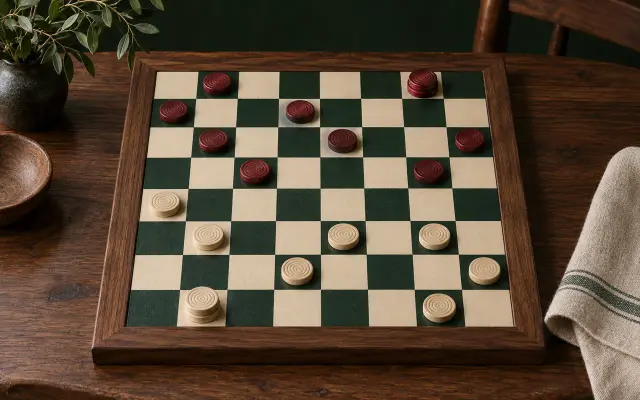
Checkers
American Checkers rules on an 8×8 board: setup, forward moves, compulsory captures, multiple jumps, crowning, when pieces can move backward and how to win.
Also known as English draughts, Draughts