
Rummikub beginner strategy: rack planning and manipulation
Beginner Rummikub strategy: organise your rack, compare opening melds, find simple table moves and manage the risk of holding a joker.
On this page
This guide uses the 2019 English 2600 Classic edition on our Rummikub rules page. Its rulebook suggests retaining useful tiles early, but every delayed play has a cost. The decision routine below is our practical interpretation of those trade-offs.
Read your rack two ways
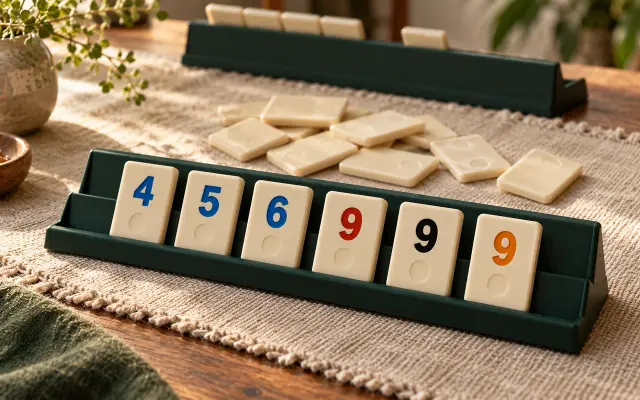
First sort by colour to find consecutive numbers. Then look across colours for repeated numbers. A tile that could serve either a group or a run gives you a choice; do not count it in both plans unless you hold a second copy.
For example, a red 8 may complete red 6–7–8 or join blue 8 and black 8. Compare the rack left behind after each option, rather than deciding from the first set you notice.
Plan the opening and its leftovers
Mark the complete sets that reach your opening threshold. Then inspect what remains: have you stranded several isolated tiles, or kept useful pairs? An opening that removes more tiles may be worth choosing even if its face-value total is lower.
Delaying can preserve options while the table develops, but it also postpones access to table manipulation. Treat holding back as a choice with a reason, not a permanent rule.
Scan for the simplest move first
Once you have opened, use this order:
- Complete a set from your rack.
- Extend a table run or add a missing colour to a group.
- Look for a spare fourth tile in a group or a run you can split.
- Consider a larger rearrangement only after you can describe its final sets.
This routine reduces the chance of spending the whole turn on an elaborate move while overlooking a small useful one.
Compare keeping a tile with playing it
Suppose your rack contains a complete four-tile group. Playing all four reduces your rack immediately; playing three preserves a possible addition next turn. The retained tile might also be useful elsewhere, but somebody may change the table before your turn returns.
Use jokers with an exit plan
A joker can solve several possible rack problems, so holding it briefly can preserve flexibility. It also carries a large leftover penalty. As an opponent approaches an empty rack, prefer a legal use now over waiting indefinitely for a perfect finish.
Before retrieving a table joker, identify its new set and the rack tile you will play. Use the initial meld and joker walkthrough to check the procedure.
Finish with a table check
Before moving tiles, name every set in the proposed final layout. After moving, count them again. A modest completed move is better than an unfinished plan that forces you to restore the table and take a penalty.
Continue learning
Similar games
Backgammon
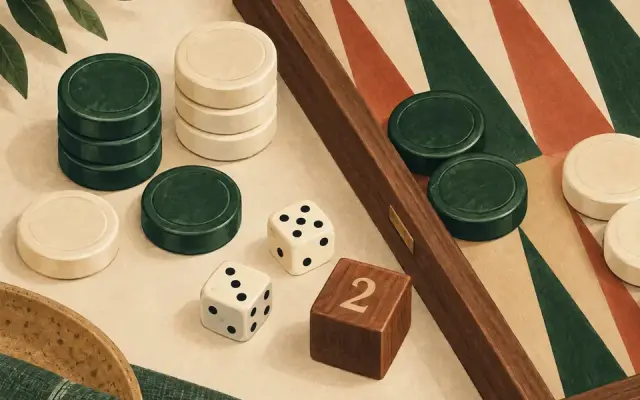
Backgammon rules for beginners: board setup, dice moves, hitting and the bar, bearing off to win — with the 15 opening moves and key terms.

CATAN
Learn CATAN’s 2025 base-game rules for 3–4 players: setup, resource production, trading, building costs, the robber and how to reach 10 victory points.
Also known as Settlers of Catan
Checkers
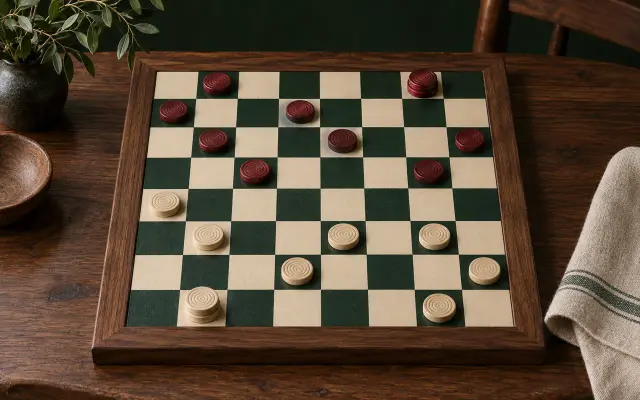
American Checkers rules on an 8×8 board: setup, forward moves, compulsory captures, multiple jumps, crowning, when pieces can move backward and how to win.
Also known as English draughts, Draughts