
Go scoring: how to count a finished game
How to count territory, prisoners, pass stones and komi at the end of a Go game, with a worked 9×9 example.
On this page
This guide explains how to count the end of a game under the rules on our Go rules page: territory scoring with pass stones and 7.5 komi for White.
Step 1: Finish the game
The game pauses after two consecutive passes. Players then agree which groups are dead. Dead stones are removed and become prisoners of the player who would have captured them. If you disagree, resume play; capturing the disputed stones settles their status. If the first two moves after resumption are also passes, end with all stones still on the board.
White must make the final move. If Black passed last, White passes once more and gives a pass stone.
Step 2: Count each side
A player’s score is:
- the empty points surrounded only by their live stones (territory), plus
- all their prisoners, including dead stones removed at the end and any pass stones they received.
Neutral points (dame) touch both players’ live stones and count for neither. In this version, empty points in a seki that are surrounded only by one player’s stones count for them.
Step 3: Add komi
White adds 7.5 points. The half point means there are no draws. The higher total wins.
Worked example
On a 9×9 board, the game ends and the dead stones are removed.
| Territory | Prisoners | Komi | Total | |
|---|---|---|---|---|
| Black | 20 | 4 | 0 | 24 |
| White | 17 | 3 | 7.5 | 27.5 |
White wins by 3.5 points.
Why pass stones matter
Passing gives your opponent a prisoner, so a pass is not free. Under this BGA ruleset, territory and area counting give the same game result: a stone played inside your own territory costs you one point of territory either way, and a pass costs you one point through the pass stone.
Other counting systems
- Chinese scoring counts stones on the board plus surrounded empty points (area) and uses 7.5 komi.
- Japanese scoring counts territory plus captures with 6.5 komi. Seki points are not counted.
- Korean scoring counts like Japanese scoring.
The systems usually agree on the winner and differ in edge cases. Say which one you use before you start.
Handicap games
Under the cited BGA rules, White receives 0.5 komi in a handicap game. Black has the handicap stones, White plays first, and the count is otherwise the same.
Common counting mistakes
- Counting dame. Neutral points score for neither side.
- Forgetting komi. White must add 7.5.
- Missing prisoners from dead stones. Remove dead stones and add them to the capturer’s prisoners.
- Forgetting pass stones. Each pass gives the opponent one prisoner.
- Counting unsettled areas. Territory must be fully surrounded by live stones.
Continue learning
Similar games
Backgammon
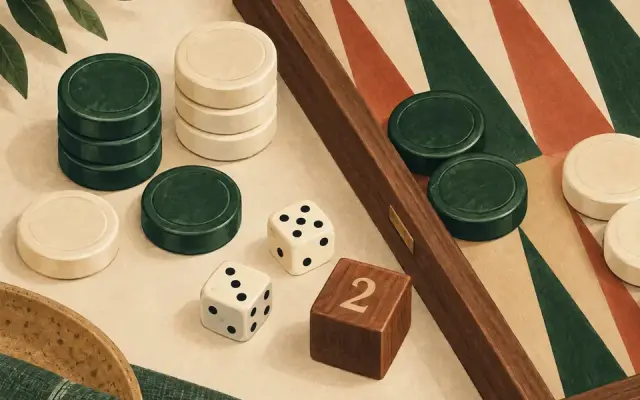
Backgammon rules for beginners: board setup, dice moves, hitting and the bar, bearing off to win — with the 15 opening moves and key terms.
Checkers
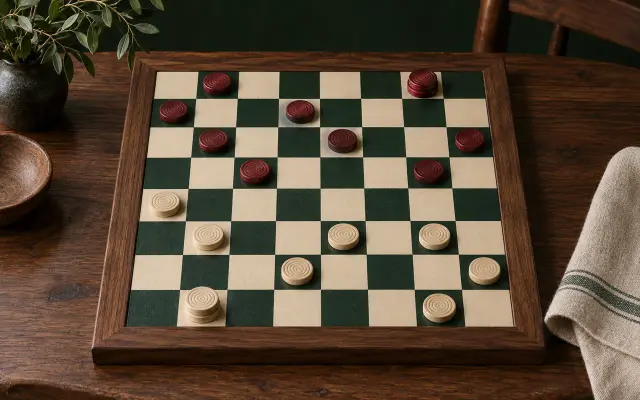
American Checkers rules on an 8×8 board: setup, forward moves, compulsory captures, multiple jumps, crowning, when pieces can move backward and how to win.
Also known as English draughts, Draughts

Chess
Beginner chess rules: how to set up the board, how each piece moves, castling, en passant, promotion, checkmate and draws — one clear beginner page.