
Territory scoring with pass stones and 7.5 komi; other rule sets are variants
How to play Go
Go rules for your first 9x9 game: stones on the board's intersections, liberties and capture, two passes to end, then scoring territory, prisoners and komi.
Also known as Baduk, Weiqi
On this page
Quick reference
At the table
Ruleset: Territory scoring with pass stones and 7.5 komi; other rule sets are variants
- Goal
- Control more of the board than your opponent by surrounding territory and capturing stones.
- Setup
- Start with an empty 9x9 board. Black plays first; White receives 7.5 komi at the end.
- Turn
- Place a stone on an empty point, or pass and give your opponent a pass stone. Capture strings with no liberties, and never make a self-capturing move.
- Scoring
- Count surrounded empty points plus prisoners, including pass stones. Neutral points count for no one. White adds 7.5.
- End of game
- Two consecutive passes end play. Remove agreed dead stones, then the higher score wins.
Objective
Surround territory and capture stones. This version uses territory scoring with pass stones and a 7.5-point komi for White. Chinese, Japanese and Korean rules are variants, as is handicap play — both covered below.
Setup
Start on an empty 9x9 board. Black plays first. White receives 7.5 komi: points added to White’s score at the end to offset Black’s first-move advantage. Komi values vary between rule sets and events. A standard tournament board is 19x19; 13x13 is a common middle size.
Turns
Place a stone on an empty intersection or pass, giving an unused stone to your opponent as a prisoner. Stones never move. Orthogonally connected stones form strings; adjacent empty intersections are liberties.
Capture opposing strings with no liberties: remove them and keep them as prisoners. Your own string must have a liberty after captures; self-capture is forbidden.
A string reduced to a single liberty is in atari — one move from capture. A lone stone in the middle of an empty board has four liberties; fill three of them and it is in atari. Its owner must extend to a new liberty, connect to a friendly string, or capture a neighbouring string. If none of those works, you capture it with your next play. Check your own strings for atari before your opponent checks theirs.
A board play cannot recreate a position previously created by a play of the same player (situational superko). The everyday case is the ko: a shape where each side can capture a single opposing stone in the same point. Black takes the white stone; White’s immediate recapture would recreate the whole-board position from before Black’s capture, so superko bars it. White plays elsewhere first — a ko threat. If Black answers the threat, the board has changed and White may retake; if Black ignores it, White retakes and the threat stone stays as a gain. Passing is allowed.
Winning
After two consecutive passes, agree dead strings and remove them as prisoners. If disputed, resume play, with the opponent of the last player to pass moving first; capture the disputed stones to establish their status. If both refuse to resume by passing again, making four consecutive passes, retain all disputed stones.
White must make the final move; if Black passed last, White passes once more and gives a pass stone. Count your surrounded empty intersections plus all prisoners, including pass stones. Shared neutral intersections — dame — count for neither player. Under these rules, exclusively surrounded empty points in seki count. White adds 7.5. Higher score wins.
Life and death
A group lives by holding two separate eyes: empty intersections fully surrounded by your own stones. One eye is not enough. An attacker fills your outside liberties, then plays in the eye itself and captures the group.
Two separate eyes cannot be filled in turn. To capture, the attacker must fill both eye points — but playing inside one eye leaves that attacking stone with no liberties while the group still breathes through the other eye. That is self-capture, and it is forbidden. Neither eye can ever be filled, so the group can never lose its last liberty. This is why two-eyed groups are alive and one-eyed groups are dead.
Not every eye-shaped space is a genuine eye: an eye point is false when enough of its diagonal points are held by enemy stones you cannot capture — one such stone for a point on the edge or in a corner, two for a point in the centre. A group relying on a false eye is not alive.
Handicap
In a handicap game the stronger player takes White. Black places 2 to 5 handicap stones on a 9x9 board before White’s first move; White then plays first and receives 0.5 komi under these BGA rules. Handicap stones go on the star points: two on opposite corners, three add a third corner, four take all four corners, and five add the centre point. Larger boards extend the scheme to nine star points. Handicap play is a variant; the games described above are even games.
Variants
Chinese scoring counts area — your stones plus your surrounded empty points — with 7.5 komi. Japanese scoring counts territory, surrounded empty points plus captures, with 6.5 komi; Korean rules count the same way. The systems usually agree on the winner and differ in edge cases such as seki and pass stones. This version uses territory counting with pass stones and 7.5 komi; treat every other combination as a variant to agree on before playing. Board size changes nothing in the rules: 13x13 and 19x19 play exactly like the 9x9 game.
Key terms
- Atari — a string with one liberty left; one move from capture.
- Ko — a capture-and-recapture shape in a single point; superko bars the immediate retake.
- Komi — points added to White’s score to offset Black’s first move; 7.5 in this version.
- Dame — neutral points bordered by both players’ live groups; they score for neither.
- Seki — a standoff where two groups share the liberties that keep them alive; neither can capture without self-capture.
- Sente — a forcing move the opponent must answer; you keep the initiative.
- Gote — a move that needs no answer; playing it hands the choice of the next move to your opponent.
Beginner tips
Connected stones share liberties. Before expanding, check whether your existing strings can survive. Two separate, genuine eyes keep a string safe — see Life and death above.
Common questions
What is atari in Go?
A string with exactly one liberty left. It can be captured with the next play unless its owner extends to a new liberty, connects to a friendly string, or captures a neighbouring string first. Atari is the game’s basic warning sign: check your own strings for it before your opponent does.
What happens in a ko?
Black captures a single white stone that could recapture in the same point. The immediate recapture would recreate the whole-board position from before Black’s play, and situational superko forbids that. White must play elsewhere first — a ko threat. If Black answers the threat, the board has changed and White may retake; if Black ignores it, White retakes and the ignored threat stays on the board as a gain.
Why does White get 7.5 points?
Black’s first move is a real advantage, so White is compensated with komi added at the end of the game. This version uses 7.5; other rule sets set it between 5.5 and 7.5, and handicap games use 0.5 komi under BGA rules. The half point prevents draws.
What is the difference between Chinese and Japanese scoring?
Chinese scoring counts area — stones plus surrounded empty points. Japanese scoring counts territory — surrounded empty points plus prisoners, like this version. Winners usually agree either way; the counts diverge in edge cases such as seki and pass stones.
Learn this game
Similar games
Backgammon
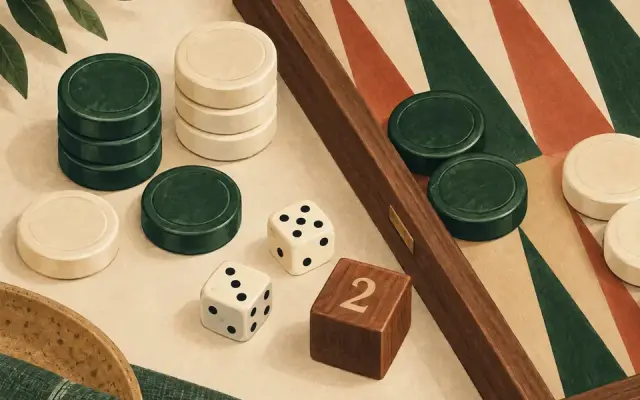
Backgammon rules for beginners: board setup, dice moves, hitting and the bar, bearing off to win — with the 15 opening moves and key terms.
Checkers
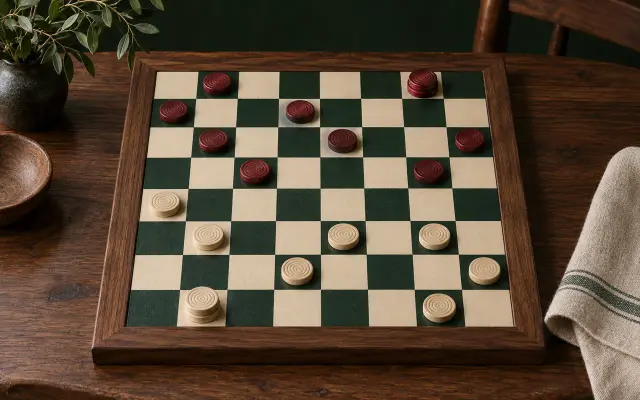
American Checkers rules on an 8×8 board: setup, forward moves, compulsory captures, multiple jumps, crowning, when pieces can move backward and how to win.
Also known as English draughts, Draughts

Chess
Beginner chess rules: how to set up the board, how each piece moves, castling, en passant, promotion, checkmate and draws — one clear beginner page.