
Go beginner strategy for 9×9 games
First principles for Go: liberties, connection, eyes, territory and playing sensibly on a small board.
On this page
Go rewards patient shape and good judgement about which stones are safe. This guide follows the territory-scoring game on our Go rules page, using a 9×9 board.
Count liberties
Most tactics come down to liberties. A string with one liberty is in atari. Before every move, check whether your strings are safe and whether any of your opponent’s strings are close to capture.
Stay connected
Two stones that are connected share liberties and are harder to capture. If your opponent can cut between two stones, ask which one you would save. Try to leave shapes with a solid connection instead of a gap.
Build eyes
A group with two separate, genuine eyes is alive. A single eye does not guarantee life; groups in mutual life (seki) can survive without two eyes. On a small board you win or lose a lot on life and death, so:
- Make room for two eyes before you play elsewhere.
- Do not fill your own eye. A single-point eye is one of your two lives.
- Attack a group by reducing its space and eye room.
Territory and the board
On a 9×9 board, the centre and the points near the corners matter. Playing right at the edge gives little territory. Play moves that both take space and are hard to attack.
Do not overplay
Answering every move can be slow, but ignoring a real threat can lose a large group. A forcing move is sente. Use forcing moves to gain something, not automatically.
Komi and counting
White receives 7.5 komi in this version. Count before the end, not only your own area but the komi. A game that feels close on the board may already be decided.
Learn from your games
Play many 9×9 games. Review where a group died and why. After you are comfortable on 9×9, move to 13×13 and then 19×19. The rules stay the same.
Continue learning
Similar games
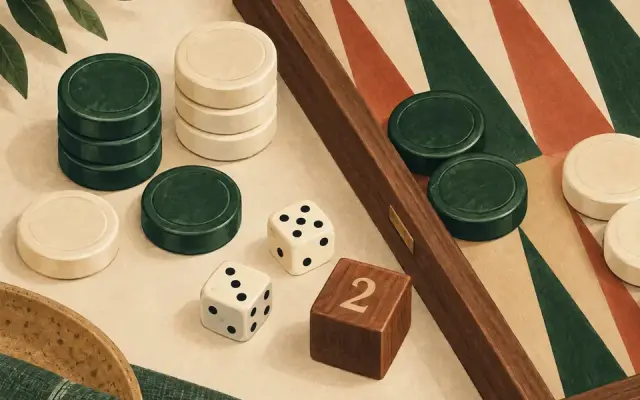
Backgammon
Backgammon rules for beginners: board setup, dice moves, hitting and the bar, bearing off to win — with the 15 opening moves and key terms.
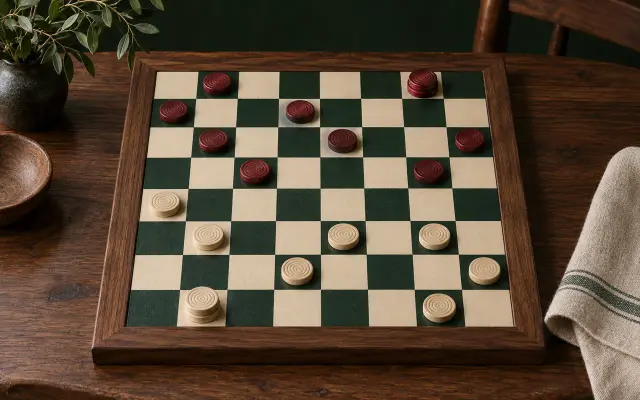
Checkers
American Checkers rules on an 8×8 board: setup, forward moves, compulsory captures, multiple jumps, crowning, when pieces can move backward and how to win.
Also known as English draughts, Draughts

Chess
Beginner chess rules: how to set up the board, how each piece moves, castling, en passant, promotion, checkmate and draws — one clear beginner page.