
Draw Dominoes scoring: dominoes, blocks and pips
How to count pips in Draw Dominoes: going out, blocked hands, ties and reaching 100 points.
On this page
This guide follows the scoring on our Draw Dominoes rules page: two-player play to 100 points with a double-six set.
Counting pips
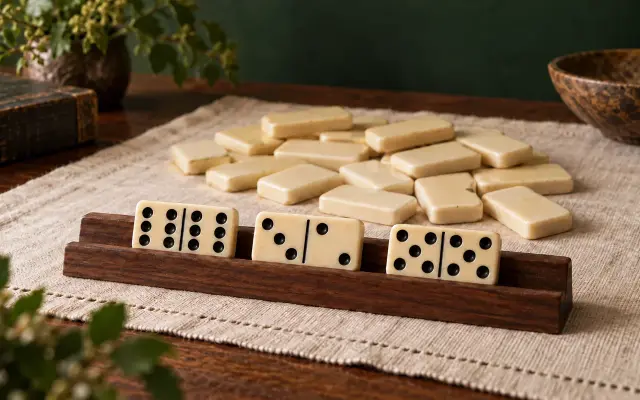
Count both halves of each tile. A 6–4 tile is 10 pips. A blank counts 0, so 0–0 is 0 and the 6–6 double is 12. A full double-six set contains 168 pips.
Two ways a hand ends
Domino. A player plays their last tile. That player scores all the pips left in the opponent’s hand.
Blocked hand. Only two tiles remain in the boneyard and neither player can play. The player with fewer pips scores the difference between the two totals.
Worked examples
Domino. Anna plays her last tile. Ben holds 6–3, 2–0 and 5–5 (21 pips). Anna scores 21 points.
Blocked hand. Anna finishes with 6 pips and Ben with 18. Anna scores 18 − 6 = 12 points.
Tie in a block. If both players hold the same total, the difference is zero and nobody scores.
Winning the match
Turn all tiles face down, shuffle and draw new hands after each hand. The first player to reach 100 or more after a completed hand wins.
Variants
Foster’s Complete Hoyle gives 50 or 100 points as the target for the Block Game, of which the Draw Game is a variation; this page uses 100. Agree the target before the first hand.
Block Dominoes, where you never draw, is a different game.
Continue learning
Similar games
Backgammon
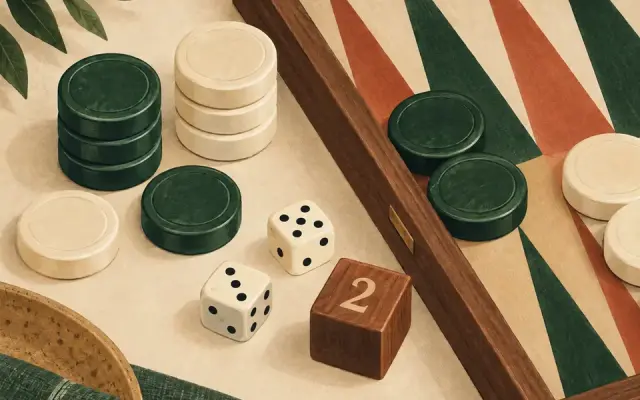
Backgammon rules for beginners: board setup, dice moves, hitting and the bar, bearing off to win — with the 15 opening moves and key terms.
Checkers
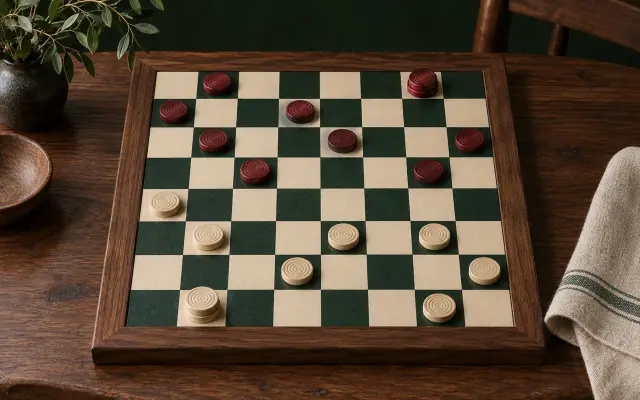
American Checkers rules on an 8×8 board: setup, forward moves, compulsory captures, multiple jumps, crowning, when pieces can move backward and how to win.
Also known as English draughts, Draughts
Cribbage
Two-player Cribbage rules with three- and four-player variants: the deal, the crib, the go, and scoring fifteens, pairs, runs and the 29 hand.
Also known as Crib