
Draw Dominoes strategy for beginners
Practical Draw Dominoes strategy: opening, doubles, tracking numbers, controlling the ends and managing the boneyard.
On this page
This guide is for two-player Draw Dominoes with a double-six set, as described on our Draw Dominoes rules page: single line, no spinners, optional drawing before you play, and the last two tiles always left in the boneyard.
Count the numbers
Each number from 0 to 6 appears on exactly seven tiles in a double-six set. Keep a count of how many of each number are on the table and in your hand. If most 4s are gone, an opponent who cannot play a 4 will have to draw, and a line ending in 4 will be hard to continue.
Play doubles early
A double can only be played when its number is open at an end. It is harder to place than other tiles and cannot be used to bridge two numbers. Play doubles when you can, so they don’t get stuck in your hand.
Get rid of heavy tiles
If your opponent goes out, every pip in your hand scores for them; in a block, your pips reduce or reverse your margin. Prefer to play heavy tiles (such as 6-5 or 6-6) when you have a choice, and keep light tiles for later.
Keep your hand flexible
Aim for a hand with several different numbers so you can answer almost any open end. A hand with many tiles of the same number can be blocked easily.
Control the ends
You can often choose between two open ends. Choose the end that leaves a number you hold plenty of, and try to leave an end of a number you know is scarce, forcing an opponent to draw.
Drawing
When blocked, you must keep drawing until you find a playable tile or only two tiles remain, and you keep everything you draw. You may also draw before playing when you could already play. Extra tiles give you more options to answer the ends, but they add pips you may be caught holding, so draw voluntarily only when the extra choice is worth that risk.
Watching for blocks
Once the boneyard is down to two tiles, the hand can end in a block. Count pips before each play. If you hold fewer pips than your opponent probably does, encourage a block by closing the line. If not, try to keep the line open and go out.
Plan for the match
The first to 100 after a completed hand wins. If you are far behind, play for going out. If you are near the target, take the safest score.
Continue learning
Similar games
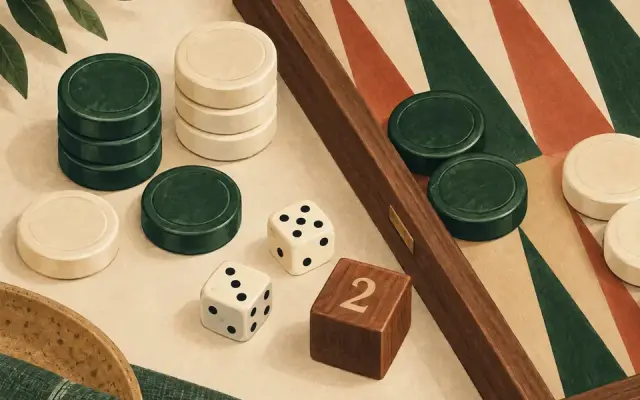
Backgammon
Backgammon rules for beginners: board setup, dice moves, hitting and the bar, bearing off to win — with the 15 opening moves and key terms.
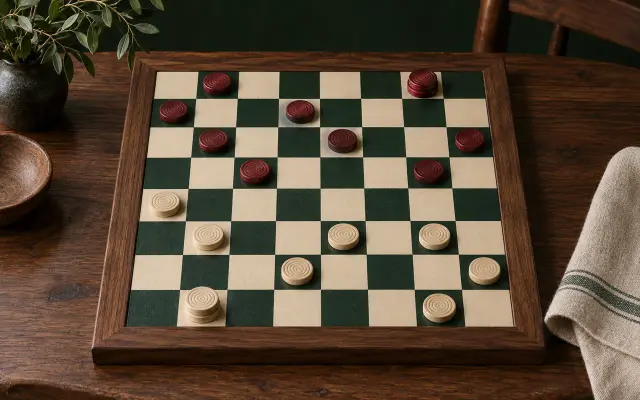
Checkers
American Checkers rules on an 8×8 board: setup, forward moves, compulsory captures, multiple jumps, crowning, when pieces can move backward and how to win.
Also known as English draughts, Draughts
Cribbage
Two-player Cribbage rules with three- and four-player variants: the deal, the crib, the go, and scoring fifteens, pairs, runs and the 29 hand.
Also known as Crib