
Common Draw Dominoes mistakes
Frequent Draw Dominoes errors: matching ends, doubles, drawing, blocked hands and pip counting.
On this page
This guide lists the common errors in two-player Draw Dominoes with a double-six set, as on our Draw Dominoes rules page. For strategy see the strategy guide and for pip counts the scoring guide.
Playing mistakes
- Matching totals instead of ends. Only the touching halves need the same number of pips.
- Matching a blank with a number. A blank only matches a blank.
- Playing on the side of a double. A double is placed crosswise, but the line has just two ends. There are no branches here.
- Thinking you may not draw while you can play. In this ruleset you may draw before playing, even when you hold a legal tile.
- Drawing only one tile. If you can’t play, draw until you find a playable tile or only two tiles remain.
- Drawing the last two tiles. They always stay in the boneyard.
- Putting back an unplayable draw. Every drawn tile stays in your hand.
Opening mistakes
- Giving the set to the wrong player. The player with the higher double sets first; if neither has a double, the player with the heavier tile does. The setter may then lead any tile.
- Drawing the wrong hand size. Each player draws 7 tiles.
Ending and scoring mistakes
- Calling a block too early. The boneyard must be down to two tiles and neither player able to play.
- Forgetting the blocked-hand formula. The lower pip total wins and scores the difference between the two totals.
- Scoring the winner’s own pips. When someone goes out, they score all pips left in the opponent’s hand.
- Counting only one half of a tile. Count both halves. A blank is zero.
- Awarding a tie. If a blocked hand leaves equal totals, the difference is zero and nobody scores.
- Stopping at 99. The match ends when a player reaches 100 or more after a completed hand.
Mixing games
- Playing Block Dominoes. In that game no one draws. It is a different variant.
- Using spinners. They are not part of this version.
Continue learning
Similar games
Backgammon
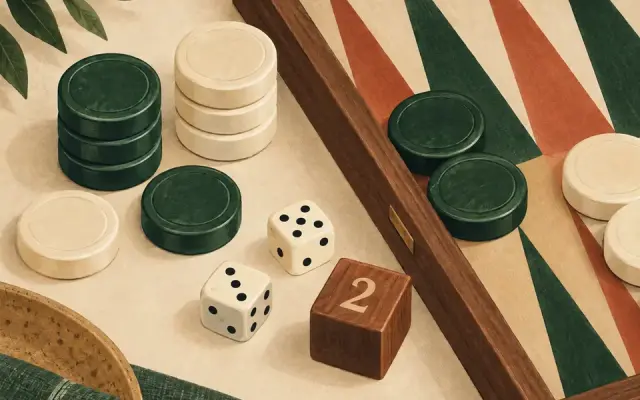
Backgammon rules for beginners: board setup, dice moves, hitting and the bar, bearing off to win — with the 15 opening moves and key terms.
Checkers
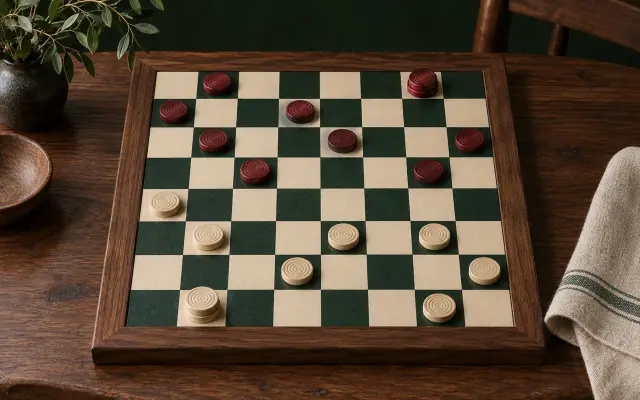
American Checkers rules on an 8×8 board: setup, forward moves, compulsory captures, multiple jumps, crowning, when pieces can move backward and how to win.
Also known as English draughts, Draughts
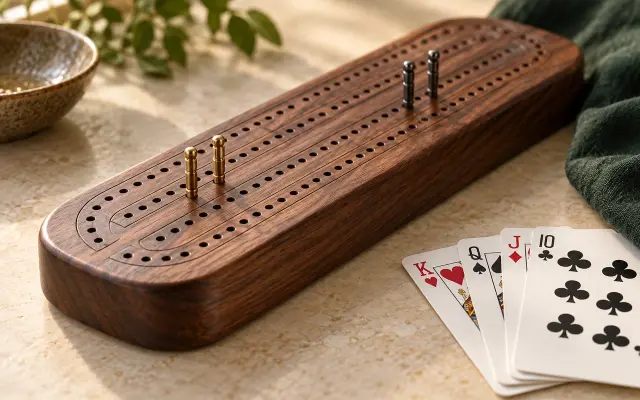
Cribbage
Two-player Cribbage rules with three- and four-player variants: the deal, the crib, the go, and scoring fifteens, pairs, runs and the 29 hand.
Also known as Crib