
Two-player double-six Draw Dominoes after Foster’s Complete Hoyle; matches to 100 points
How to play Draw Dominoes
Two-player Draw Dominoes rules with a double-six set: seven tiles each, the first set, matching ends, drawing from the boneyard, blocked hands and scoring to 100.
Also known as Draw game
On this page
Quick reference
At the table
Ruleset: Two-player double-six Draw Dominoes after Foster’s Complete Hoyle; matches to 100 points
- Goal
- Empty your hand first, or hold fewer pips when neither player can play.
- Setup
- Each player draws 7 tiles. The rest form the boneyard. The higher double, or else the heavier tile, sets first with any tile.
- Turn
- Add a tile to either end of the line, matching touching ends. You may draw before playing; if blocked you must draw until you can play or only two tiles remain.
- Scoring
- Going out scores all pips in the opponent’s hand. If both are blocked, the lower total scores the difference.
- End of game
- A hand ends on a domino or a block. First to 100 points after a completed hand wins.
Objective
Be first to empty your hand, or hold fewer pips than your opponent when neither of you can play. Win hands to score points, and be the first player to reach 100 points after a completed hand.
This page teaches the two-player Draw Game with a standard double-six set, following R. F. Foster’s Complete Hoyle. Players may draw from the boneyard before playing and must draw when blocked, but the last two tiles always stay in the boneyard. Block Dominoes, where players never draw, is a separate game.
Setup
Turn all 28 dominoes face down and shuffle them thoroughly. Each player draws 7 tiles. The undrawn tiles stay face down as the boneyard.
Keep your tiles hidden from your opponent, for example standing on edge facing you.
The player holding the higher double has the first play, called the set. If neither player holds a double, the player with the heavier tile, the one with more pips, sets first. The setter may lead any tile from their hand. This higher-double test is a convention Foster’s gives for other domino games; his Draw and Block sections only say the player whose turn it is to set may lay any tile. This page uses the test at the start of every hand.
Turns
Players alternate turns. Add one tile to either open end of the growing line so the touching ends show the same number. A blank matches only a blank.
Doubles are placed crosswise to make the line easy to read, but they have only two playable ends like any other tile. A double is not a spinner in this ruleset, so it never creates a third or fourth branch.
Drawing from the boneyard
You may draw any number of tiles from the boneyard before you play, even if you can already play. If you cannot play, you must draw until one of these happens:
- you draw a tile you can play, and play one tile; or
- only two tiles remain in the boneyard, in which case you say “go” and pass.
Never draw the last two tiles. Every drawn tile stays in your hand.
Worked example
The line’s open ends are 2 and 5. You hold 6–3, 4–4 and 1–0, so none can play. Draw from the boneyard. The first tile is 6–1, which also cannot play and stays in your hand. The next tile is 5–3, so place its 5 end against the open 5 and end your turn. The new open end is 3.
For a blocked-hand scoring example, suppose the hand blocks with you holding 6 pips and your opponent holding 18. You hold fewer, so you score the difference: 18 − 6 = 12 points.
Winning
A hand ends in either of two ways:
- Domino: a player plays their last tile. That player scores all pips remaining in the opponent’s hand.
- Block: only two tiles remain in the boneyard and neither player can play. Both players show their tiles. The player with fewer pips scores the difference between the two totals.
Count both halves of every remaining tile. A blank counts zero. If a blocked hand leaves equal totals, the difference is zero and nobody scores.
After scoring, turn all tiles face down, shuffle and draw new hands. The first player to reach 100 or more after a completed hand wins the match.
Common mistakes
- Matching tile totals instead of ends. Only the touching halves need the same pip count.
- Playing on the side of a double. A crosswise double remains part of one line and has only two ends.
- Drawing just one tile and passing. When blocked, keep drawing until you find a play or only two tiles remain.
- Drawing the last two tiles. They always stay in the boneyard.
- Discarding unplayable draws. Every drawn tile stays in your hand.
- Calling the hand blocked too early. A block needs the boneyard down to two tiles and neither player able to play.
- Scoring the winner’s own pips. A domino scores the opponent’s pips; a block scores only the difference.
Variants
Foster’s Complete Hoyle also describes the Block Game, in which nobody draws: a blocked player simply says “go”. The Draw Game is described there as a variation of the Block Game, which is played to 50 or 100 points; this page uses 100.
Three- and four-player draw games, partnership play, spinners and larger double-nine or double-twelve sets need different hand sizes and rules, and are not covered here.
Common questions
How many dominoes do you start with?
Each player draws seven tiles from the 28 in a double-six set. The other 14 stay face down as the boneyard.
Do you keep drawing dominoes until you can play?
Yes. If you cannot play, keep drawing until you find a playable tile or only two tiles remain in the boneyard, then pass. You may also choose to draw before playing even when you could play.
Can you play on all four sides of a double?
No. A double is placed crosswise but has only two playable ends in this ruleset. Building extra branches requires a spinner variant.
Learn this game
Similar games
Backgammon
Backgammon rules for beginners: board setup, dice moves, hitting and the bar, bearing off to win — with the 15 opening moves and key terms.
Checkers
American Checkers rules on an 8×8 board: setup, forward moves, compulsory captures, multiple jumps, crowning, when pieces can move backward and how to win.
Also known as English draughts, Draughts
Cribbage
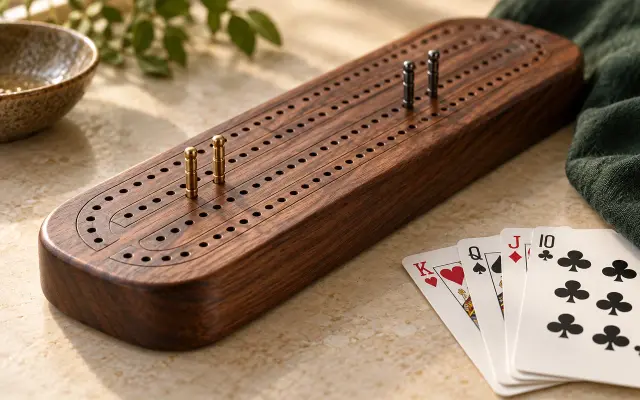
Two-player Cribbage rules with three- and four-player variants: the deal, the crib, the go, and scoring fifteens, pairs, runs and the 29 hand.
Also known as Crib