
Connect Four results: winning lines, draws and matches
Check legal four-in-a-row wins, distinguish gaps from completed lines, and agree how draws count in a casual Connect Four match.
On this page
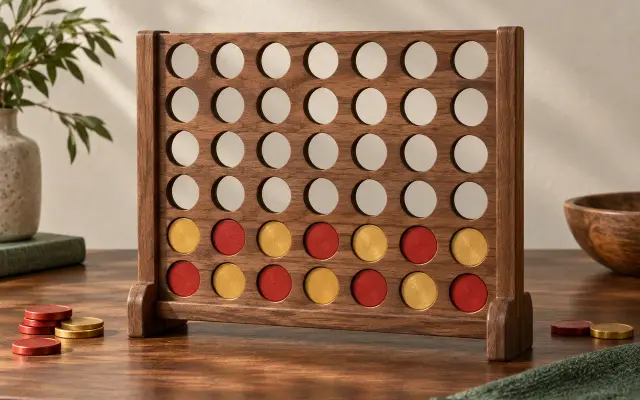
Classic Connect Four has no points for individual discs or partial lines. The first legal drop that creates four of your colour in a straight line wins. This guide explains how to check that result and keep a series of games unambiguous.
Check the disc that just landed
Look along the row, column and both diagonals through the newest disc. A completed line has four adjacent discs of the same colour, with no gap or opposing disc in the middle.
| Pattern | Result |
|---|---|
| Four same-colour discs across a row | Win |
| Four same-colour discs up a column | Win |
| Four same-colour discs on either diagonal | Win |
| Three discs and an empty space | Not a win yet |
| A bent group of four | Not a winning line |
| Five connected in a straight line | Win: it includes four |
A move completing two lines still ends one game. There is no extra bonus for a double line or a five-disc run. Stop immediately after the winning drop.
A potential line must obey gravity
Number columns 1–7 from left to right and rows 1–6 from bottom to top. Red discs at (1,1), (2,2) and (3,3) would need a red disc at (4,4) to finish a rising diagonal.
But a legal drop reaches (4,4) only if column 4’s bottom three spaces are already occupied. If column 4 is empty, the disc lands at (4,1), leaving the diagonal incomplete. The other discs in this example also require occupied spaces underneath them. Coordinates describe locations, not permission to place discs at arbitrary heights.
When a full board is a draw
The grid contains 7 × 6 = 42 spaces. If all fill without a winning line, neither player has another legal drop and the game is a draw. This is the logical no-move ending used on our rules page; the cited Hasbro sheet focuses on the four-in-a-row win.
Check the final drop for a line before calling the game drawn. A winning 42nd disc is a win, not a draw caused by running out of spaces.
A full column alone does not end the game. Play continues in other columns with room. Discs remain in place; removing one during play belongs to a different edition, such as PopOut.
Agree how a match handles draws
For a casual first-to-two-wins match, you may agree that draws give neither player a win and another game is played. Under that house convention, Red win, draw, Yellow win, Red win ends 2–1 to Red, after four games.
Alternatively, agree a fixed number of games and keep wins and draws in separate columns. These are casual match choices, not additional Hasbro scoring rules. State the method before playing, especially whether a draw consumes one of the scheduled games.
Alternate who opens across games so that one player does not always take the first drop. After each ending, empty the grid using the release bar and close it securely before starting again. Do not carry old discs into the next position.
For checking immediate threats before your turn, see Connect Four beginner strategy. The mistakes guide covers unsupported diagonals and full-column moves.
Continue learning
Similar games
Backgammon
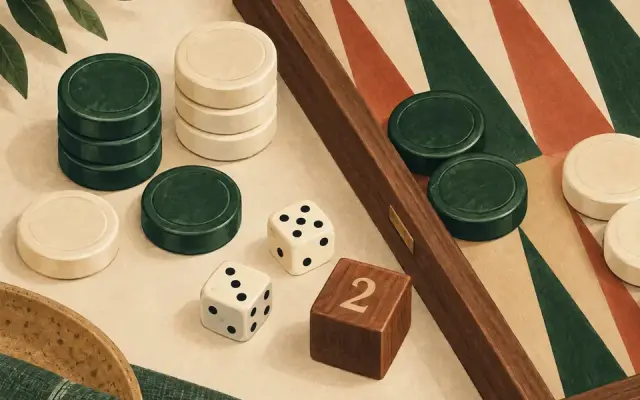
Backgammon rules for beginners: board setup, dice moves, hitting and the bar, bearing off to win — with the 15 opening moves and key terms.
Checkers
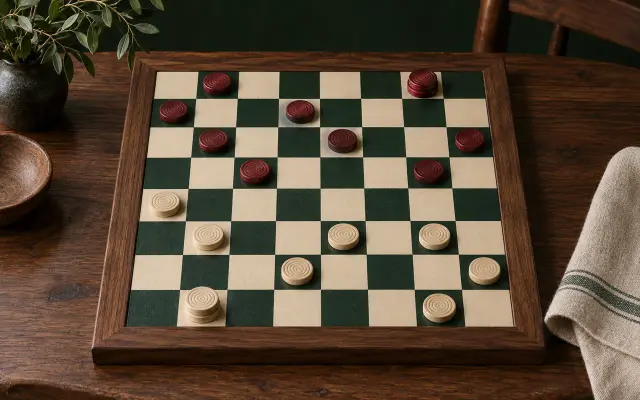
American Checkers rules on an 8×8 board: setup, forward moves, compulsory captures, multiple jumps, crowning, when pieces can move backward and how to win.
Also known as English draughts, Draughts

Mancala (Kalah)
Mancala rules for Kalah with four stones per pit: board setup, counterclockwise sowing, extra turns, opposite-pit captures, the end sweep and winning.
Also known as Kalah