
Connect 4 strategy: centre control and threats
How to win at Classic Connect 4: the centre column, building double threats, blocking and the odd-even rule.
On this page
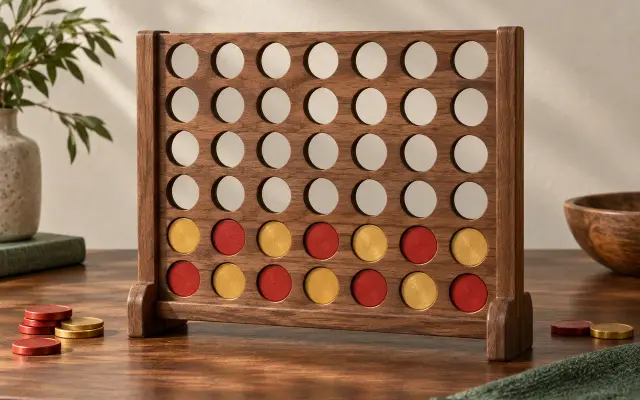
This guide applies to Classic Connect 4 on our Connect Four rules page: a 7-column, 6-row grid and a first player who moves first. Rows are counted from the bottom, with row 1 at the base.
Start in the centre
The middle column belongs to more possible fours than any other. A disc there can join horizontal, vertical and both diagonal lines. Start in the centre if you move first, and take the centre if it is still open when you move second. Victor Allis’s 1988 thesis proves a first-player win on the standard board with perfect play from the middle. This is a solved-game result, not a promise that a centre opening alone wins.
Play to make two threats at once
A threat is an empty space that would complete four for you. One threat is easy to block. Two immediately playable winning squares that need different blocks force a win, provided the opponent cannot win on their next move. Look for shapes where one disc creates a second line, especially diagonals.
Always check your opponent’s three in a row
Before your own plan, scan for any line where your opponent has three and the fourth space is playable, meaning the space below is filled. Block it now. Also check diagonals; they are the ones people miss.
Do not give the opponent a lift
If you play into the space directly below a square where your opponent wants a disc, you hand them that square. Before dropping a disc, look at the space above it.
The odd-even idea
Allis explains how odd and even threats matter when other columns are exhausted and players must fill the last column. Odd-row threats can favour the first player and even-row threats the second, but other threats and move order can change who gets a square. Count the remaining legal drops rather than applying parity as a universal rule. See sections 3.3 and 4 of the thesis.
Full board
If all 42 spaces fill without a four, the game is a draw. If you cannot win, keep making blocks, and see whether your opponent runs out of safe drops first.
Continue learning
Similar games
Backgammon
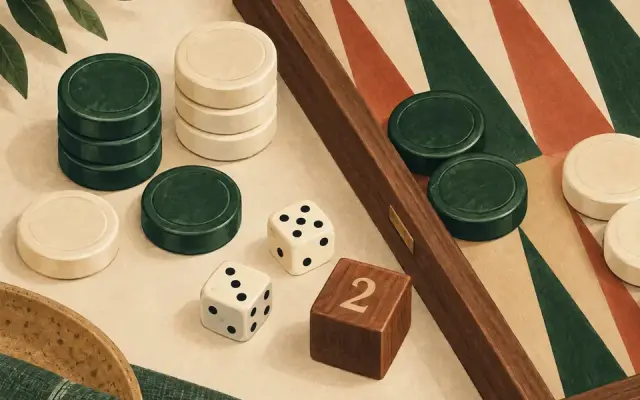
Backgammon rules for beginners: board setup, dice moves, hitting and the bar, bearing off to win — with the 15 opening moves and key terms.
Checkers
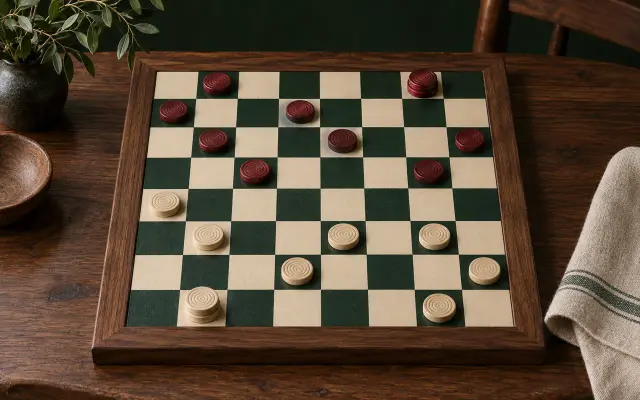
American Checkers rules on an 8×8 board: setup, forward moves, compulsory captures, multiple jumps, crowning, when pieces can move backward and how to win.
Also known as English draughts, Draughts

Mancala (Kalah)
Mancala rules for Kalah with four stones per pit: board setup, counterclockwise sowing, extra turns, opposite-pit captures, the end sweep and winning.
Also known as Kalah