
Chess results: checkmate, draws and match points
Distinguish checkmate from stalemate, claimed from automatic draws, and piece values from the points awarded for a finished chess game.
On this page
A standard chess game is decided by its result, not by adding the value of captured pieces. FIDE normally awards 1 for a win, ½ for a draw and 0 for a loss, unless the event specifies another scoring system.
Checkmate and stalemate use different tests
First ask whether the player to move has any legal move, then whether their king is attacked.
| Position of the player to move | Result |
|---|---|
| King attacked; no legal move escapes check | Checkmate: a loss |
| King not attacked; no legal move anywhere | Stalemate: a draw |
| At least one legal move exists | Play continues unless another ending applies |
A trapped king alone is not enough for stalemate if another piece has a legal move. A checked king is not mated if the player can capture the attacker, block a line attack or move the king safely.
Two minimal positions
With Black to move, place Black’s king on a8, White’s king on c7 and White’s queen on b7, with no other pieces. The queen attacks a8. It also covers a7 and b8; capturing the queen on b7 would move beside White’s king. Black has no legal escape: checkmate.
Now use Black’s king on a8, White’s king on c6 and White’s queen on b6, again with Black to move. Black is not in check. The queen covers a7 and b8, and b7 is covered too. Black has no legal move: stalemate, even though White has a queen advantage.
These positions illustrate why counting material cannot determine the result.
Other immediate endings
A player may resign. Under FIDE’s rule, resignation ends in a loss unless the opponent cannot checkmate by any possible legal sequence, in which case it is drawn.
A dead position is drawn immediately: neither side can checkmate by any possible legal sequence. Bare kings are a simple example. Do not treat every position you cannot personally win as dead; the legal possibility of mate is the test.
Players may agree a draw, subject to event restrictions. With a clock, running out of time normally loses, but the result is a draw if the opponent cannot checkmate by any possible legal sequence. This is not just a test of whether the opponent can force mate.
Claimed draws versus automatic draws
Three occurrences of the same position allow a correctly made draw claim by the player to move. The position includes the side to move and legal possibilities, including castling and en-passant rights. Repeating the same moves is not the only way to repeat a position.
The 50-move rule also permits a correct claim after 50 moves by each player without a pawn move or capture, or using an intended move that completes that condition. Follow FIDE’s claim procedure; simply announcing “fifty” at any time is not sufficient.
Fivefold repetition and 75 moves by each player without a pawn move or capture produce automatic draws. Checkmate on the final move takes precedence over the 75-move draw. A pawn move or capture restarts that move count.
Record a result, not a material score
Write 1–0 for a White win, 0–1 for a Black win, and ½–½ for a draw. In a three-game series, two wins and a draw give a player 1 + 1 + ½ = 2½; the opponent has ½ under standard scoring.
The familiar pawn/knight/rook/queen values are planning aids, not official points awarded for taking pieces. For move choices before the ending, see planning after the opening.
Continue learning
Beginner strategy
 Beginner strategyYour first ten moves in ChessA practical checklist for your first ten moves in Chess: give every move a job, make room in the centre, look after your king and check before you move.Beginner strategyMake a plan after the Chess openingTurn a playable opening into a simple middlegame plan by improving pieces, reading pawns and limiting counterplay.
Similar games
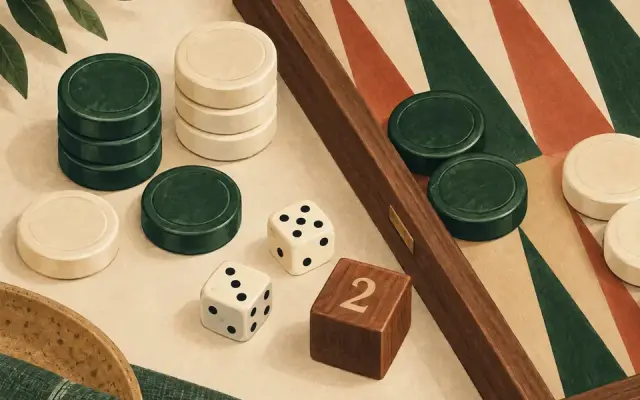
Backgammon
Backgammon rules for beginners: board setup, dice moves, hitting and the bar, bearing off to win — with the 15 opening moves and key terms.
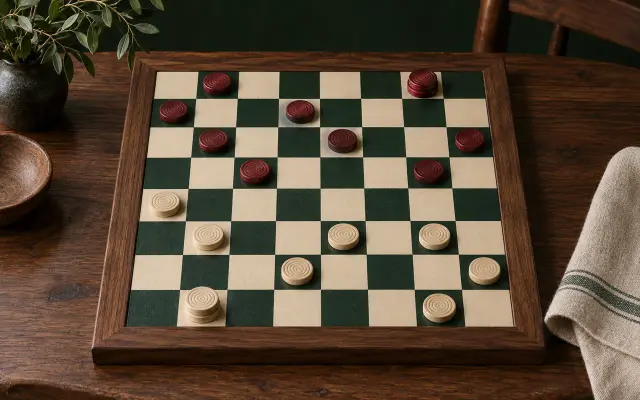
Checkers
American Checkers rules on an 8×8 board: setup, forward moves, compulsory captures, multiple jumps, crowning, when pieces can move backward and how to win.
Also known as English draughts, Draughts
Connect 4
Classic Connect 4 rules: assemble and orient the vertical grid, take turns dropping discs, and make four horizontally, vertically or diagonally.
Also known as Connect Four, Four in a Row, Four-in-a-row