
Your first ten moves in Chess
A practical checklist for your first ten moves in Chess: give every move a job, make room in the centre, look after your king and check before you move.
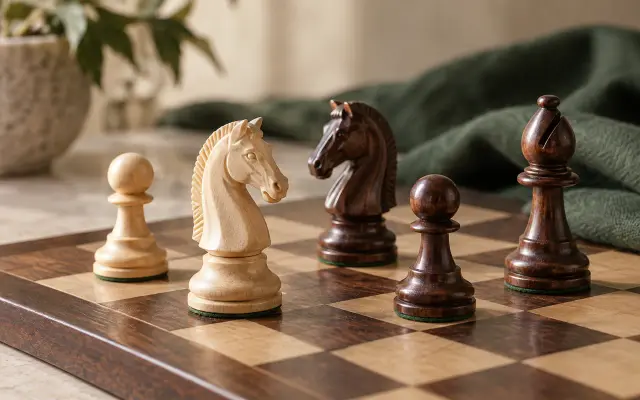
On this page
Give every move a job
In your first games, focus on improving your position rather than memorising a long sequence. A good question is: what will this move allow me to do next?
Make room in the centre
Central pawns can open lines for your bishops and queen. Develop knights and bishops toward useful squares. A piece participating in the game usually contributes more than one left on its starting square.
Development is not a race to touch every piece. Before moving a knight or bishop, ask which square helps it influence the centre, defend something useful, or prepare castling. If an apparently active square lets a pawn chase the piece away immediately, it may cost more time than it gains.
Look after your king
Consider castling once the path is clear and it is safe. It connects a rook with the game while moving the king away from central lines. Castling is an option, not a requirement: check the actual position.
Check before you move
Ask three questions: is my king safe, is a piece hanging, and what did the opponent’s last move threaten? This short pause prevents many beginner mistakes.
Then scan forcing moves in a fixed order: checks, captures, and direct threats—for both players. You do not need to calculate every possibility. You do need to notice when a general opening idea must wait because a piece or king is under immediate attack.
Know when the opening is over
There is no move number that ends every opening. You are usually entering the middlegame when most minor pieces are active, the kings have made a safety decision, and the rooks can begin to join the play. At that point, stop asking “What opening move should I know?” and start asking which piece is least useful and what the pawn structure allows you to improve.
Treat principles as questions
Sometimes a threat requires moving the same piece twice. Sometimes capturing material matters more than development. Use these ideas to choose between legal moves; do not follow them blindly.
Continue learning

Similar games
Backgammon
Backgammon rules for beginners: board setup, dice moves, hitting and the bar, bearing off to win — with the 15 opening moves and key terms.
Checkers
American Checkers rules on an 8×8 board: setup, forward moves, compulsory captures, multiple jumps, crowning, when pieces can move backward and how to win.
Also known as English draughts, Draughts
Connect 4
Classic Connect 4 rules: assemble and orient the vertical grid, take turns dropping discs, and make four horizontally, vertically or diagonally.
Also known as Connect Four, Four in a Row, Four-in-a-row