
UNO scoring: card values and the 500-point game
Score UNO Classic rounds, count last-card draw penalties and compare winner-takes-points with Mattel’s alternative scoring system.
On this page
This guide follows the Mattel Classic 112-card instructions used on our UNO rules page. It covers scoring after a round, not extra points for making individual plays. Special UNO editions can assign other values.
Score the cards left in opponents’ hands
Under the main method, the player who empties their hand receives the combined value of all cards the other players still hold. Only that round’s winner adds points.
| Card left in hand | Points |
|---|---|
| Number 0–9 | Printed number |
| Draw Two, Reverse or Skip | 20 |
| Wild or Wild Draw Four | 50 |
| Wild Shuffle Hands or Customizable Wild | 40 |
Colour makes no difference. Two red cards and two blue cards use the same values. A zero is worth zero; a Draw Two is worth 20, not two. Include the Shuffle Hands and Customizable cards only if they are part of the deck and rules you are using.
Resolve the final draw penalty first
If the last card is Draw Two or Wild Draw Four, the next player still draws the required cards. Add those cards to their hand before counting the round’s score. Nobody gets another ordinary turn after the final card.
Suppose the winner’s final card is Draw Two. The next player has a 4 and a Skip, then draws a 7 and a Wild. Their hand contributes 4 + 20 + 7 + 50 = 81. Counting before the forced draw would wrongly record only 24.
Ordinary stacking is not part of these printed rules: the penalised player does not avoid drawing by playing another draw card. See common UNO mistakes for legal draws and challenges.
Worked example: three opponents
Alex goes out. The remaining hands are:
| Player | Cards remaining | Points |
|---|---|---|
| Bea | 2, 8, Reverse | 30 |
| Cam | Wild, Draw Two | 70 |
| Dee | 0, 5, Customizable Wild | 45 |
Alex adds 30 + 70 + 45 = 145 to their running total. The other players add nothing under the main method. If Alex began the round on 380, their new total is 525, so they win the game.
Keep one score column per player and enter a round total only in the winner’s column. If nobody has reached 500, reshuffle and deal the next round.
Mattel’s alternative: lowest total wins
The printed instructions also offer a different system. Each player adds the value of their own leftover cards after each round. When one player’s running total reaches 500, the player with the lowest total wins.
For the same example, Bea adds 30, Cam 70 and Dee 45; Alex adds zero. This method makes points penalties, whereas the main method makes them rewards. Choose one before the first deal and do not switch mid-game.
What does not create a separate score?
Calling UNO, changing the colour, skipping someone and successfully playing a Wild do not earn additional points. Those plays affect who gets out and what remains in other hands. The score is calculated from the final hands.
A one-round casual game can simply end with the player who goes out, but that is different from the printed 500-point game. For managing expensive cards before scoring, see UNO beginner strategy.
Continue learning
Similar games
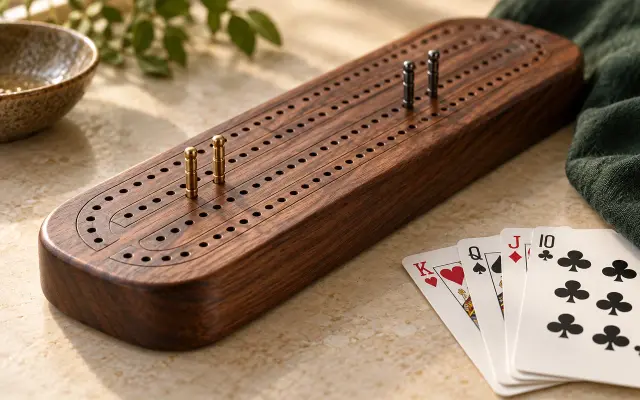
Cribbage
Two-player Cribbage rules with three- and four-player variants: the deal, the crib, the go, and scoring fifteens, pairs, runs and the 29 hand.
Also known as Crib
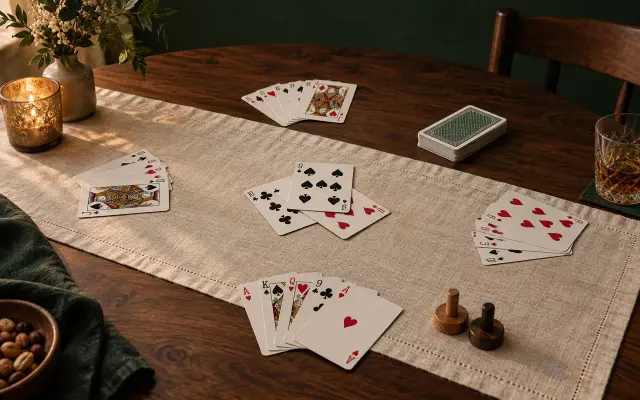
Euchre
North American Euchre rules for four players: the 24-card deck, choosing trump, right and left bowers, following suit, going alone and scoring to 10.
Gin Rummy
Gin Rummy rules for two players: ten-card hands, sets and runs, deadwood, knocking, laying off, going gin, undercuts and scoring a match to 100.
Also known as Gin