
Two-player Gin Rummy with 20-point gin and 10-point undercut bonuses
How to play Gin Rummy
Gin Rummy rules for two players: ten-card hands, sets and runs, deadwood, knocking, laying off, going gin, undercuts and scoring a match to 100.
Also known as Gin
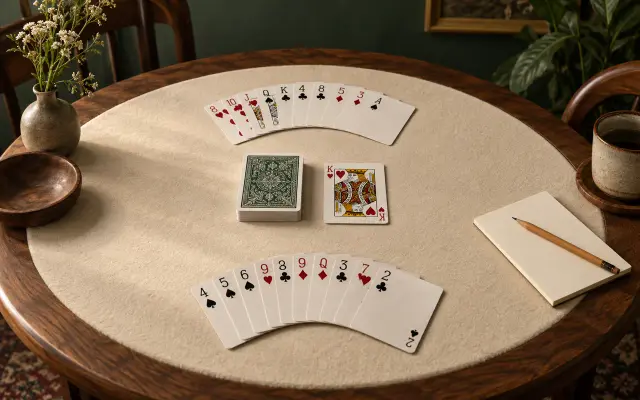
On this page
Quick reference
At the table
Ruleset: Two-player Gin Rummy with 20-point gin and 10-point undercut bonuses
- Goal
- End hands with less deadwood than your opponent; first player to 100 points wins.
- Setup
- Deal 10 cards each, turn one card face up to start the discard pile, and leave the rest as the stock.
- Turn
- Draw the top stock or discard card, then discard one card. Aces are low and cards must be in sets or same-suit runs.
- Scoring
- Knock with 10 or less deadwood and score the difference. Gin scores opponent’s deadwood plus 20; an undercut scores the difference plus 10.
- End of game
- Score the hand, reshuffle and deal again. First to 100 or more after a completed hand wins; then add game, hand and shutout bonuses.
Full scoring table
| Combination | Score |
|---|---|
| Knocker has less deadwood | Difference |
| Opponent equal or lower (undercut) | Difference + 10 |
| Gin (no layoffs) | Opponent’s deadwood + 20 |
| Ace / 2 to 10 / court card | 1 / face value / 10 |
Objective
Score points by arranging cards into melds and ending a hand with less unmatched-card value, called deadwood, than your opponent. Knock with 10 or fewer deadwood points, or go gin with no deadwood. The first player to 100 points wins the match.
This version uses the original 20-point gin bonus and 10-point undercut bonus. Many modern sets use 25-point bonuses; keep one scoring system for the whole match.
Setup
Use a standard 52-card deck without jokers. Aces are low and count 1 point. Number cards count face value; jacks, queens and kings count 10 each.
Choose a dealer, who deals 10 cards to each player. Place the next card face up to start the discard pile and the rest face down as the stock.
On the first hand, the non-dealer gets first choice of the upcard. If they pass, the dealer may take it. If both pass, the non-dealer draws from the stock and normal play begins. Deal alternates between the players each hand.
Melds and deadwood
A set is three or four cards of one rank, such as 7♣ 7♦ 7♥. A run is three or more consecutive cards of one suit, such as 4♠ 5♠ 6♠. Aces are low only: A-2-3 is valid, but Q-K-A is not.
One card cannot belong to two melds at once. If 7♥ could complete either a set of sevens or a heart run, choose one arrangement when the hand is shown.
Cards outside melds are deadwood. Add their card values to find the deadwood total. You may rearrange your cards into the lowest legal total when scoring.
Turns
After the opening choice, players alternate:
- Draw the top card of the stock or the top face-up discard.
- Add it to your hand and decide which cards form melds.
- Discard one card face up, returning your hand to 10 cards.
If you take the face-up discard, you cannot discard that same card immediately. The next player may see and take only the new top discard.
Knocking and going gin
After drawing, you may end the hand if your deadwood totals 10 or less. Discard one card face down and reveal your hand; this is knocking. Separate your melds from your deadwood.
The opponent reveals their hand and may lay off unmatched cards onto the knocker’s melds: a fourth card can join a set, and adjacent suited cards can extend a run. Then both players total their remaining deadwood.
If all 10 cards form melds after the final discard, you have gin. The opponent reveals their hand but may not lay off cards against gin, and gin always wins the hand.
If only two cards remain in the stock and the player who took the third-from-last card discards without knocking, the hand is void: cancel it without a score and deal again.
Scoring
If the knocker has less deadwood after layoffs, the knocker scores the difference.
If the opponent has equal or lower deadwood, the opponent has undercut the knocker. The opponent scores the deadwood difference plus a 10-point undercut bonus. Equal deadwood therefore scores 10 points to the opponent.
Going gin scores the opponent’s full deadwood, with no layoffs, plus a 20-point gin bonus. The opponent cannot undercut a gin.
Worked example
You knock with 8 deadwood. After laying off, your opponent has 14 deadwood. You score the difference: 14 − 8 = 6 points.
If the opponent instead reduces their deadwood to 5, they undercut you. The opponent scores the 3-point difference plus the 10-point bonus: 8 − 5 + 10 = 13 points.
Winning
Record the hand score, gather and shuffle all 52 cards, then deal again. The first player to reach 100 or more after a completed hand wins the match.
Only the hand winner scores. Melds do not earn points by themselves, and deadwood is not carried into the next deal.
When the match ends, the standard rules add end-of-game bonuses to the totals: 100 points for winning the game, 20 for each hand won, and another 100 if the loser won no hands. These bonuses change the final margin, not who won.
Common mistakes
- Melding mixed suits as a run. Every card in a run must share one suit.
- Using an ace above a king. Aces are low only in this ruleset.
- Using one card in two melds. Choose one legal arrangement when scoring.
- Knocking above 10 deadwood. A standard knock requires 10 or less after the discard.
- Allowing layoffs against gin. The opponent may lay off only after a knock. Against gin, count their deadwood as it stands.
- Giving every close result to the knocker. Equal or lower opponent deadwood is an undercut.
- Scoring 25-point bonuses by habit. This page uses 20 for gin and 10 for an undercut.
Variants
Other rule books use different bonus values, such as 25 points for gin and for an undercut, and some tables vary the deal rotation. Those versions work if both players use them consistently, but do not mix them with the system above.
Oklahoma Gin and Hollywood Gin are separate variants with their own knocking limits or scoring columns; they are not covered here. Three- and four-player adaptations also exist, but standard Gin Rummy is the two-player game taught here.
Common questions
When can you knock in Gin Rummy?
In this ruleset, you may knock when your deadwood totals 10 or less after the final discard. Reveal your melds and unmatched cards; your opponent may then lay off cards onto your melds.
Can you lay off cards when someone goes gin?
No. Going gin means all ten cards form melds after the discard. The opponent may not lay off onto those melds, and gin always wins: score the opponent’s full deadwood plus the 20-point gin bonus.
Can an ace be high in Gin Rummy?
No. Aces are low only: ace–2–3 in one suit is a valid run, but queen–king–ace is not.
Learn this game
Similar games
Cribbage
Two-player Cribbage rules with three- and four-player variants: the deal, the crib, the go, and scoring fifteens, pairs, runs and the 29 hand.
Also known as Crib
Rummy
Basic rummy rules: the deal (10, 7 or 6 cards), drawing and discarding, melding sets and runs, laying off on melds, and scoring when someone goes out.
Also known as Straight Rummy, Basic Rummy
UNO
UNO rules for the current 112-card Classic deck: matching cards, action cards, Wild Draw Four challenges, calling UNO and scoring to 500 points.
Also known as Uno