
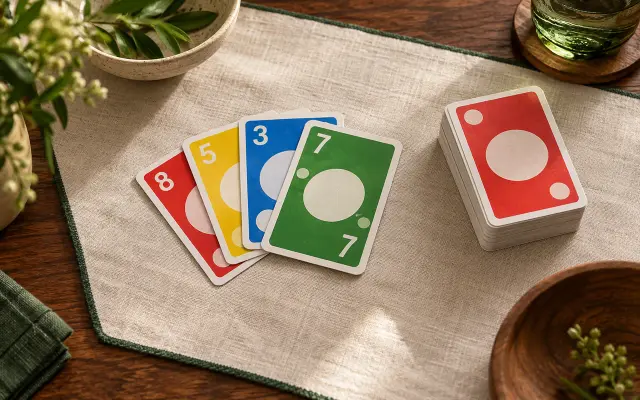
UNO Classic with the current 112-card deck
How to play UNO
Independent rules summary
UNO rules for the current 112-card Classic deck: matching cards, action cards, Wild Draw Four challenges, calling UNO and scoring to 500 points.
Also known as Uno
On this page
Quick reference
At the table
Ruleset: UNO Classic with the current 112-card deck
- Goal
- Empty your hand to score opponents’ cards; first to 500 points wins.
- Setup
- Deal seven cards each. Put the rest face down and turn over a starting discard.
- Turn
- Play one matching card or Wild. Otherwise draw one; play that drawn card if legal or end your turn.
- Scoring
- Number cards score face value, coloured actions 20, standard Wilds 50, and the extra 112-card Wilds 40.
- End of game
- The round ends when a player has no cards. Apply any final draw penalty, score the hands, and deal again.
Full scoring table
| Combination | Score |
|---|---|
| Number card | Face value |
| Draw Two, Reverse or Skip | 20 |
| Wild or Wild Draw Four | 50 |
| Wild Shuffle Hands or Customizable Wild | 40 |
Objective
Be first to empty your hand in each round. You then score the cards left in every opponent’s hand. Keep playing rounds until someone reaches 500 points.
This page follows Mattel’s current 112-card Classic deck. It includes the Wild Shuffle Hands card and three optional Customizable Wild cards. Older 108-card decks omit those four cards but otherwise use the same core matching, action-card and scoring rules.
Setup
Remove any Customizable Wild cards you do not want to use. If you include one, write and agree its rule before dealing. Each player draws a card; the highest number deals, with every symbol card counting as zero for this draw.
Shuffle and deal seven cards to each player. Put the rest face down as the draw pile. Turn its top card face up beside it to begin the discard pile. The player to the dealer’s left normally starts, although a starting action card may change this.
Resolve a starting action card before the first ordinary turn. Draw Two makes the player left of the dealer draw two and miss their turn; Skip also skips that player. Reverse makes the dealer start, with play continuing in the opposite direction. For Wild, Wild Shuffle Hands or a Customizable Wild, the player left of the dealer chooses the opening colour. Return a starting Wild Draw Four to the deck and reveal another card instead.
Turns
On your turn, play one card that matches the top discard by colour, number or symbol. A blue 7 can take any blue card, any colour 7, or a Wild. A red Skip can take another Skip or any red card.
If you cannot—or choose not to—play from your hand, draw exactly one card. You may play that card immediately if it is legal. After choosing to draw, you cannot play a different card from your hand that turn.
If the draw pile runs out, leave its top discard in place, shuffle the rest of the discard pile and use it as the new draw pile.
Action cards
- Draw Two: the next player draws two cards and misses their turn.
- Reverse: change the direction of play. When revealed as the opening discard, the dealer starts and play continues in the opposite direction.
- Skip: the next player misses their turn.
- Wild: choose the colour that continues. You may play it even if another card in your hand is legal.
- Wild Draw Four: choose the continuing colour; the next player draws four and misses their turn. You may play it only when you hold no card matching the current colour. A matching number or symbol in another colour does not make it illegal.
- Wild Shuffle Hands: collect every player’s hand, shuffle all those cards together, then redeal them one at a time beginning left of the person who played it. Choose the continuing colour.
- Customizable Wild: apply the agreed written rule and choose the continuing colour.
Draw penalties resolve on the next player; that player does not answer with another draw card under these rules.
Challenging a Wild Draw Four
The affected player may challenge before drawing. The person who played the Wild Draw Four privately shows their hand to the challenger.
- If they held a card matching the previous colour, the play was illegal and they draw four instead.
- If they did not, the challenge fails and the challenger draws six cards: the original four plus two more.
Calling UNO
When you play your next-to-last card, call “UNO” to show that one card remains. If another player catches you before the next player begins their turn, draw two cards. Once that next turn begins, the missed call can no longer be penalized.
Worked example
The top discard is a red 7. You hold a blue 7, a red Skip and a Wild Draw Four.
You may play the blue 7 because its number matches, or the red Skip because its colour matches. You may not legally play the Wild Draw Four because you hold a red card. If you had no red card, the blue 7 would not prevent the Wild Draw Four: its number matches, but its colour does not.
Winning
The round ends when a player plays their last card. If that card is Draw Two or Wild Draw Four, the next player still draws the required cards; those cards count in the round score.
The winner adds the value of every card left in opponents’ hands:
| Card | Points |
|---|---|
| Number card | Face value |
| Draw Two, Reverse or Skip | 20 |
| Wild or Wild Draw Four | 50 |
| Wild Shuffle Hands or Customizable Wild | 40 |
Shuffle and deal another round if nobody has reached 500. The first player to reach 500 points wins the game.
Common mistakes
- Stacking draw cards. A Draw Two or Wild Draw Four makes the next player draw and lose their turn; stacking is a house rule.
- Drawing until something plays. Draw only one card on a normal turn.
- Playing another card after drawing. Only the newly drawn card may be played that turn.
- Using Wild Draw Four whenever convenient. It is illegal when you hold the current colour.
- Forgetting the colour test. A matching number or action symbol in another colour does not block Wild Draw Four.
- Catching a missed UNO too late. The penalty window closes when the next player begins their turn.
Variants
For a game with an ordinary deck, try Crazy Eights. Its standard rules deal five cards each and draw until playable, so check that game’s rules before switching from UNO.
Older Classic decks contain 108 cards and omit Wild Shuffle Hands and the Customizable Wilds. Remove those four cards to play that edition.
Mattel also gives an alternative scoring method: every player records the cards left in their own hand; when someone reaches 500 penalty points, the player with the lowest total wins.
Stacking, jump-in, drawing until playable, playing multiple identical cards, swapping on 7 and rotating hands on 0 are common house rules or belong to named editions. Agree them before dealing rather than treating them as part of this Classic ruleset.
Common questions
Can you stack +2 or +4 cards in UNO?
No. In UNO Classic, the next player draws the penalty cards and misses their turn; they cannot pass the penalty on with another draw card. Stacking is a house rule or a rule of a separate edition.
Do you draw until you can play in UNO?
No. Draw one card on a normal turn. You may play that newly drawn card if it is legal, or end your turn. After drawing, you cannot play a different card from your hand.
Can you finish UNO with a Draw Two or Wild Draw Four?
Yes, provided the card is legal. The next player still draws two or four cards, and those cards count when scoring the finished round.
Can you play a Wild Draw Four when you have the current colour?
No. It is legal only when your hand has no card matching the current colour. A matching number or symbol in a different colour does not prevent it; the affected player may challenge an illegal play.
Learn this game
Similar games
Cribbage
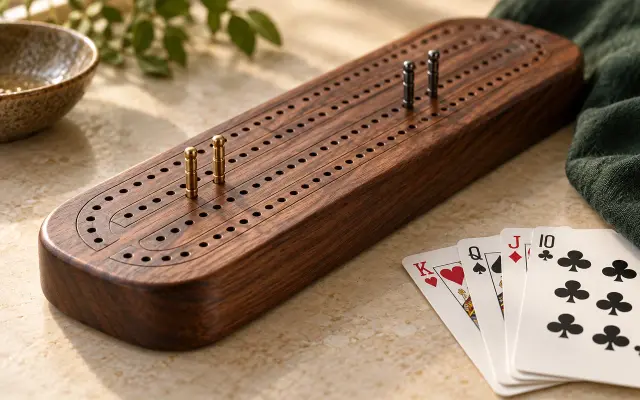
Two-player Cribbage rules with three- and four-player variants: the deal, the crib, the go, and scoring fifteens, pairs, runs and the 29 hand.
Also known as Crib
Euchre
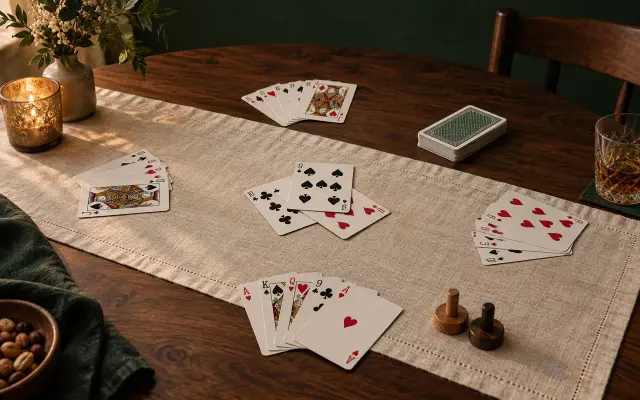
North American Euchre rules for four players: the 24-card deck, choosing trump, right and left bowers, following suit, going alone and scoring to 10.
Gin Rummy
Gin Rummy rules for two players: ten-card hands, sets and runs, deadwood, knocking, laying off, going gin, undercuts and scoring a match to 100.
Also known as Gin