
Common UNO mistakes and how to fix them
Sort official UNO rules from house rules: drawing, Wild Draw Four challenges, UNO calls and end-of-round scoring.
On this page
Most UNO arguments are really house rules disagreeing with the printed ones. This guide follows Mattel’s Classic instructions for the 112-card deck.
Stacking draw cards
Under the printed rules, a Draw Two makes the next player draw two cards and miss their turn. A Wild Draw Four does the same with four. The instructions do not let the next player answer by adding another draw card, so stacking is a house rule. Agree it before dealing or leave it out.
Drawing until something fits
If you cannot match the top card, you draw one card. If that card is playable you may play it that turn; otherwise play moves on.
Playing another card after a draw
You may choose to draw even when you hold a playable card. If you do, you may play only the card you just drew. Nothing else from your hand is legal that turn.
Playing an action card on the wrong card
Draw Two, Reverse and Skip may be played only on a matching colour or on another card of the same symbol. A red Draw Two on a blue 5 is illegal. A green Skip on a red Skip is legal, because the symbols match.
Wild cards can be played on your turn even if you hold another playable card.
Misjudging when a Wild Draw Four is legal
You may play Wild Draw Four only when you hold no other card matching the colour on the discard pile. A matching number or an action card in another colour does not stop you. After a Wild, the colour in play is the colour that was named.
Suppose the top card is a red 7. You hold a blue 7 and a Wild Draw Four but no red card. The Wild Draw Four is legal even though the blue 7 matches the number.
Getting the challenge wrong
If you suspect a Wild Draw Four was played illegally, you may challenge. The player who played it shows you their hand.
- They held a matching colour: they draw the four cards instead of you.
- They did not: you draw the four cards plus two more, six in total.
Challenge only when the risk is worth it.
Missing the UNO call
When you play your next-to-last card, say “UNO”. If another player catches you before the next player begins their turn, you draw two cards. After that turn starts, the missed call can no longer be penalised.
Forgetting the last-card penalty
The round ends when someone plays their last card. If that card is a Draw Two or Wild Draw Four, the next player still draws the two or four cards, and those cards count in the round’s scoring.
Scoring the round
The winner scores every card left in their opponents’ hands:
| Card | Points |
|---|---|
| Number card | Face value |
| Draw Two, Reverse or Skip | 20 |
| Wild or Wild Draw Four | 50 |
| Wild Shuffle Hands or Customizable Wild | 40 |
Play rounds until someone reaches 500. Mattel also gives an alternative: each player tallies their own leftover points, and when someone reaches 500 the player with the lowest total wins.
Starting cards
If the first card is a Wild Draw Four, return it to the deck and draw another. If it is a Skip, the player to the dealer’s left is skipped. If it is a Reverse, the dealer plays first and play moves the other way.
Continue learning
Similar games
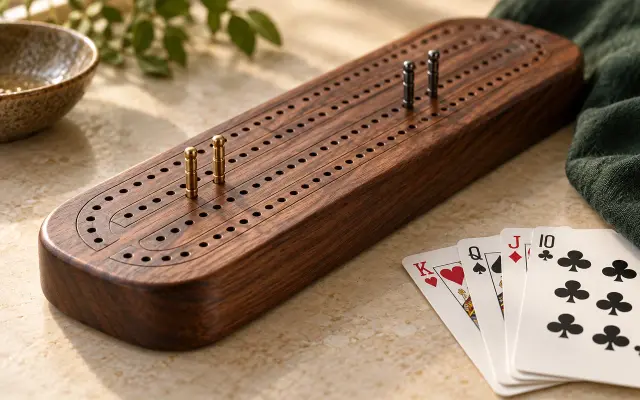
Cribbage
Two-player Cribbage rules with three- and four-player variants: the deal, the crib, the go, and scoring fifteens, pairs, runs and the 29 hand.
Also known as Crib
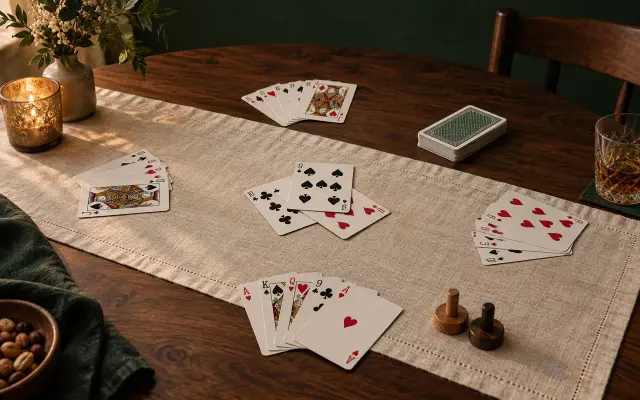
Euchre
North American Euchre rules for four players: the 24-card deck, choosing trump, right and left bowers, following suit, going alone and scoring to 10.
Gin Rummy
Gin Rummy rules for two players: ten-card hands, sets and runs, deadwood, knocking, laying off, going gin, undercuts and scoring a match to 100.
Also known as Gin