
CATAN beginner strategy: resources, trades and expansion
Plan resource access, compare settlement and city options, trade toward a build and manage robber risk in the 2025 CATAN base game.

On this page
This guide uses the 2025 English sixth-edition base game for 3–4 players from our CATAN rules page. The suggestions are practical heuristics, not a guaranteed winning plan. For your first game, use the publisher’s fixed beginner layout; placement decisions below apply when you move to variable setup.
Judge numbers and resources together
A site with attractive dice numbers can still leave you unable to buy what you need. Roads require wood and brick; settlements also require wool and wheat; cities require ore and wheat. Plan how your two starting sites work together rather than judging each alone.
With two fair, independent six-sided dice, there are 36 equally likely ordered outcomes. A 6 or 8 has five outcomes, a 5 or 9 four, and a 2 or 12 one. These frequencies help compare production; they do not promise that a number will appear in a short game. The robber can also stop a productive hex.
If one candidate site touches 6, 9 and 3, its numbers have 5 + 4 + 2 = 11 outcomes out of 36 in which one of those distinct hexes produces, before robber or supply effects. A site touching 5, 10 and 11 has 4 + 3 + 2 = 9 out of 36. The first has more production opportunities, but the second may provide a resource your other site lacks.
Leave room to expand
Look beyond your starting intersection. A future settlement needs an empty legal intersection connected to your roads, and its neighbouring intersections must be free of buildings. A promising resource mix is less useful if nearby opponents can shut off every affordable route.
Do not buy roads only because you can. Before spending wood and brick, identify the settlement site or route bonus those roads could reach. Roads by themselves score no victory points.
Compare a city with a new settlement
A new settlement adds one point and access to its adjacent hexes. A city replaces an existing settlement, adding one net point while doubling that building’s production.
If you already have ore and wheat, upgrading a productive settlement may be easier than paying for roads and a new settlement. If your production lacks an important resource, expansion can solve a problem a city cannot. Make the choice from the board and your available cards, not a fixed build order.
Trade toward a specific purchase
Before offering a trade, name the build it enables and count the missing cards. A player trade may preserve more resources than a 4:1 supply trade, but the opponent also receives something useful.
Suppose you have two wood, one brick and one wheat. Trading one wood for wool leaves the four resource types needed for a settlement. That trade is useful only if you also have a legal place to build it. A port grants a better rate only when your settlement or city occupies it; reaching it with a road is not enough.
Manage a large hand
A rolled 7 makes players with more than seven resource cards discard half, rounded down. Building can reduce that exposure and convert cards into lasting production or points. Do not spend everything on an unhelpful purchase merely to stay below eight cards: compare the discard risk with the value of saving for your next build.
Development cards do not count toward the discard limit. A newly bought ordinary development card cannot be played that turn, so do not rely on an immediate Knight to free a blocked hex.
Track a realistic path to ten
Count buildings, the two bonus tiles you actually hold, and hidden Victory Point cards. Bonus ownership can change. Before chasing Longest Route, compare the roads needed with another city or settlement you could afford.
Use the victory-point and bonus guide to check your total, and the common-mistakes guide for turn timing and placement exceptions.
Continue learning

Similar games

Monopoly
Monopoly Classic rules: starting money, auctions, rent, jail, houses, mortgages and bankruptcy, with examples and house rules clearly separated.
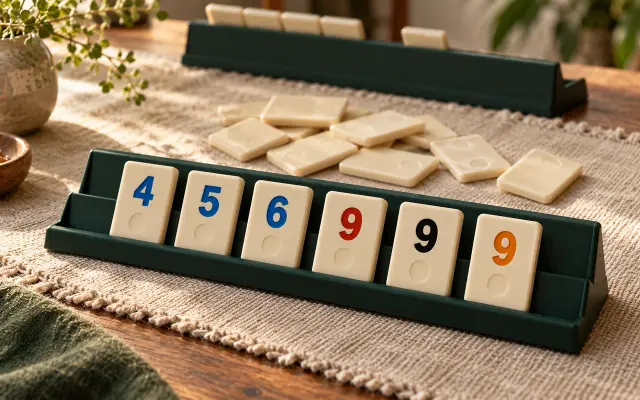
Rummikub
Rummikub Classic rules: groups, runs, the 30-point initial meld, rearranging tiles, retrieving jokers, turn limits and scoring, with examples.

Scrabble
Scrabble US Classic rules: legal word placement, premium squares, blanks, exchanges, challenges, seven-tile bonuses and final scoring.