
Go Fish, standard rules: four-card books, all 13 books collected
How to play Go Fish
Go Fish rules for 2–5 players: how many cards to deal, asking for ranks, drawing, collecting four-card books and winning when all 13 books are complete.
Also known as GoFish
On this page
Quick reference
At the table
Ruleset: Go Fish, standard rules: four-card books, all 13 books collected
- Goal
- Collect the most four-card books of one rank.
- Setup
- Use 52 cards, no jokers. Deal seven each for 2–3 players, five each for 4–5. Undealt cards form the stock.
- Turn
- Ask one opponent for a rank in your hand. Take every match and ask again; if they have none, draw one. Ask again if you draw the requested rank or complete a book; otherwise play passes left.
- Scoring
- Count books, not card values. Each completed set of four equal ranks is one book.
- End of game
- Finish all 13 books. Most books wins; equal highest counts share the win. With an empty hand, draw one on your turn if stock remains; otherwise sit out.
Objective
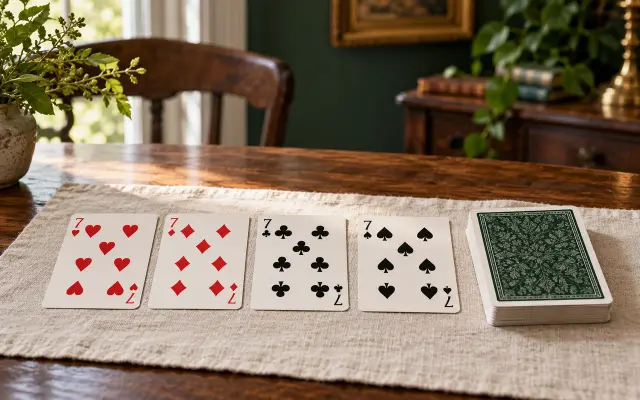
Collect more books than anyone else: each book contains all four cards of one rank, such as four sevens. This page follows one common ruleset for 2–5 players. Emptying your hand does not win.
Setup
Use a standard deck without jokers. To choose the dealer, deal each player a face-up card; the lowest card deals, with ace high. Shuffle the full deck and let the player on the dealer’s right cut it.
Deal clockwise, starting left of the dealer:
- 2 or 3 players: seven cards each.
- 4 or 5 players: five cards each.
Keep hands hidden. Stack the remaining cards face down as the stock. The player left of the dealer starts.
Turns
Ask one opponent for a rank already in your hand: “Sam, do you have any sevens?” They must give you every card of that rank. If you receive cards, ask again; you may change opponent or rank.
If they have none, they say “Go fish.” Draw one card. Show it and ask again if it matches your request; otherwise your turn passes left, unless you completed a book.
Whenever you complete a book, show all four cards and place them face up beside you. This page’s ruleset also gives another ask for completing a book, even if the drawn card was not the requested rank.
Empty hands and an empty stock
If your hand is empty, draw one card when your turn comes and ask for its rank. If the stock is empty too, sit out; your books still count.
When the stock runs out, keep asking. An unsuccessful request ends your turn without a draw. Continue until every book is complete.
Worked example
You hold 7♣, 7♦ and Q♠. Sam holds 7♥ and 7♠. Ask Sam for sevens: both cards come to you. Put the four sevens beside you as a book. You can now ask another opponent for queens because Q♠ remains in your hand.
Later, you ask for queens and hear “Go fish.” Drawing Q♥ lets you ask again. Drawing 3♣ normally ends your turn. But if you already held the other three threes, that draw completes a book, so the book-completion rule gives another ask.
Winning
Stop when all 13 books are on the table. The largest book count wins. Card values do not matter: four aces and four twos each make one book.
For example, counts of 6, 4 and 3 use all 13 books; the player with 6 wins. With counts of 5, 5 and 3, use a shared win for the tied leaders. This is our tie convention; the standard rules supply no tiebreak.
Common mistakes
- Asking for a rank absent from your hand.
- Giving only one matching card instead of all of them.
- Laying down pairs in a four-card-book game.
- Ending play when the first player runs out of cards.
Variants
Other versions change the deal size, end the game as soon as a hand or the stock is empty, or collect pairs instead of four-card books. Agree the version before dealing; this page keeps the standard deal and ending together.
For another family card game with a different goal, try UNO, where players race to empty their hands.
For a game where everyone builds on a shared layout, try Kings in the Corner: you play lower cards of the opposite colour on piles and win by emptying your hand.
Prefer drawing from another player’s hand? Old Maid uses blind draws and two-card pairs, with the last unpaired queen deciding the loser.
Common questions
How many cards do you start with in Go Fish?
Seven each with two or three players; five each with four or five.
Do you collect pairs or four of a kind?
Four of a kind here. Pairs belong to a separate variant.
Can you ask for a card you do not have?
You must hold its rank. With a queen, you may ask for queens, but not kings.
Do you keep playing after drawing a card?
Only if it matches your request or completes a book under these rules.
What happens when the draw pile is empty?
Keep asking. A failed request passes play left; there is no draw. Finish all 13 books.
Learn this game
Similar games
Briscola
Two-player Briscola rules: prepare a 40-card deck, rank ace and three highest, use trump, draw winner first and count 120 card points to decide the hand.
Also known as Two-player Briscola
Canasta
Classic Canasta rules for four players: 11-card hands, partnership melds, frozen discard piles, red threes, going out and scoring a game to 5,000.
Also known as Classic Canasta, Partnership Canasta
Crazy Eights
Crazy Eights rules for 2–5 players: deal five cards, match suit or rank, choose a suit with a wild eight, draw until playable and score remaining cards.
Also known as Crazy Eight, Crazy 8s, Crazy 8