
Kings in the Corner, standard rules: seven-card deal, draw at the start of your turn
How to play Kings in the Corner
Kings in the Corner rules for 2–4 players: deal seven cards, build alternating-colour piles, place kings in the corners, move piles and score leftover cards.
Also known as Kings Corner, Kings Corners, King’s Corners, Kings in the Corners
On this page
Quick reference
At the table
Ruleset: Kings in the Corner, standard rules: seven-card deal, draw at the start of your turn
- Goal
- Be first to play every card from your hand onto the layout.
- Setup
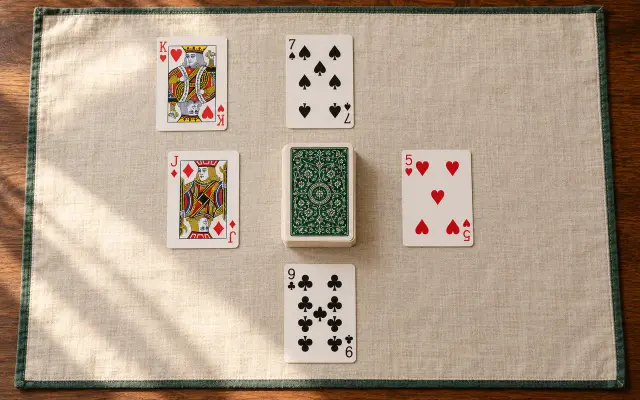
- Deal seven cards each from 52. Turn four stock cards face up north, east, south and west of the stock. The four corners start empty.
- Turn
- Draw one card. Then play as many cards as you like: build downward on alternating colours, put kings in empty corners, move whole piles and fill emptied side spots with any card.
- Scoring
- After a round, the winner scores 0. Other players add 10 for each king and 1 for each other card left in hand.
- End of game
- The first empty hand wins the round. For a longer game, play until someone reaches an agreed total such as 25; the lowest total then wins.
Full scoring table
| Combination | Score |
|---|---|
| King left in hand | 10 |
| Any other card left in hand | 1 |
Objective
Be the first player to play every card from your hand onto a shared layout. This page teaches the common version for 2–4 players: seven-card hands, a draw at the start of each turn, and kings that go only in the corners.
Setup
Use a standard 52-card deck without jokers. Deal seven cards each, one at a time. Put the rest face down in the middle as the stock.
Turn four cards face up from the stock, one on each side of it: north, east, south and west. Each starts a pile. If a king turns up, put it in a corner of the layout (between two piles) and turn another card in its place. The four corners otherwise start empty.
The player to the dealer’s left goes first; play passes clockwise. Kings rank highest and aces lowest.
Turns
Start your turn by drawing one card from the stock. Then make as many of these plays as you like, in any order:
- Build: play a card from your hand on the last card of any pile, if it is one rank lower and the opposite colour. A red 6 goes on a black 7; a black queen goes on a red king. Suits do not matter, only colour. An ace goes on a 2, and nothing goes on an ace.
- Kings: put a king from your hand in an empty corner. That corner becomes a pile, and you can build a queen of the opposite colour on it. Nothing outranks a king, so it never goes on top of another card.
- Move a pile: pick up a whole pile and put it on another pile if its first card (the highest) could be played on the other pile’s last card. You cannot move part of a pile.
- Fill an empty side: once a pile has moved, play any card from your hand into the empty north, east, south or west spot to start a new pile there.
A card or pile you have placed stays there for the rest of the game. Your turn ends when you stop playing. A pile that begins with a king cannot move, because nothing outranks it.
Worked turn
The layout shows 7♠ north, 5♥ east, 9♣ south and J♦ west. After drawing, you hold 6♦, 4♠, K♥, Q♠, 10♣, 8♥, 2♥ and 5♦.
You play 6♦ on 7♠, 4♠ on 5♥, 10♣ on J♦ and 8♥ on 9♣. You put K♥ in a corner and build Q♠ on it.
North is now 7♠ and 6♦. Its first card, the black 7, can go on the red 8♥ at the end of the south pile, so you move the whole north pile there. North is empty, and you play 2♥ to start a new pile.
That leaves one card, 5♦. It needs a black 6, and none is showing, so your turn ends with one card in hand.
When the stock is empty
Do not reshuffle. Players simply skip the draw and keep playing.
The sources do not say how to settle a layout where nobody can play and the stock is empty. Agree a convention before the game, such as ending the round and counting cards.
Winning
The first player to play their last card wins the round. For a single round that is the game.
To play several rounds, the winner scores nothing and everyone else adds the cards left in their hand:
| Card left in hand | Points |
|---|---|
| King | 10 |
| Any other card | 1 |
Scoring example: one player holds K♠, 5♦ and 9♣: 12 points. Another holds 3♥ and Q♥: 2 points. The winner adds 0, and the other two add 12 and 2.
Agree a target before dealing, such as 25 or 50. When a player reaches it, the player with the lowest total wins. Sources differ on how to end a long game, so this page does not fix one beyond that.
Common mistakes
- Building a red card on a red card, or a black card on a black one.
- Putting a non-king in an empty corner, or a king on top of another card.
- Moving part of a pile instead of the whole pile.
- Drawing after your turn instead of before it, if your group plays with the draw at the start.
- Taking back a card or pile after placing it.
Variants
Some groups draw at the end of the turn, after all plays. Others draw until a playable card appears, play it, then draw once more. Some require you to play whenever you can, while this page lets you stop when you like. Another scoring method counts jacks and queens as 2 points, or awards a point for each corner a player completes.
These change the game; they are not part of the rules above. A commercial edition that uses chips and a pot is a different game and is not described here.
If you want another game about emptying your hand, try Crazy Eights, which uses a single discard pile, or Go Fish, which collects sets by asking other players.
Common questions
How many cards do you deal in Kings in the Corner?
Seven each, for two to four players. The rest of the deck is the stock, and four cards from it start the layout.
Where can you put a king?
In an empty corner. A king can also start a new pile in an emptied side spot, but corners are the usual place. A king never goes on top of another card.
Are aces high or low?
Low. An ace goes on a 2 of the opposite colour, and nothing can be built on an ace.
Can you move part of a pile?
No. You move a whole pile, and only if its first card fits on the last card of another pile.
Do you have to play a card if you can?
Not in this version: you may stop whenever you like. Some groups require it, so agree before the first deal.
When do you draw a card?
At the start of your turn here. Some groups draw at the end of the turn instead; that is a variant, so keep it consistent within a game.
Similar games
Briscola
Two-player Briscola rules: prepare a 40-card deck, rank ace and three highest, use trump, draw winner first and count 120 card points to decide the hand.
Also known as Two-player Briscola
Canasta
Classic Canasta rules for four players: 11-card hands, partnership melds, frozen discard piles, red threes, going out and scoring a game to 5,000.
Also known as Classic Canasta, Partnership Canasta
Crazy Eights
Crazy Eights rules for 2–5 players: deal five cards, match suit or rank, choose a suit with a wild eight, draw until playable and score remaining cards.
Also known as Crazy Eight, Crazy 8s, Crazy 8