Go Fish strategy: what to ask and who to ask
Win more books in Go Fish: ask for the right ranks, use what opponents reveal, remember who holds what and play the empty-stock endgame.
On this page
Go Fish rewards attention more than luck. This guide uses the four-card-book rules on our Go Fish rules page. These are practical habits, not a guarantee of winning.
Ask for the ranks you hold most
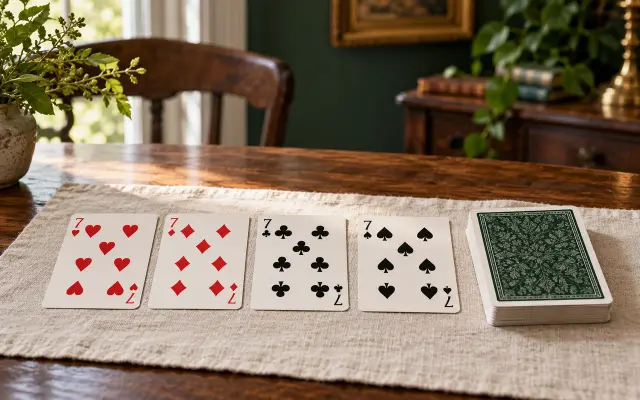
You can only ask for a rank you already hold, and you need all four cards to make a book. If you hold three of a rank, exactly one card of it remains, in an opponent’s hand or in the stock. If you hold two, two remain.
Ask for your biggest groups first. They are closest to becoming books, and a successful ask lets you ask again.
Treat every request as information
When a player asks for a rank, they must hold at least one card of it. You now know something about their hand for free. When a player says “Go fish” to a request, they hold none of that rank right now.
Keep a short mental note of each: who asked for what, and who had none. These facts are the main way to find cards without luck.
Choose who to ask
Do not ask at random. Prefer the player you know holds the rank, then a player who has not yet shown they lack it. Avoid asking someone who just said “Go fish” for the same rank, unless they have drawn since.
Worked decision
Three players. You hold 9♠, 9♦, 4♣, K♥, K♣, 2♦ and J♠. Earlier, Mia asked Ben for fours, so Mia holds at least one four. You hold 4♣.
You could ask for nines or kings, where you hold two of each. But asking Mia for fours should work: she held a four when she asked, and unless someone has taken it from her since, she must give you all her fours. Take them and ask again. The best-informed ask comes first, then your pairs.
Know the size of the stock
At the start the stock holds 38 cards with two players, 31 with three, 32 with four and 27 with five. Early on, many cards are hidden in the stock, so “Go fish” is common. As the stock shrinks, fewer cards are hidden from you, and the notes you have kept matter more.
Playing the empty stock
When the stock is empty, nobody can draw. A failed request simply ends your turn, and every card is in someone’s hand. Now your notes decide the game. Count which books are done, which ranks you hold, and which opponent must hold the missing cards. Ask the player you know holds them.
What not to chase
Every request tells the table which rank you hold, so opponents can ask you for it. A rank you hold only one card of is the least useful to reveal. Ask for single cards only when you have no stronger ask.
To see how the game is decided, read Go Fish scoring and books, and avoid common Go Fish mistakes.
Continue learning
Similar games
Briscola
Two-player Briscola rules: prepare a 40-card deck, rank ace and three highest, use trump, draw winner first and count 120 card points to decide the hand.
Also known as Two-player Briscola
Canasta
Classic Canasta rules for four players: 11-card hands, partnership melds, frozen discard piles, red threes, going out and scoring a game to 5,000.
Also known as Classic Canasta, Partnership Canasta
Crazy Eights
Crazy Eights rules for 2–5 players: deal five cards, match suit or rank, choose a suit with a wild eight, draw until playable and score remaining cards.
Also known as Crazy Eight, Crazy 8s, Crazy 8