
Old Maid, standard rules: one queen removed, pairs by rank
How to play Old Maid
Old Maid rules for 2–5 players: remove one queen, deal 51 cards, discard matching pairs, draw from your neighbour and avoid holding the last queen.
Also known as OldMaid
On this page
Quick reference
At the table
Ruleset: Old Maid, standard rules: one queen removed, pairs by rank
- Goal
- Discard your cards in pairs and avoid the last unpaired queen.
- Setup
- Remove any one queen from 52 cards, leaving 51. Deal every card. Discard equal-rank pairs face down; three of a kind leaves one card.
- Turn
- Dealer offers their cards face down to the next active player on the left. That player draws one, discards any new pair, then offers their own cards left.
- Scoring
- No point total: empty-handed players are safe. A player found to have discarded a false pair becomes the Old Maid under this page’s house rule.
- End of game
- Skip players with empty hands. When all pairs are discarded, the player holding the single remaining queen loses.
Objective
Avoid holding the final unpaired queen. You become safe by getting rid of your cards; the last queen’s holder loses. This page follows standard-deck Old Maid for 2–5 players, with pairs matched by rank.
Setup
Remove one queen from a standard deck without jokers. Any queen will do: the remaining three queens leave one that cannot be paired.
Shuffle the 51 cards and deal them all, one at a time, clockwise. Unequal hands are fine. For example, with four players, three receive 13 cards and one receives 12.
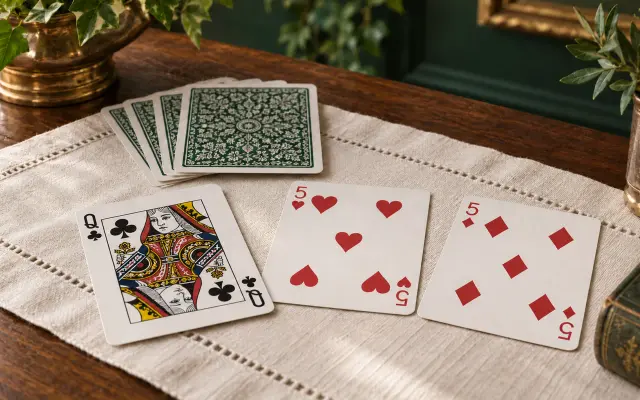
Everyone looks through their own hand and lays down all pairs of equal rank, face down. Two fives are a pair regardless of suit or colour. With three fives, discard two and keep one (Foster’s older text does not allow discarding from three of a kind, but modern play does); four fives make two pairs.
Keep the remaining cards hidden. There is no draw pile.
Turns
The dealer begins by spreading their remaining cards face down for the next active player on their left. That player takes one card without seeing its face and adds it to their hand.
If the draw creates a pair, lay both cards down face down. Otherwise keep the drawn card. Then offer your own hidden cards to the next active player on your left. Continue around the table in this way.
Empty hands
Once your hand is empty, you are safe and take no further part. Skip empty-handed players when offering cards. If the player who just drew empties their hand, the next active player to their left, who still holds cards, offers theirs onward instead. The same skipping rule applies if someone starts with only pairs.
Worked turn
You hold 5♣, 9♦ and Q♥. You draw 5♥ from the player on your right. Discard 5♣ and 5♥ together: their colours differ, but their ranks match. You now offer your remaining 9♦ and Q♥ face down to the next active player on your left.
Later, only two players remain. One holds Q♠ and 7♦; the other holds 7♣. If the second player draws 7♦, they discard both sevens and become safe. The other player is left with Q♠ and loses. If they draw Q♠ instead, no pair forms and play continues.
Winning
Normally, play ends with 25 discarded pairs and one queen. Everyone who emptied their hand is safe; the player still holding that queen loses. Finishing first does not earn extra points in this ruleset.
Check your pairs: this page’s house rule is that a player found to have discarded two cards that were not a pair loses and becomes the Old Maid. Such a mistake can leave three unpaired cards instead of the intended one. Do not declare the ordinary ending until the pairs are correct.
Common mistakes
- Keeping a same-rank pair because its colours differ.
- Discarding all three cards of a three-of-a-kind.
- Leaving undealt cards as a stock; all 51 cards are dealt.
- Drawing from an empty-handed player instead of skipping them.
- Choosing a card while its face is visible.
Variants
Special Old Maid decks use matching pictures and a single unmatched character. Use that deck’s pair markings and instructions.
Foster’s Complete Hoyle removes the queen of hearts specifically; removing any one queen gives the same game. Versions that remove a different card, or reward the final odd-card holder, are separate games; this page uses the unpaired queen as the losing card.
For a different matching goal, try Go Fish: it collects four-card books by asking for ranks, rather than drawing blindly from another hand.
Common questions
Which card do you remove for Old Maid?
Remove any one queen and all jokers. The resulting standard-deck game uses 51 cards.
Do pairs have to be the same colour?
No. Two cards of the same rank make a pair here, whatever their suits or colours.
What do you do with three of a kind?
Discard one pair and keep the third card. Four of a kind makes two pairs.
What happens when you have no cards left?
You are safe and sit out. The remaining players skip you when passing cards.
Is the first player out the only winner?
No. All players who empty their hands are safe. The ordinary ending has one loser: the last queen’s holder.
Similar games
Briscola
Two-player Briscola rules: prepare a 40-card deck, rank ace and three highest, use trump, draw winner first and count 120 card points to decide the hand.
Also known as Two-player Briscola
Canasta
Classic Canasta rules for four players: 11-card hands, partnership melds, frozen discard piles, red threes, going out and scoring a game to 5,000.
Also known as Classic Canasta, Partnership Canasta
Crazy Eights
Crazy Eights rules for 2–5 players: deal five cards, match suit or rank, choose a suit with a wild eight, draw until playable and score remaining cards.
Also known as Crazy Eight, Crazy 8s, Crazy 8