
Klondike Solitaire strategy: how to win more often
Tips for draw-one Klondike: unblocking face-down cards, managing empty columns, foundation timing and the stock.
On this page
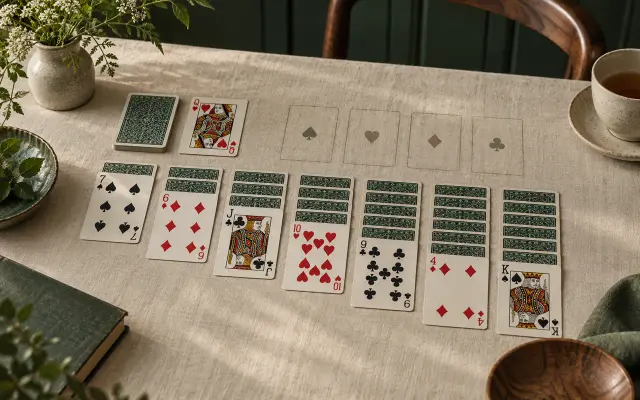
This guide is for draw-one Klondike with unlimited redeals as on our Klondike Solitaire rules page. Not every deal can be won, but a good order of moves gives you the best chance.
Uncover hidden cards first
Face-down cards are where you gain new options. Prefer a move that flips a card over to one that just rearranges what you can already see. When two moves are possible, choose the one that reveals a card from the column with the most face-down cards.
Move aces and twos up early
Aces are needed to start the foundations, and twos follow. Play them to the foundation as soon as they are free. Low cards are seldom useful in the tableau.
Don’t rush the middle cards up
A 5 or 6 moved to a foundation may need to come back to help a tableau sequence. Keep cards in the tableau if they help you reach a face-down card or if you need a card of the opposite colour. It’s common to keep the foundations roughly level.
Empty columns need kings
Only a king or a sequence headed by a king can enter an empty column. Do not empty a column unless a king is ready, or one can be reached soon. An empty column with no king available wastes a space.
Using the stock
Look at everything visible before you turn a stock card. Then cycle the stock and note which cards are in it, so you know which ones are still to come. With unlimited redeals you can pass through the stock as many times as you like. Stop when a full pass produces no useful move.
Choosing between equal moves
If two cards of the same rank and colour could go on the same target, look at which column each would free up or which face-down card it would uncover. Keep the option that leaves more moves open.
Foundation cards can come back
Our house rules explicitly allow a legal move from a foundation back to the tableau; agree this permission before playing. It can rescue a stuck deal, but use it sparingly.
Accept a lost deal
If no useful moves remain after cycling the stock, the game is lost. Shuffle and deal again.
Continue learning
Similar games
Cribbage
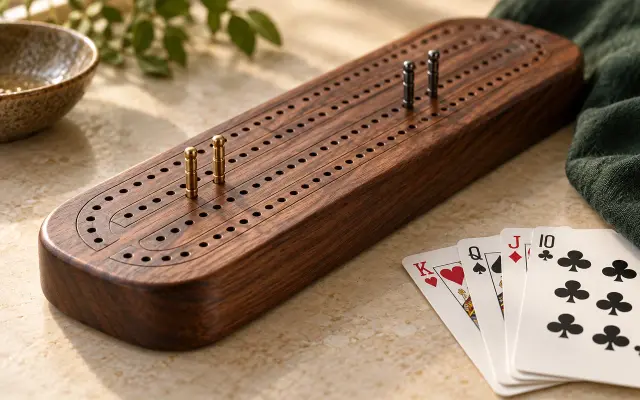
Two-player Cribbage rules with three- and four-player variants: the deal, the crib, the go, and scoring fifteens, pairs, runs and the 29 hand.
Also known as Crib
Euchre
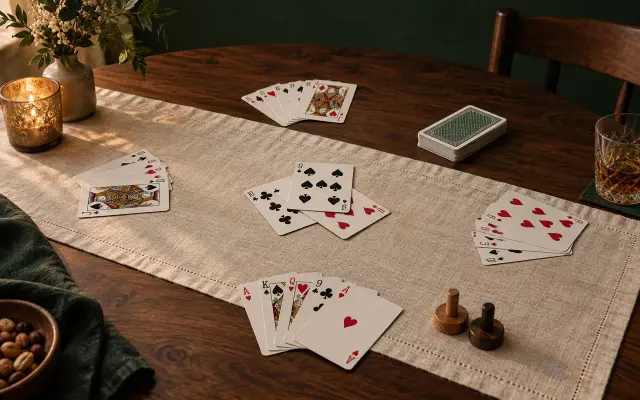
North American Euchre rules for four players: the 24-card deck, choosing trump, right and left bowers, following suit, going alone and scoring to 10.
Gin Rummy
Gin Rummy rules for two players: ten-card hands, sets and runs, deadwood, knocking, laying off, going gin, undercuts and scoring a match to 100.
Also known as Gin