
Draw-one Klondike with unlimited redeals
How to play Klondike Solitaire
Klondike Solitaire rules for draw one: deal the seven-column tableau, build down in alternating colours, use the stock and move every suit to its foundation.
Also known as Patience, Solitaire
On this page
Quick reference
At the table
Ruleset: Draw-one Klondike with unlimited redeals
- Goal
- Move all 52 cards to four foundation piles, ace to king in each suit.
- Setup
- Deal seven tableau columns of 1 to 7 cards, with only the top card face up. The other 24 cards form the stock.
- Turn
- Build the tableau down in alternating colours, turn one stock card at a time and play the waste’s top card. Only kings fill empty columns.
- Scoring
- There is no score in this basic version. Completing all four foundations is a win.
- End of game
- You win when every foundation reaches king. If no useful move remains after cycling the stock, the game is lost.
Objective
Move all 52 cards to four foundation piles, one pile per suit. Each foundation begins with an ace and builds upward in suit through 2, 3 and so on to king.
This page teaches draw-one Klondike with unlimited passes through the stock. The familiar draw-three form is a variant with different access to the waste pile.
Setup
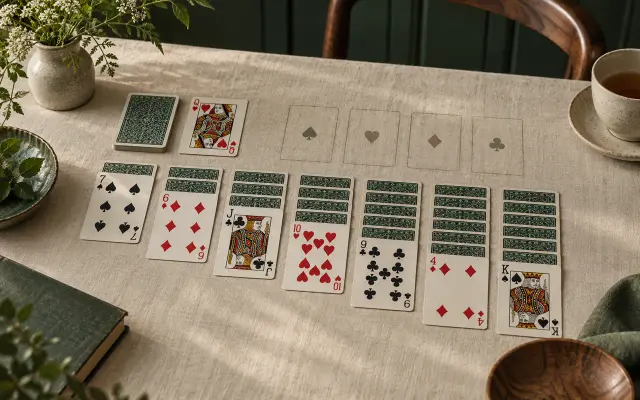
Shuffle one standard 52-card deck without jokers. Deal a row of seven cards from left to right. The first card is face up and the other six are face down. Start the next row at the second column, turning the first card of that row face up. Continue in this pattern until:
- column 1 has one face-up card;
- column 2 has one face-down card and one face-up card;
- the pattern continues to column 7, which has six face-down cards and one face-up card.
These seven columns form the tableau. Place the remaining 24 cards face down as the stock. Leave room beside it for a face-up waste pile and above the tableau for four foundations.
Turns
There is no fixed turn cycle. Make any legal move, then continue until you win or no useful move remains.
Build on the tableau
Place a face-up card on a card one rank higher and of the opposite colour. A black 6 can go on a red 7; a red queen can go on a black king. Suits do not need to match in the tableau.
You may move a whole face-up sequence together when every card in that sequence already descends by one rank and alternates colour. The card at the top of the moving sequence must fit its new destination.
Whenever a move exposes a face-down tableau card, turn that card face up. Only a king, or a correctly built sequence headed by a king, may move into an empty tableau column.
Use the stock and waste
Turn the stock’s top card face up onto the waste. Only the waste’s top card is available to play, either onto the tableau or a foundation. If it cannot or should not be played, turn the next stock card onto it.
When the stock is empty, pick up the waste, turn it face down without shuffling, and use it as the new stock. This ruleset allows unlimited redeals. Keeping the order unchanged matters: shuffling would create a different game.
Build the foundations
Start each foundation with an ace. Build upward in the same suit: A♣, 2♣, 3♣ and so on. The top card of a foundation can be played when it is exposed in the tableau or on top of the waste.
This version allows a foundation’s top card to return to the tableau when that creates a legal alternating-colour build. Use that move carefully; it can uncover a needed card, but it also moves you away from the finish.
Worked example
A black 6 is at the head of a legal face-up sequence, with a red 5 and black 4 beneath it. A red 7 is exposed in another column. Move the entire 6-5-4 sequence onto the red 7, preserving its order.
Turn over the face-down card the move exposed. If the first column is now empty, you cannot fill it with any convenient card: only a king or a sequence beginning with a king may enter that space.
Winning
You win when all four foundations contain complete same-suit sequences from ace through king. At that point every card has left the tableau, stock and waste.
Klondike is not guaranteed to be solvable from every shuffled deal, and a legal move can still make a solvable deal impossible. If you can make no legal or useful move after cycling the stock, the game is lost; shuffle and deal again.
There is no score in this basic version. A win is completing all four foundations. If comparing several games, count wins or record the time taken, but decide the method before the first deal.
Common mistakes
- Building tableau cards in the same colour. Red must go on black and black on red.
- Moving a broken sequence. Every card in a moved run must already descend by one and alternate colour.
- Putting a non-king in an empty column. Empty tableau spaces accept only kings or king-led sequences.
- Forgetting to turn an exposed card. Flip a newly uncovered tableau card face up immediately.
- Playing a buried waste card. Only the top card of the waste is available.
- Shuffling during a redeal. Turn the waste over as a unit so its order is preserved.
- Sending every card to a foundation at once. A low foundation card can sometimes be needed to build a tableau sequence and reach a face-down card.
Variants
Our draw-one, unlimited-redeal house rules also permit legal moves from a foundation back to the tableau. Agree that permission before playing; published Klondike implementations differ.
Draw-three Klondike turns three stock cards at a time, with only the top exposed card available. Removing a card can reveal another card in that waste packet. Published draw-three games also differ on whether players get unlimited passes or only three passes through the stock. These restrictions make access to stock cards more demanding; do not mix draw-three dealing into the draw-one sequence above.
Limited-redeal Klondike gives a fixed number of trips through the stock, even in draw-one play. Vegas scoring commonly charges for the deal and pays for cards moved to foundations, often with limited redeals. Timed computer versions may award points for speed or moves.
Some rules forbid moving cards back from foundations to the tableau. This page allows it. Choose one convention before starting, because it changes which recoveries are legal late in the game.
Common questions
What card can fill an empty Solitaire column?
In Klondike, only a king or a legal descending, alternating-colour sequence headed by a king can fill an empty tableau column.
Do suits have to match in Solitaire?
On the Klondike tableau, build downward in alternating colours; the suits need not match. On the foundations, build upward from ace to king in the same suit.
How many times can you go through the Solitaire deck?
This page’s draw-one Klondike rules allow unlimited redeals. Turn the waste over without shuffling to make the new stock. Other variants limit redeals or draw three cards at a time.
Learn this game
Similar games
Cribbage
Two-player Cribbage rules with three- and four-player variants: the deal, the crib, the go, and scoring fifteens, pairs, runs and the 29 hand.
Also known as Crib
Euchre
North American Euchre rules for four players: the 24-card deck, choosing trump, right and left bowers, following suit, going alone and scoring to 10.
Gin Rummy
Gin Rummy rules for two players: ten-card hands, sets and runs, deadwood, knocking, laying off, going gin, undercuts and scoring a match to 100.
Also known as Gin