Blackjack payouts, pushes and insurance explained
How 3:2, 6:5, even-money wins, pushes and insurance settle, with worked stake examples.
On this page
Blackjack has no running score. Every hand settles on its own, so the important question is what a result pays. This guide uses the ruleset on our Blackjack rules page.
Settlement table
Bet 10 units. Profit is what you win on top of getting your stake back.
| Result | Profit | Returned to you |
|---|---|---|
| You bust | −10 | 0 |
| Dealer busts, you do not | +10 | 20 |
| Your total beats the dealer’s | +10 | 20 |
| Dealer’s total beats yours | −10 | 0 |
| Equal totals (push) | 0 | 10 |
| Your natural, dealer has none | +15 | 25 |
| Late surrender | −5 | 5 |
3:2 versus 6:5
“3:2” means 3 units of profit for every 2 bet, so a natural on 10 units wins 15. A “6:5” table pays 6 for every 5 bet, so the same natural wins only 12. That is a real change in the rules, not a different way of writing 3:2. Check the placard before you play.
What counts as a natural
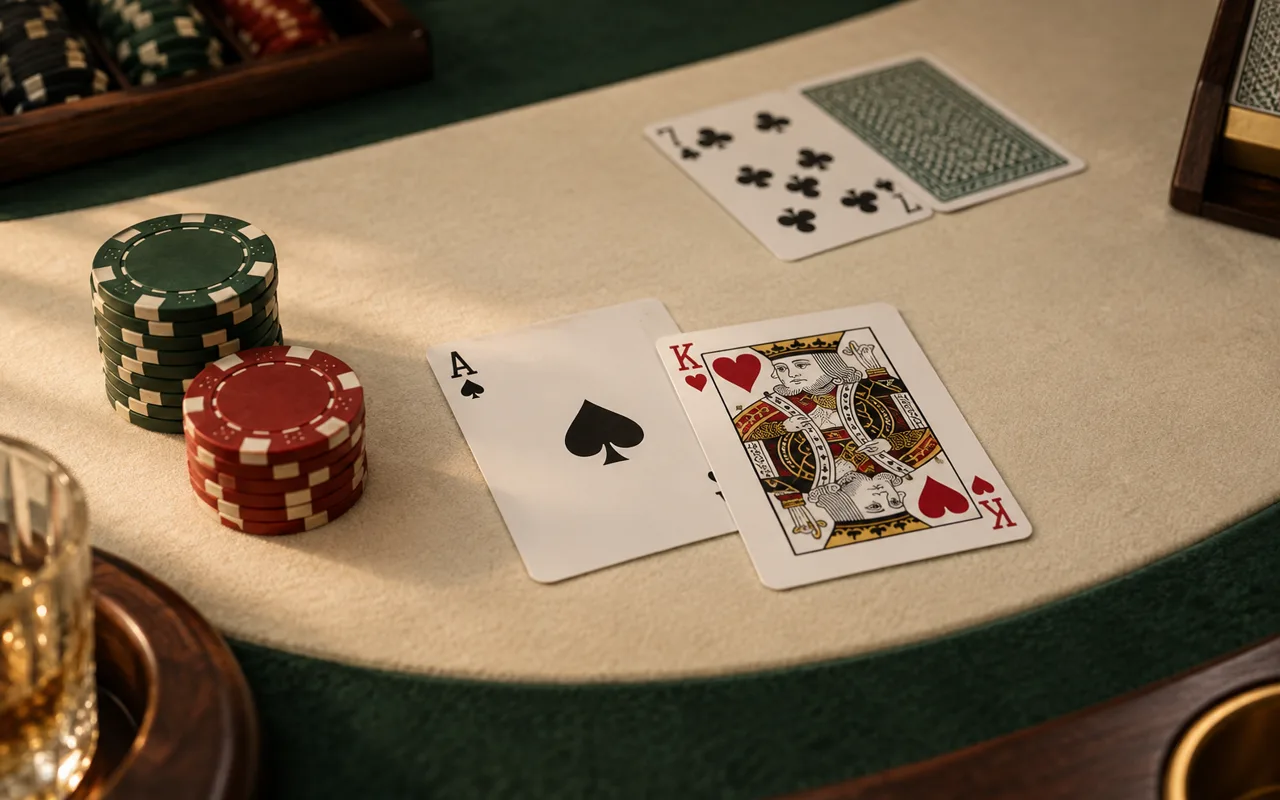
Only an ace plus a 10-value card as your first two cards is a natural. A 21 made with three or more cards is an ordinary 21. A 21 made after splitting is also an ordinary 21 and pays even money.
If both you and the dealer have a natural, the hand is a push.
Doubles and splits
A double doubles your bet, so a winning double on an original 10-unit bet earns 20 units of profit. After a split, each hand carries its own bet and settles separately. You can win one and lose the other.
Insurance
When the dealer’s upcard is an ace, insurance is offered. It is a side bet of up to half your original bet that the dealer has a natural. It commonly pays 2:1.
Example: you bet 10 and take insurance for 5.
- Dealer has a natural: insurance pays 10. You lose your 10-unit main bet, so you finish level.
- Dealer has no natural: you lose the 5 insurance stake and play your hand on.
Insurance settles separately from your main hand. It is generally not a good bet, and basic strategy declines it.
Home games
Without money, agree what the chips are worth, whether insurance is used and how many deals make a session. Do this before the first card.
Sources & review
Suggest a correctionContinue learning
Similar games
Cribbage
Cribbage rules for two players, with three- and four-player variants: the deal, the crib, the go, and scoring — fifteens, pairs, runs, the 29 hand, skunks and muggins.
Also known as Crib
Euchre
North American Euchre rules for four players: the 24-card deck, choosing trump, right and left bowers, following suit, going alone and scoring to 10.
Gin Rummy
Gin Rummy rules for two players: ten-card hands, sets and runs, deadwood, knocking, laying off, going gin, undercuts and scoring a match to 100.
Also known as Gin