Six-deck American blackjack; dealer stands on all 17s
How to play Blackjack
Blackjack rules for a six-deck, stand-on-soft-17 game: card values, hitting, standing, doubling, splitting, surrender, natural payouts and dealer play.
Also known as 21
On this page
Quick start
- Bet, then receive two cards while the dealer takes one card face up and one face down.
- Hit, stand, double, split or surrender as your cards and the table rules allow.
- Win by beating the dealer without going over 21; a natural blackjack pays 3:2.
Objective
Make a hand closer to 21 than the dealer without going over 21. You play against the dealer, not against the other players. A total over 21 is a bust and loses immediately, even if the dealer later busts.
This page uses a common six-deck American game: the dealer stands on every 17, including soft 17; a two-card natural blackjack pays 3:2; doubling after a split is allowed; and late surrender is available. Casino and home rules vary, so check the table rules before betting.
Card values
- Number cards count at face value.
- Jacks, queens and kings count 10.
- An ace counts as 1 or 11, whichever gives the hand the better legal total.
A hand is soft while an ace can count as 11 without busting. Ace-6 is soft 17. If a 10 is added, the ace changes to 1 and the hand becomes hard 17.
A natural blackjack is an ace plus any 10-value card as the first two cards of the original hand. A multi-card 21 and a 21 made after splitting aces are totals of 21, but they are not natural blackjacks.
Setup
Shuffle six standard decks together. One person deals and manages the bank; one to seven others play. Give each player a betting area and chips or counters. Agree values if you are playing at home without money.
Each player places a bet before the deal. The dealer gives two cards to every player and two to the dealer. Players’ cards are face up in the usual casino game. The dealer shows one card, called the upcard, and keeps the other face down as the hole card.
When the upcard is an ace, the dealer may offer insurance before checking the hole card. Insurance is a separate side bet that the dealer has a natural; it is not part of the main hand. When the upcard is an ace or a 10-value card, the dealer checks for blackjack before normal play. If the dealer has it, settle the hand immediately.
Turns
Play moves from the dealer’s left. On your hand, choose among the actions the hand allows:
- Hit: take another card. You may keep hitting until you stand or bust.
- Stand: take no more cards. Your final total remains in play against the dealer.
- Double down: double your opening bet, receive exactly one more card, then stand. In this ruleset you may double on any opening two-card total, including after a split.
- Split: if the first two cards have equal value, add a second bet equal to the first and separate them into two hands. Deal one new card to each and play the hands in order. This ruleset permits one split only, so a hand cannot be split again.
- Surrender: after the dealer has checked for blackjack and before you take another action, give up the hand and recover half the original bet. This is late surrender.
Split aces receive one new card each and then stand. A 10-value card dealt to a split ace makes 21, not a natural blackjack. Other split hands play normally.
After every player finishes, the dealer reveals the hole card. The dealer hits totals of 16 or less and stands on totals of 17 or more. Here that includes soft 17: ace-6 stands. The dealer makes no choices based on the players’ hands.
Worked example
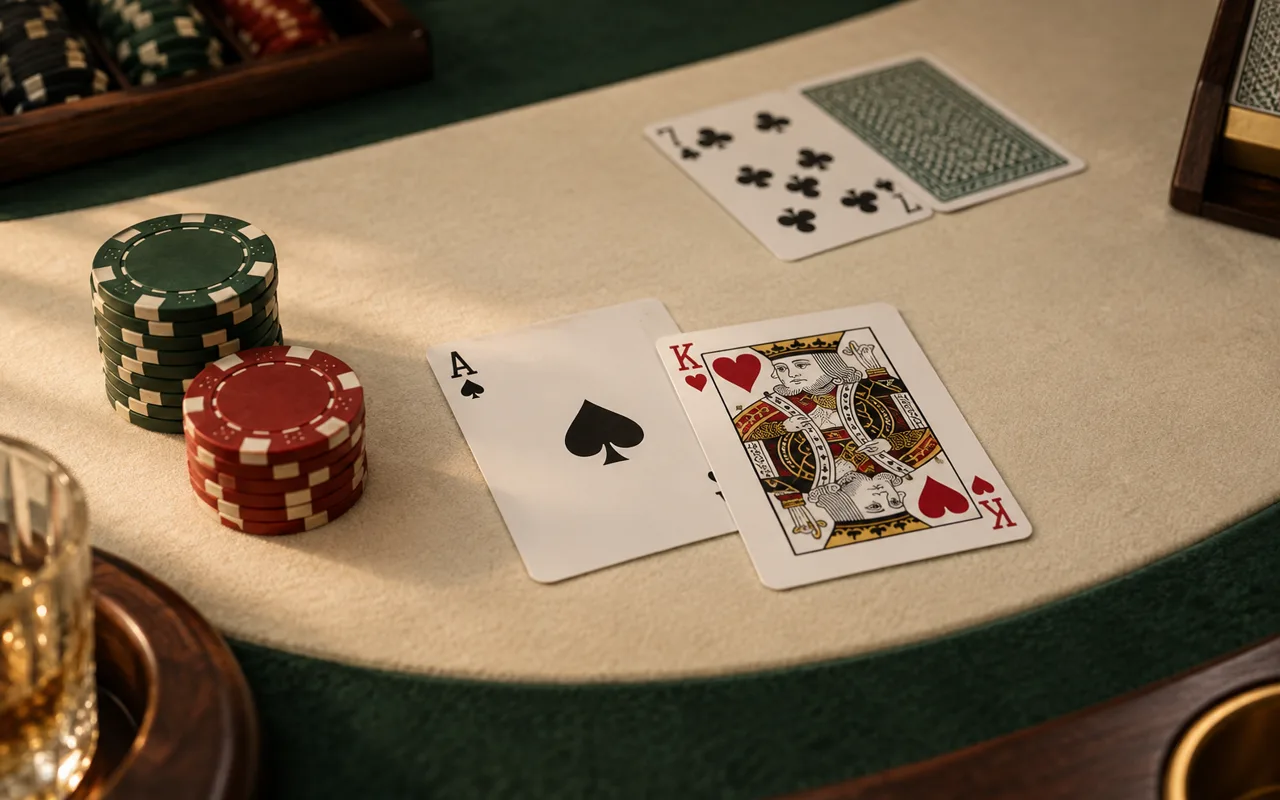
You bet 10 units and receive A♠ K♥. That is a natural blackjack. The dealer shows 7, reveals another 7, draws a third 7 and finishes on 21.
Your natural still wins because a two-card blackjack beats any ordinary 21. At the selected 3:2 payout, you receive 15 units of profit and keep your returned 10-unit stake. If the dealer had also held a natural, the hand would be a push and your original stake would be returned with no profit.
Winning
Settle each hand separately after the dealer finishes:
| Result | Settlement |
|---|---|
| You bust | Lose the bet immediately |
| Dealer busts and you did not | Win even money (1:1) |
| Your total is higher than the dealer’s | Win even money (1:1) |
| Dealer’s total is higher | Lose the bet |
| Equal totals | Push; the original bet is returned |
| Your natural blackjack and dealer has no natural | Win 3:2 |
For a 10-unit bet, an even-money win earns 10 units of profit. A natural at 3:2 earns 15 units. The returned stake is not profit.
Blackjack is normally played as a series of independent hands rather than to an overall score. If playing a fixed home session, agree the number of deals or finishing time before starting.
Common mistakes
- Trying to beat another player. Only your result against the dealer matters.
- Treating every 21 as blackjack. Only an ace and a 10-value card dealt as the original two cards make a natural.
- Waiting to surrender. Late surrender is available only as the first decision, after the dealer checks for blackjack.
- Taking more cards after doubling. A double receives exactly one card.
- Calling a soft hand hard. An ace may change from 11 to 1 whenever that prevents a bust.
- Reading the payout incorrectly. “3:2” means 15 profit on a 10-unit bet. A 6:5 table pays only 12 on the same bet and is a different, less favorable rule.
Variants
Always read the table placard or agree the house rules. A dealer may hit soft 17 instead of standing. Doubling may be limited to certain totals, doubling after splitting may be barred, and a table may allow more than one split or let players resplit aces. Surrender is not offered everywhere.
Some tables pay 6:5 for a natural rather than the 3:2 used here. That is a meaningful payout change, not another way to write the same rule. European no-hole-card blackjack also changes the sequence: the dealer does not take a hole card until players have acted, which affects doubled and split bets when the dealer later makes blackjack.
Insurance commonly pays 2:1 when the dealer has blackjack. Because it is resolved independently from the main hand, a player can lose the main bet and win insurance, or lose insurance and continue the hand. Home groups may omit insurance entirely without changing the core turn sequence.
Sources & review
Rules checked 26 September 2026. Refer to the linked rules for tournament procedures and detailed adjudication.
Suggest a correctionSimilar games
Cribbage
Cribbage rules for two players, with three- and four-player variants: the deal, the crib, the go, and scoring — fifteens, pairs, runs, the 29 hand, skunks and muggins.
Euchre
North American Euchre rules for four players: the 24-card deck, choosing trump, right and left bowers, following suit, going alone and scoring to 10.
Gin Rummy
Gin Rummy rules for two players: ten-card hands, sets and runs, deadwood, knocking, laying off, going gin, undercuts and scoring a match to 100.