Texas Hold’em strategy for beginners
Position, starting hands, pot odds and outs explained simply for a first home game of no-limit Texas Hold’em.
On this page
This guide is for a casual game of no-limit Texas Hold’em as taught on our Texas Hold’em rules page, played with chips that need not represent money. It covers the ideas that help most beginners. Laws about gambling vary; do not assume that using money is permitted where you are.
Play fewer hands
The most common beginner error is playing too many hands. In a full ring, most starting hands are weak enough to fold before the flop. Playing fewer, stronger hands puts you ahead more often after the flop.
Strong starting hands include high pairs (such as A-A, K-K, Q-Q, J-J), A-K and A-Q. Suited cards and connected cards (such as 9♥ 8♥) are playable, especially in late position, because they make flushes and straights.
Position matters
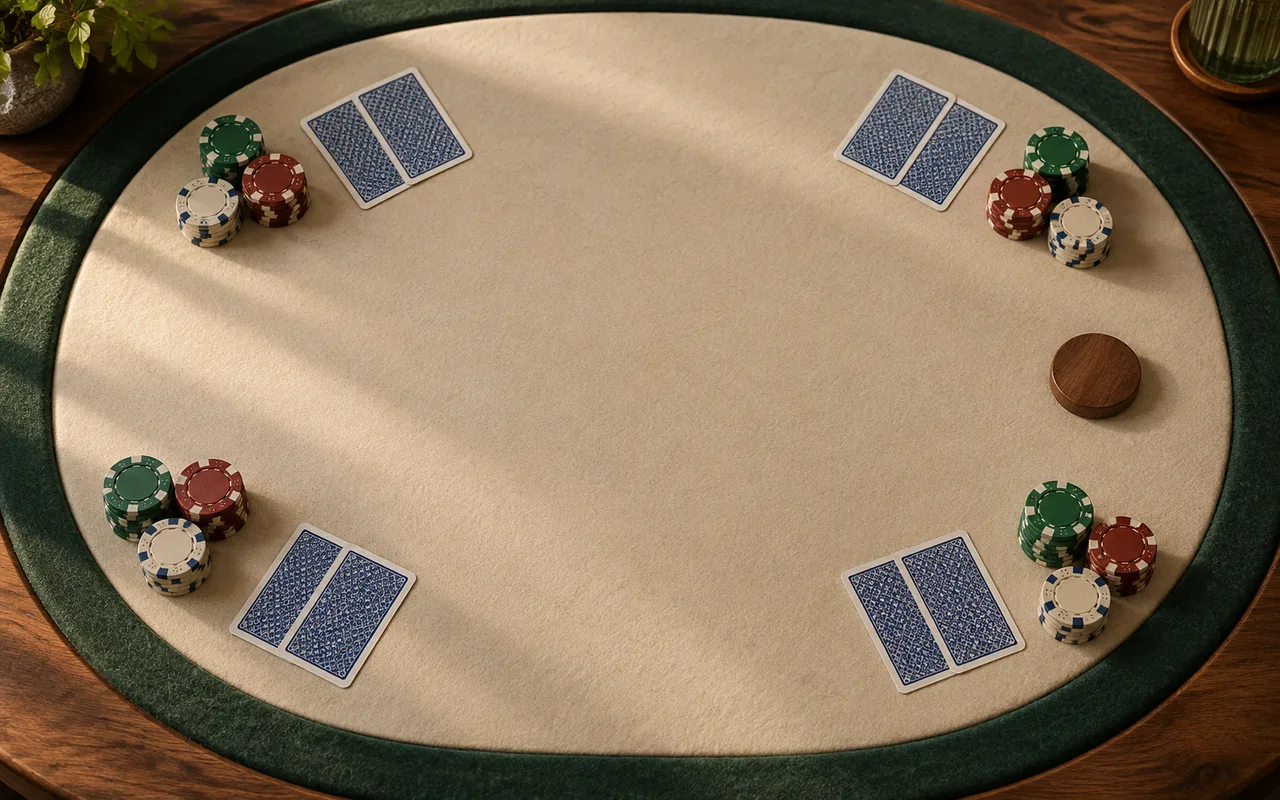
The players who act last on each betting round see what everyone else does first. The dealer button gives the best position after the flop. Play more hands from late position and fewer from early position, because you have more information.
Bet with a purpose
Every bet or raise should have a reason: to win the pot now, to get called by worse hands, or to make a draw pay to continue. If you have no reason, checking is often better.
Outs and drawing odds
An out is a card that would give you a hand you expect to win. A rough guide with two cards still to come:
- A flush draw (four cards of a suit) has 9 outs. That is about 35% to complete by the river from the flop.
- An open-ended straight draw has 8 outs, about 31%.
- With one card to come, the chances are about half that: roughly 20% for a flush draw, 17% for an open-ended straight draw.
A quick estimate: multiply your outs by 4 on the flop (two cards to come), or by 2 on the turn (one card to come).
Pot odds
Compare the price of a call to the size of the pot. If you must call 10 into a pot of 40, you pay 10 to win 50, or 1 to 5, which needs you to win about one time in six (about 17%). If your chance of completing your hand is higher than that, calling is reasonable.
Fold when you’re beaten
Calling every bet because you’ve already put chips in is a mistake. Chips already in the pot are gone. Ask what your hand is worth now.
Watch the board
Look at the flop, turn and river for flushes and straights that are possible, and for pairs that could give someone three of a kind or a full house. Your hand is worth less when the board is dangerous.
Manage your stack
Avoid risking most of your stack on a single marginal hand. Blinds come around every hand, so a short stack loses chips quickly. A patient player waits for a good spot.
Sources & review
Suggest a correctionContinue learning
Similar games
Blackjack
Blackjack rules for a six-deck, stand-on-soft-17 game: card values, hitting, standing, doubling, splitting, surrender, natural payouts and dealer play.
Also known as 21, Twenty-one
Cribbage
Cribbage rules for two players, with three- and four-player variants: the deal, the crib, the go, and scoring — fifteens, pairs, runs, the 29 hand, skunks and muggins.
Also known as Crib
Euchre
North American Euchre rules for four players: the 24-card deck, choosing trump, right and left bowers, following suit, going alone and scoring to 10.