Basic no-limit Texas Hold’em table play
How to play Texas Hold’em
No-limit Texas Hold’em rules for a home table: blinds, hole cards, betting actions, flop, turn, river, hand rankings, all-ins and showdown.
Also known as Texas Holdem, Hold'em, Holdem
On this page
Quick reference
At the table
Ruleset: Basic no-limit Texas Hold’em table play
- Goal
- Win the pot by making the best five-card hand or making every opponent fold.
- Setup
- Move the dealer button, post small and big blinds, and deal two private cards each.
- Turn
- In betting order, fold, check, call, bet or raise. Deal the flop, turn and river between rounds.
- Scoring
- Hands rank from high card up to straight flush. Use the best five cards from your two hole cards and five board cards.
- End of game
- A hand ends when one player remains or after showdown. Award the pot and move the button clockwise.
Full scoring table
| Combination | Score |
|---|---|
| Straight flush | Highest |
| Four of a kind | 2nd |
| Full house | 3rd |
| Flush | 4th |
| Straight | 5th |
| Three of a kind | 6th |
| Two pair | 7th |
| One pair | 8th |
| High card | Lowest |
Objective
Win the chips in the pot. You can win immediately when every other player folds, or at showdown by making the strongest five-card poker hand from the seven cards available to you: two private hole cards and five shared community cards.
This page teaches basic no-limit Texas Hold’em for a home table. Chips need not represent money. Tournament schedules, cash-game buy-ins, antes and venue procedures are separate rules that must be agreed before play.
Setup
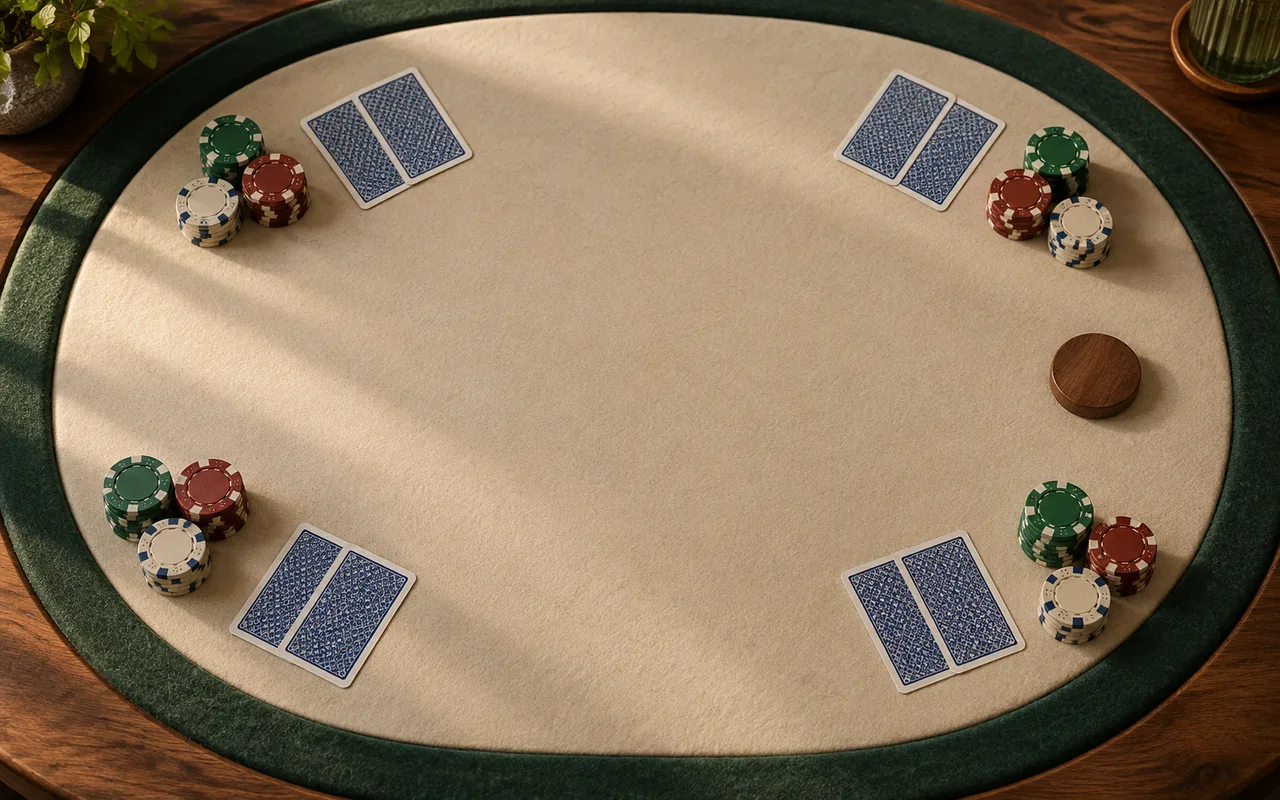
Seat two to ten players and give each an equal starting stack for a casual game. Use a marker as the dealer button. It moves one seat clockwise after every hand and determines the deal and betting order.
Before cards are dealt, the player immediately left of the button posts the small blind and the next player posts the big blind, normally twice as large. Agree the blind values before starting.
Shuffle and deal two cards face down to every player, one at a time, beginning left of the button. Players may look at their own hole cards but keep them hidden.
With only two players, the button posts the small blind and acts first before the flop; the other player posts the big blind and acts first on later rounds.
Turns
A hand has up to four betting rounds. Action moves clockwise and continues until every player still in the hand has matched the current bet or is all-in, with no further raise to answer.
On your action you may:
- Fold: surrender your cards and any chips already committed.
- Check: bet nothing and remain in the hand, allowed only when you face no bet.
- Call: match the current bet, or put in your entire smaller stack if you cannot fully match it.
- Bet: make the first wager of a round.
- Raise: increase an existing bet. In no-limit play you may wager up to your whole stack.
A normal minimum opening bet is one big blind. A minimum raise must increase the bet by at least the size of the previous full bet or raise. State a raise and its total clearly before moving chips.
The four betting rounds
- Preflop: after the hole cards, action begins with the player left of the big blind. The big blind acts if nobody has raised when action returns.
- Flop: burn one card face down and deal three community cards face up. Action begins with the first active player left of the button.
- Turn: burn one and deal a fourth community card. Hold another betting round from the first active player left of the button.
- River: burn one and deal the fifth community card. Hold the final betting round in the same order.
If all but one player folds at any point, the remaining player wins without showing cards.
All-in bets and side pots
You may go all-in for fewer chips than the amount needed to call. You remain eligible only for the part of the pot you matched. Put later unmatched chips into one or more side pots; only players who contributed to a side pot can win it. Award each pot separately at showdown.
An all-in raise smaller than a full minimum raise does not by itself reopen raising for players who have already acted. For a first home game, have one dealer track the current bet and construct side pots before dealing the next board card.
Hand rankings
Use exactly five cards. You may use both, one or none of your hole cards.
| Rank | Hand | Meaning |
|---|---|---|
| 1 | Straight flush | Five consecutive cards of one suit |
| 2 | Four of a kind | Four cards of one rank |
| 3 | Full house | Three of one rank plus two of another |
| 4 | Flush | Five cards of one suit |
| 5 | Straight | Five consecutive cards of mixed suits |
| 6 | Three of a kind | Three cards of one rank |
| 7 | Two pair | Two different pairs |
| 8 | One pair | Two cards of one rank |
| 9 | High card | None of the combinations above |
An ace may be high in A-K-Q-J-10 or low in 5-4-3-2-A, but it does not wrap around. Compare the ranks that make the combination, then remaining kickers from highest to lowest. Suits never break a tie in Hold’em.
Worked example
The board is A♣ K♦ 8♠ 8♥ 2♣. You hold A♦ Q♠; an opponent holds K♣ Q♥.
Your best five cards are A-A-8-8-Q: two pair, aces and eights, with a queen kicker. The opponent has K-K-8-8-Q: kings and eights. Your higher top pair wins. Neither player is required to use both hole cards.
Winning
After river betting, remaining players reveal at showdown. Compare each best five-card hand and award the pot to the strongest. If hands tie exactly, split the pot as evenly as possible; any indivisible chip is awarded by the agreed house or venue procedure.
Gather the cards, move the button one seat clockwise and post the next blinds. A casual session can end after an agreed number of hands or time. A tournament ends when one player holds all tournament chips; cash play follows the table’s agreed buy-in and departure rules.
Common mistakes
- Using six or seven cards as a hand. Only the best five count.
- Requiring both hole cards. Hold’em permits two, one or zero.
- Checking while facing a bet. You must call, raise or fold.
- Calling after folding. A folded hand is dead for that pot.
- Treating suits as tie-breakers. Equal five-card hands split the pot.
- Giving an all-in player every side pot. They can win only pots they funded.
- Acting from the same seat on every round. Preflop begins left of the big blind; later rounds begin left of the button.
Variants
Fixed-limit Hold’em fixes bet and raise sizes. Pot-limit Hold’em caps a wager at the current pot calculation. Both change betting decisions from the no-limit game above.
Cash tables and tournaments differ in buy-ins, blind increases, antes, re-entry and removal of chips. Poker TDA rules standardize tournament procedure but do not define every home or cash game. Heads-up play also has its own blind and action order, noted in Setup.
For a beginner game, use chips without money, omit antes, fix the blinds for the session and agree a finishing time. Laws governing gambling vary; do not assume that using money is permitted where you are playing.
Sources & review
Rules checked 28 September 2026. Refer to the linked rules for tournament procedures and detailed adjudication.
Suggest a correctionLearn this game
Similar games
Blackjack
Blackjack rules for a six-deck, stand-on-soft-17 game: card values, hitting, standing, doubling, splitting, surrender, natural payouts and dealer play.
Also known as 21, Twenty-one
Cribbage
Cribbage rules for two players, with three- and four-player variants: the deal, the crib, the go, and scoring — fifteens, pairs, runs, the 29 hand, skunks and muggins.
Also known as Crib
Euchre
North American Euchre rules for four players: the 24-card deck, choosing trump, right and left bowers, following suit, going alone and scoring to 10.