
Perudo-style Liar’s Dice with wild ones and five dice each
How to play Liar’s Dice
Perudo-style Liar’s Dice rules: hidden rolls, wild ones, legal bid raises, switching to and from ones, challenges, losing dice and elimination.
Also known as Dudo
On this page
Quick reference
At the table
Ruleset: Perudo-style Liar’s Dice with wild ones and five dice each
- Goal
- Be the last player with at least one die.
- Setup
- Each player has five dice and a cup. Shake, cover and look at only your own dice.
- Turn
- Raise the previous bid in quantity or face, or challenge it by calling dudo. Ones are wild except when bidding ones.
- Scoring
- There are no points. The loser of a challenge gives up one die.
- End of game
- Count the named face across all cups: a true bid costs the challenger a die, a false bid costs the bidder. The die loser opens the next round.
Objective
Be the last player with at least one die. Players make increasingly high claims about all dice hidden under every cup, using probability, observation and bluffing. A challenge reveals whether the latest bid was true.
This page teaches the Perudo or Dudo family of Liar’s Dice: five dice each, ones wild, clockwise bidding and elimination. Exact-bid calls and special last-die rounds are separated as variants.
Setup
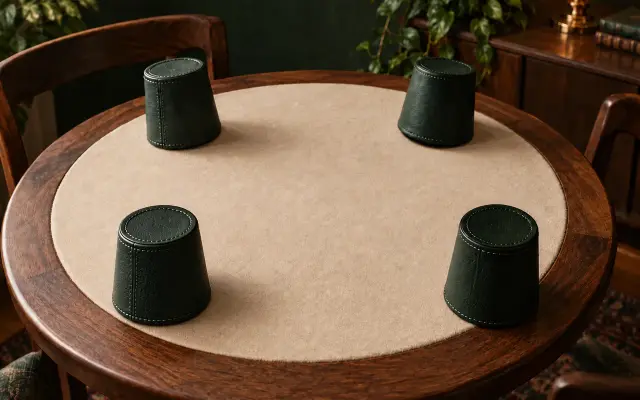
Give every player five standard dice and one opaque cup. Choose a starting player. Everyone shakes their dice under the cup, turns it onto the table and secretly looks at their own dice without showing anyone else.
All dice still in play count toward bids, not only the bidder’s dice. Keep your own result hidden until a challenge. Players may bluff: a bid is a claim, not a promise about the bidder’s cup.
Bid order
A bid names a quantity and a face, such as “five 4s.” For a bid of 2s through 6s, every die showing that face counts, and every 1 also counts as wild. For a bid of 1s, only actual 1s count.
After a normal bid, the next player can make it higher in either of these ways:
- keep the quantity and raise the face, such as five 4s to five 5s;
- raise the quantity and name any normal face, such as five 4s to six 2s.
The quantity can never decrease while staying on normal faces. After the highest normal face, raise the quantity to continue.
Switching to and from ones
To change a normal-face bid to wild ones, halve the quantity and round up. Five 4s can become at least three 1s; six 4s can also become at least three 1s.
To leave a bid of ones and return to a normal face, double the quantity and add one. Three 1s require at least seven of any face from 2 through 6. While continuing to bid ones, raise their quantity.
These conversions preserve the bid order. Ones are wild when evaluating a bid of 2s through 6s, but other faces never become wild for a bid of ones.
Turns
The starting player makes an opening bid on a face from 2 through 6; this Perudo edition does not allow opening on ones. Play moves clockwise. On your turn, do one of two things:
- Make a legal higher bid and pass play to the left.
- Challenge the previous bid by calling dudo or “liar.”
After a challenge, everyone lifts their cup. Count the dice matching the named face, including wild ones for bids of 2 through 6.
- If the count is at least the bid quantity, the bid was valid and the challenger loses one die.
- If the count is below the bid quantity, the bid was false and the bidder loses one die.
Remove the lost die from the game. Every remaining player rerolls all their dice for a new round, and the player who lost the die makes the opening bid. A player who loses their last die is eliminated; the next active player to their left opens the next round.
Worked example
The current bid is five 4s. When challenged, the cups reveal four actual 4s and two 1s. Because ones are wild for a bid of 4s, six dice count. The bid is valid, so the challenger loses one die.
Instead of challenging five 4s, the next player could legally bid at least three 1s. After three 1s, returning to a normal face requires at least seven of that face: 2 × 3 + 1 = 7.
Winning
Keep playing challenge rounds and removing one die from the losing player each time. The last player who still has one or more dice wins.
Dice are not normally regained in this primary game. Eliminated players do not bid, challenge or reveal information about later rounds. With fewer dice in play, remember to reduce the range of plausible quantities—but no bid is prohibited merely because it sounds unlikely.
Common mistakes
- Counting only the bidder’s cup. A claim covers every hidden die still in play.
- Forgetting wild ones. Ones count with bids of 2s through 6s.
- Counting other faces on a bid of ones. Only actual ones satisfy that bid.
- Lowering quantity and raising face. On normal faces, quantity cannot fall.
- Switching to ones without converting. Halve the previous quantity and round up.
- Switching back without converting. Double the ones quantity and add one.
- Making the wrong player start. The player who loses a die opens the next round.
- Treating a bluff as cheating. False claims are allowed; secretly changing or showing dice is not.
Variants
An exact-bid call—often called calza—lets a player claim that the previous quantity is exactly right. Common rules reward a correct call by returning a die, up to the starting five, and punish a wrong call by taking one; restrictions vary. It is omitted from the first game because it adds a third action and special timing.
In a Palifico or last-die round, a player who has just fallen to one die may receive a special round in which ones are not wild and the first face bid cannot be changed. Published editions differ on eligibility and repeat rounds, so use the rules supplied with the set.
Other Liar’s Dice traditions make ones ordinary, forbid bids of ones, keep players at one die instead of eliminating them, or use poker-style hands inside each cup. Other house rules are not part of the game taught here.
Common questions
Are ones wild in Liar’s Dice?
Yes, in this Perudo-style ruleset. Ones count with the named face on bids of 2 through 6. For a bid of ones, count only actual ones; the optional Palifico variant changes the wild rule.
Does a Liar’s Dice bid count everyone’s dice?
Yes. The quantity refers to all dice under every active player’s cup, not just the bidder’s dice.
Who loses a die if the bid is exactly right?
The challenger loses a die. A normal dudo challenge asks whether there are at least as many matching dice as claimed, so an exact count makes the bid valid. An exact-bid call is a separate variant.
Learn this game

Similar games
Farkle
Farkle rules with the complete PlayMonster scoring table: rolling and setting aside dice, farkles, hot dice, the 500-point entry and the final round.
Also known as Farkel
Yahtzee
Classic Yahtzee rules and scoring: three rolls per turn, all 13 categories, the 35-point upper bonus, extra Yahtzee bonuses and Joker rules.
Backgammon
Backgammon rules for beginners: board setup, dice moves, hitting and the bar, bearing off to win — with the 15 opening moves and key terms.