
Common Spades mistakes
Frequent Spades errors: overbidding, bags, nil, leading spades, and mixing up team contracts and scoring.
On this page
This guide lists the errors that cost the most points in Spades, following the four-player game on our Spades rules page. For bidding advice see the Spades bidding strategy guide.
Bidding mistakes
- Overbidding. A missed contract loses 10 points per trick bid, so a bid of 7 that takes 6 loses 70.
- Counting every high card as a trick. A king without cover in its suit can be captured.
- Ignoring your partner’s bid. Both bids form one team contract.
- Bidding nil with a high spade or a long suit. These are the cards that win tricks.
- Discussing cards. Partners must not talk about specific cards during the bidding or play.
Play mistakes
- Leading spades before they are broken. You can’t lead a spade until spades have been played, unless you hold only spades.
- Forgetting to follow suit. Being trump does not let you ignore the suit led.
- Overtaking your partner. If your partner is winning, don’t waste a high card.
- Fighting for tricks after the contract is made. Extra tricks are bags.
- Not covering a nil. Your partner’s nil bid needs you to take tricks it might otherwise win.
Scoring mistakes
- Adding four independent bids. Partners combine their regular bids into one contract.
- Forgetting the bag penalty. The tenth bag costs 100 points.
- Dropping a failed nil bidder’s tricks. Those tricks still count towards the team contract.
- Scoring nil as a regular bid. A successful nil is +100 and a failed nil is −100.
- Ending the game early. Finish the hand before checking whether a team has reached 500.
Habits to build
- Write down the contract and the bag count before each hand.
- Count spades as they fall.
- Ask before bidding: how many tricks am I sure of?
Published accounts do not settle what happens to a failed nil bidder’s tricks. This site’s house rule counts them toward the partner’s contract; other tables count them only as bags. Agree this before bidding.
Continue learning
Similar games
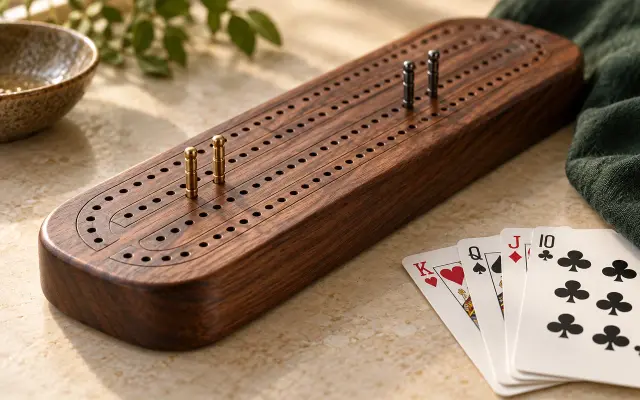
Cribbage
Two-player Cribbage rules with three- and four-player variants: the deal, the crib, the go, and scoring fifteens, pairs, runs and the 29 hand.
Also known as Crib
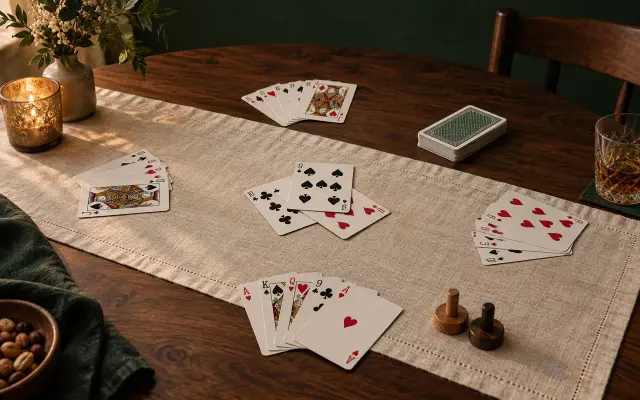
Euchre
North American Euchre rules for four players: the 24-card deck, choosing trump, right and left bowers, following suit, going alone and scoring to 10.
Hearts
Hearts rules for four players: passing, breaking hearts, shooting the moon and scoring — plus jack of diamonds, 3- and 5-player variants and a glossary.