
Four-player Black Lady; three- and five-player variants covered
How to play Hearts
Hearts rules for four players: passing, breaking hearts, shooting the moon and scoring — plus jack of diamonds, 3- and 5-player variants and a glossary.
On this page
Quick reference
At the table
Ruleset: Four-player Black Lady; three- and five-player variants covered
- Goal
- Finish with the fewest penalty points.
- Setup
- With four players, deal 13 cards each. Pass three cards left, right, across, then hold on successive hands.
- Turn
- The two of clubs leads. Follow suit when possible; the highest card of the led suit takes the trick.
- Scoring
- Each heart is 1 point and the queen of spades is 13. Taking all 26 penalty points makes every opponent add 26.
- End of game
- When anyone reaches 100 points or more, the game ends and the lowest total wins.
Objective
Finish with the fewest penalty points. Each heart costs 1 point; the queen of spades costs 13. This version uses a standard 52-card deck, four players, and the left–right–across–hold passing cycle. Other player counts and house rules are variants, covered below.
Setup
Use 52 cards without jokers. Deal 13 to each of four players. Before play, pass three cards left, then right next hand, then across, then keep your hand; repeat this cycle. Choose passes before looking at received cards.
Turns
The two of clubs leads the first trick. Everyone plays clockwise, following the lead suit if possible. Otherwise play another suit. On the first trick, do not play a heart or the queen of spades unless your hand contains only penalty cards.
The highest card of the led suit wins the trick and leads next. Aces are high; there are no trumps. Hearts cannot be led until someone discards a heart — this is called breaking hearts. If your hand is nothing but hearts, you may lead one and thereby break hearts. Discarding the queen of spades alone does not break hearts in this version.
Winning
After 13 tricks, count the penalty cards in your captured tricks and write the totals on a paper score sheet, one column per player. Each hand’s penalties total exactly 26 (or 78 when someone shoots the moon), so an arithmetic slip is easy to catch. Taking all 13 hearts and the queen of spades in one hand is shooting the moon — players also just say “shoot the moon”. The shooter scores zero and each opponent adds 26. When anyone reaches 100 or more the game ends, and the lowest total wins. If the lowest totals are tied, share the win or play additional hands until one player is lowest — agree before playing.
Variants
Three- and five-player Hearts change the deal, the opening lead and the passing cycle.
Three players. Remove the two of diamonds and deal 17 cards each; the holder of the two of clubs leads the first trick, and passing follows a left–right–hold cycle.
Five players. Remove the two of clubs and the two of diamonds (50 cards) and deal 10 cards each; the holder of the three of clubs leads. Agree the passing cycle and number of cards before play; a left–right–hold cycle works at any table size.
The jack of diamonds variant is optional and off by default in this version. Known as Omnibus hearts, it scores the jack of diamonds as a bonus: whoever takes it subtracts 10 from their score. Some groups score the ten of diamonds instead. It changes shooting the moon in one way — the shooter still needs all 13 hearts and the queen, and whoever takes the jack, possibly the shooter, still deducts 10.
Moon scoring has one other published form: subtract 26 from the shooter’s score instead of adding 26 to each opponent. Both forms appear in published rules; this version adds to the opponents. Agree before playing.
Some rule sets also let a discarded queen of spades break hearts. This version follows Britannica instead — only a discarded heart breaks hearts.
For a lower-score-wins game that needs no tricks, try Golf: each player swaps cards in a private grid of six.
Beginner tips
Keep low cards as safe exits. Watch who runs out of a suit. Passing every high card is not always wise if it leaves you without control. A short glossary for the rest of this page:
- Trick — one card from each player; the highest card of the led suit takes it.
- Breaking hearts — the first heart discarded, which allows hearts to be led afterward.
- Ducking — playing a low card to lose a trick you could have taken, avoiding its penalty cards.
- Shoot the moon — take all 13 hearts and the queen in one hand, scoring zero while opponents gain.
Common questions
Can I lead the queen of spades?
Yes, after the opening trick. Spades do not need to be broken — only hearts do.
What does “breaking hearts” mean?
The first heart discarded to a trick. From that point, hearts may be led. The queen of spades alone does not break hearts in this version.
Can the queen of spades be played in the first round?
No. The first trick carries no penalty cards unless your hand contains nothing but penalty cards — the same restriction covers hearts and the queen.
What if two players try to shoot the moon?
Only one player can take all 26 penalty points — every trick has exactly one winner. A second would-be shooter splits the penalty cards with the table and scores what they take. The reliable way to stop a shooter is to take one heart yourself.
Is subtracting 26 a real way to score the moon?
Yes. The other published form subtracts 26 from the shooter’s score instead of adding 26 to each opponent. This version adds to the opponents; agree before playing.
What happens at 100 points with a tied low score?
The game ends when anyone reaches 100 or more. If the lowest totals are tied, share the win or play additional hands until one player is lowest — agree before playing.
How do you play Hearts with 3 or 5 players?
Only the deal and opening lead change. Three players remove the two of diamonds and deal 17 each — the two of clubs leads. Five players remove the two of clubs and two of diamonds and deal 10 each — the three of clubs leads. Agree the passing cycle first. See Variants.
Learn this game
Similar games
Cribbage
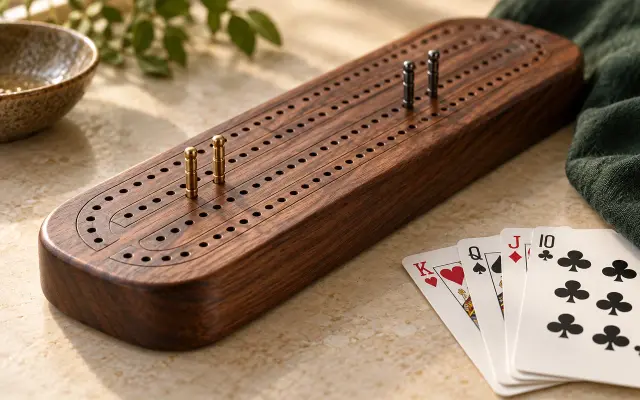
Two-player Cribbage rules with three- and four-player variants: the deal, the crib, the go, and scoring fifteens, pairs, runs and the 29 hand.
Also known as Crib
Euchre
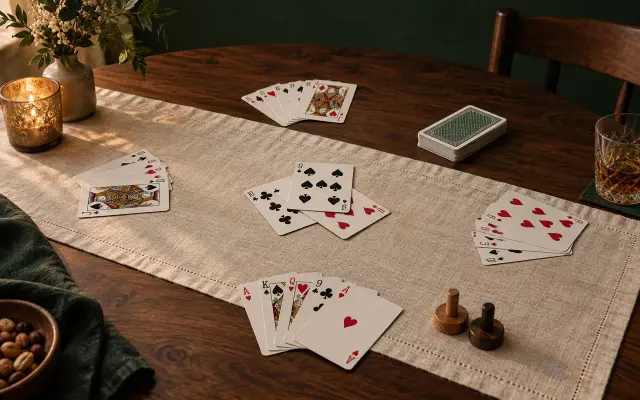
North American Euchre rules for four players: the 24-card deck, choosing trump, right and left bowers, following suit, going alone and scoring to 10.
Rummy
Basic rummy rules: the deal (10, 7 or 6 cards), drawing and discarding, melding sets and runs, laying off on melds, and scoring when someone goes out.
Also known as Straight Rummy, Basic Rummy