
Rummy strategy: melds, discards and reading opponents
Practical Basic Rummy strategy: which cards to keep, what to discard, how to watch opponents and when to go out.
On this page
This guide covers Basic Rummy as explained on our Rummy rules page: one 52-card deck, aces low, melds and lay-offs on your turn, and the option to go out by melding your last cards without a discard.
Build toward flexible hands
Some partial melds are more useful than others.
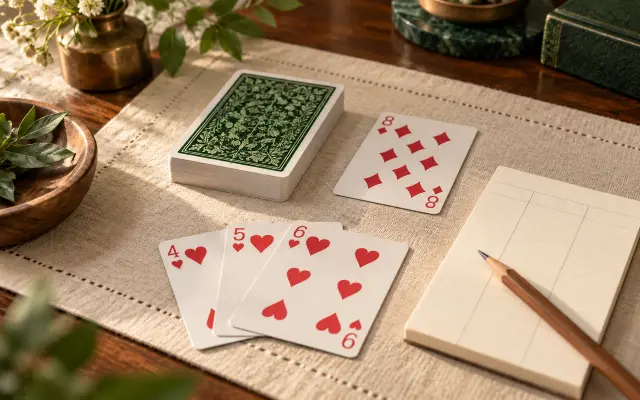
- Two cards in a row of one suit (say 6♠ 7♠) can be completed at either end, by a 5♠ or an 8♠.
- A gap (6♠ 8♠) needs one exact card, the 7♠, so it is weaker.
- A pair needs one of the two remaining cards of that rank, and a discarded card of that rank counts against you.
- Cards that could go into both a run and a set are worth keeping.
Discard with information
- Discard high, unconnected cards first. They cost 10 points if you are caught with them, and they rarely help.
- Avoid discarding a card your opponent might want. If someone picked up a 9♥ or has been discarding cards of a suit, be careful with cards next to it.
- Note what has already gone. If you hold two 7s and both other 7s are already exposed, your pair cannot become a set unless one of those exposed cards becomes available.
Reading the discard pile
The top discard is a free look at what one opponent doesn’t need. If a player takes the discard, it may help a meld, a partial meld or a lay-off; it does not prove what they hold. Adjust your own plans around those cards.
Laying off
This version lets you add cards to any meld on the table. That helps you shed cards without needing a whole new meld, so keep low-value cards that might fit an opponent’s meld, and lay them off when you can. Remember you can’t rearrange melds.
Know when the hand will end
You can go out either by discarding your last card or by melding all of your remaining cards. Holding several melds back until you can go out in one turn earns the double “going rummy” score, but risks being caught with them if someone else goes out first. If the stock is nearly gone, hold fewer high cards, because the pile will be recycled and the hand may end suddenly.
Deadwood and the score
Because melds score nothing and only leftover cards count, going out first matters more than making many melds. Get cards out of your hand steadily, and prefer a hand that is nearly complete to one with many loose points.
Continue learning
Similar games
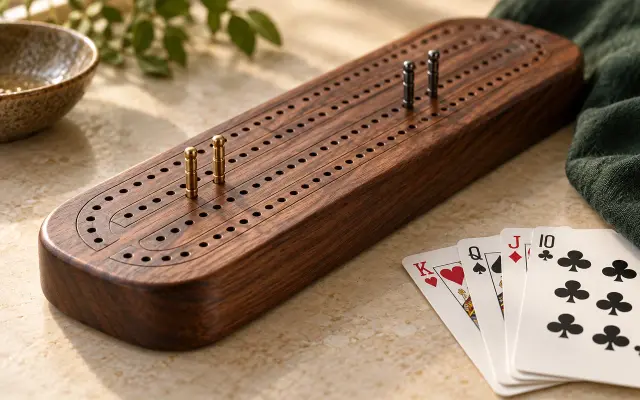
Cribbage
Two-player Cribbage rules with three- and four-player variants: the deal, the crib, the go, and scoring fifteens, pairs, runs and the 29 hand.
Also known as Crib
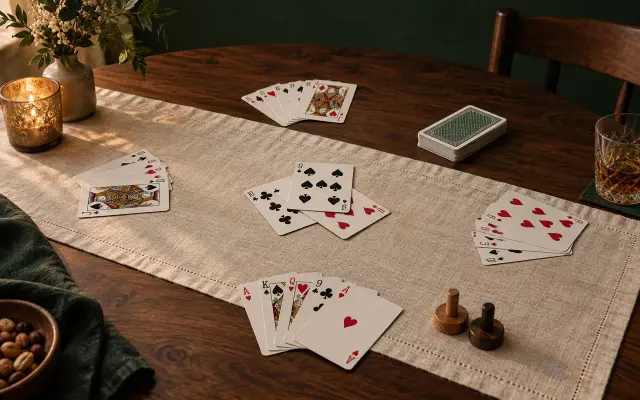
Euchre
North American Euchre rules for four players: the 24-card deck, choosing trump, right and left bowers, following suit, going alone and scoring to 10.
Gin Rummy
Gin Rummy rules for two players: ten-card hands, sets and runs, deadwood, knocking, laying off, going gin, undercuts and scoring a match to 100.
Also known as Gin