
Canasta beginner strategy: melds, discards and partners
Plan an initial meld, weigh discard-pile pickups, protect natural canastas and decide when to go out in four-player Classic Canasta.
On this page
This guide uses four-player Classic Canasta under the standard published rules, where a discarded black three is a stop card and only wild cards freeze the pile. These are practical tradeoffs, not an optimal strategy or a promise of winning.
Plan the opening before you expose cards
Check your team’s initial-meld minimum before choosing what to keep. At 90, three kings and three eights total only 60. Three aces and three kings total 90. A canasta bonus cannot bridge a shortfall.
Keeping several ranks may give you options, but high-value cards also create a larger deduction if an opponent goes out. Once your partner has opened, stop saving cards just to meet a threshold that no longer applies to your team.
Evaluate the whole discard pile
A legal pickup can bring many useful cards, but it also brings leftovers that count against your side at the end. Compare what the visible top card lets you meld with the risk of enlarging your hand. You cannot inspect or use buried cards as part of the proof that permits pickup.
With a frozen pile, save a natural pair of a rank you expect might be discarded. An exposed team meld is insufficient by itself. With an unfrozen pile, an existing meld can make the next matching discard available without a pair in hand.
Stop the pile with a black three before spending a wild card
A black three on top prevents the next player taking the pile, though it does not freeze it. It is usually the cheapest way to deny an easy pickup: a black three is worth only 5 and cannot be melded except when going out.
Discarding a two or joker freezes the pile, which a black three does not, but a wild card is valuable in melds and may also benefit the eventual recipient. A freeze does not make the pile untakeable: once the freezing card is covered, a matching natural pair can still unlock it. A black three only delays one player, so the pile can be taken normally once a natural card covers it.
Preserve flexibility in wild cards
Each meld allows at most three wild cards, and laid cards cannot be rearranged. Before using a wild to extend a short meld, consider whether it is needed to complete a different rank’s canasta.
Adding a wild to a completed natural canasta reduces its bonus from 500 to 300. A two adds 20 in card value but loses 200 in bonus: if nothing else changes before the hand ends, that addition changes the team’s score by 20 − 200 = −180. It may still enable a useful finish or reduce cards stranded in hand, but it is not automatically a scoring improvement.
Watch exposed information
Notice which ranks opponents have melded and whether the pile is frozen. Discarding a card that fits an opponent’s existing meld can offer an immediate unfrozen pickup. Do not assume you know their concealed pairs; discards and exposed melds give clues, not certainty.
Count cards remaining in hands when deciding whether to keep building. A large pickup is less attractive when an opponent appears close to going out and your own side has many expensive leftovers.
Decide whether ending helps your partnership
One canasta permits going out, but does not require it. Ending immediately may catch opponents with high-value cards; waiting may let your partner put down cards that would otherwise be deductions. Waiting also gives opponents a chance to finish first.
You may ask your partner whether to go out before or after drawing, but not after you have melded or shown that you are taking the pile. Their answer is binding. Do not ask as a casual suggestion and then ignore it.
Use the scoring guide to compare bonuses with leftover-card deductions. The mistakes guide covers the legal limits behind these decisions.
Continue learning
Similar games
Crazy Eights
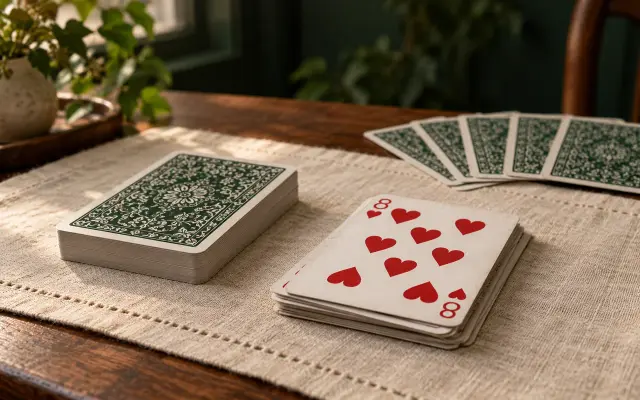
Crazy Eights rules for 2–5 players: deal five cards, match suit or rank, choose a suit with a wild eight, draw until playable and score remaining cards.
Also known as Crazy Eight, Crazy 8s, Crazy 8
Cribbage
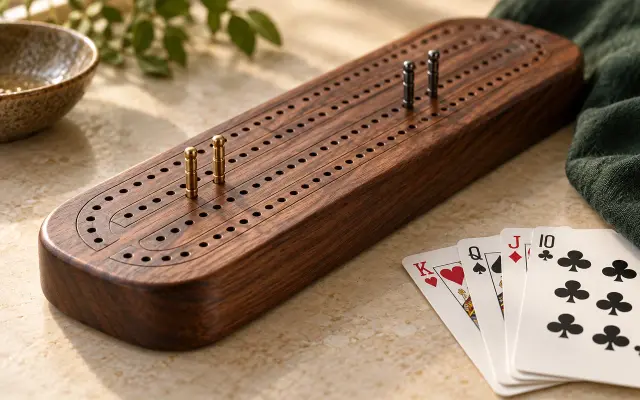
Two-player Cribbage rules with three- and four-player variants: the deal, the crib, the go, and scoring fifteens, pairs, runs and the 29 hand.
Also known as Crib
Euchre
North American Euchre rules for four players: the 24-card deck, choosing trump, right and left bowers, following suit, going alone and scoring to 10.